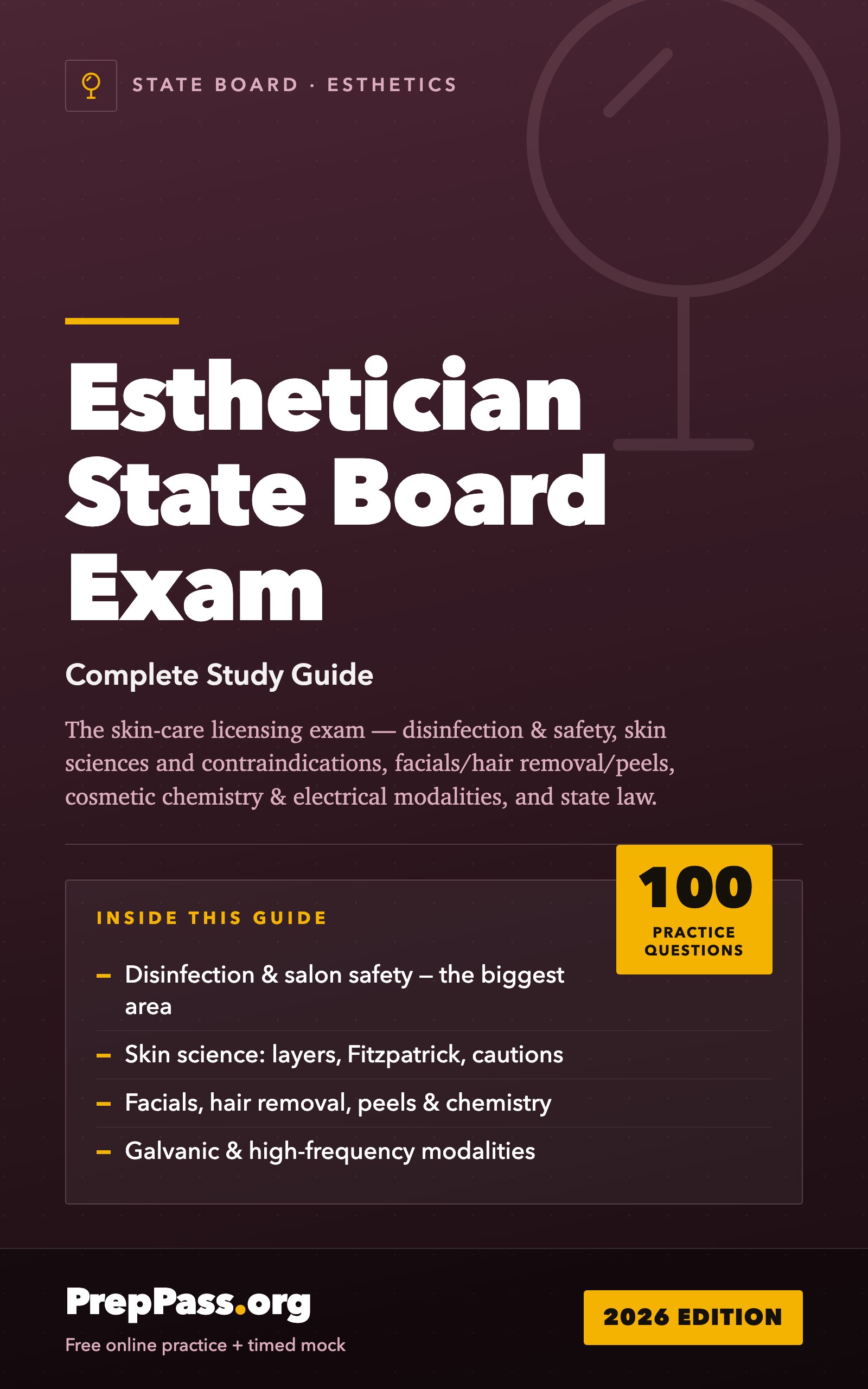
Esthetician (State Board) · 2026 Edition
Esthetician State Board Exam — Complete Study Guide (2026)
The skin-care licensing exam — disinfection & safety, skin sciences and contraindications, facials/hair removal/peels, cosmetic chemistry & electrical modalities, and state law.
- 55 practice questions inside the book, with a full answer key
- 47 pages of teaching, chapter by chapter — not a question dump
- Cross-referenced against standard esthetics/skin-science references / EPA disinfection / OSHA BBP & HazCom / NIC & state esthetics board outlines
PDF + EPUB · English · 47 pages · $14.99 one-time
This book is written in English.
Instant download after payment — no account needed, no subscription. Refund policy
Look inside the book
Three real pages, rendered straight from the PDF you download — a teaching page, a worked question, and a reference page. Nothing here was redrawn to look better.
- A question, workedPractice Exam (55 Questions) · PDF page 26
A practice question with its answer and the reasoning behind it — not just a key.
- Quick referencePractice Exam (55 Questions) · PDF page 38
A page you can turn back to: the numbers, deadlines or terms gathered in one place.
- How it's taughtPractice Exam (55 Questions) · PDF page 39
An explanation page: the material taught in prose, in the order the exam tests it.
What's included — and what isn't
Included
- Disinfection, infection control & salon safety (the biggest exam area)
- Skin sciences: layers, conditions, Fitzpatrick, and key contraindications
- Facials, hair removal, chemical peels, and cosmetic chemistry
- Electrical modalities (galvanic, high-frequency) and their contraindications
- 55 original practice questions with answer explanations
- PDF (print & tab it) + EPUB (phone / e-reader)
Not included
- No printed copy is shipped — this is a file you download and can print yourself
- No video course, instructor or tutoring comes with the book — the free videos on the site are separate
- Not your exam registration or the testing centre's fee, which you still pay to the official body
Contents
See 6 chapters and the page each one starts on
- Chapter 1 — Disinfection, Infection Control & Safetyp. 5
- Chapter 2 — Skin Sciences: Structure, Conditions & Contraindicationsp. 10
- Chapter 3 — Facial Treatments, Hair Removal & Client Servicesp. 15
- Chapter 4 — Cosmetic Chemistry & Electrical Modalitiesp. 19
- Chapter 5 — Law, Scope of Practice & Establishment Rulesp. 22
- Practice Exam (55 Questions)p. 26
Taken from the PDF you download, with the page each one starts on — not typed here.
Read a chapter free, in full
One complete chapter, exactly as it ships in the eBook. Scroll the window to read it right here; no download, no email.
Read chapter 2 here, without leaving the page
We didn't give you the easy intro — the free chapter opens on one of the hardest-working parts of the book, so you can judge the teaching where the exam gets difficult.
About a quarter of the exam tests whether you understand the skin you are working on — how it is built, what it does, how it ages, how hair grows, and, above all, when a condition belongs to a physician rather than to you. Many of these questions describe skin and ask whether you treat, modify, or refer. Learning the anatomy and the lesion vocabulary is what lets you describe skin accurately without ever crossing into diagnosis.
The Layers of the Skin
Skin has three main layers.
The epidermis is the outermost layer and is where every esthetic service takes place. From deepest to most superficial, its layers are the stratum basale, spinosum, granulosum, lucidum, and corneum. An easy anchor: the basale sits against the dermis (it builds), and the corneum faces the world (it sheds). Cell division and melanin production happen in the stratum basale; the stratum corneum is dead, keratinized tissue that you cleanse and exfoliate; the stratum lucidum is a clear layer found only on the palms and soles. [verify — the lucidum is classically described as present only in thick, glabrous skin.]
The dermis lies below and is divided into the papillary and reticular layers. It holds collagen and elastin, blood vessels, nerve endings, sebaceous and sudoriferous glands, and hair follicles. This is where skin's structure and firmness live.
The subcutaneous (subcutis) layer beneath the dermis is adipose tissue that insulates, cushions, and gives the face its contour; its loss with age drives hollowing and sagging.
Because superficial services affect only the epidermis, they improve texture and tone but cannot rebuild dermal structure — which is precisely why a deep wrinkle is not something a superficial peel can "remove," and why over-promising that result is both a marketing problem and a scope problem.
What the Skin Does, and How It Renews
The skin protects, provides sensation, regulates temperature through blood flow and perspiration, excretes waste through sweat, secretes sebum, and absorbs a limited amount of what is applied to it. Sebum and perspiration form the acid mantle, a thin film with a pH around 4.5–5.5 that discourages microbial growth and slows water loss. Highly alkaline (high-pH) cleansers strip that mantle and leave skin tight and reactive, which is why choosing a cleanser near the skin's own pH matters.
Epidermal cells are produced in the basal layer and take roughly a month in a young adult to migrate to the surface and shed — a cycle that slows with age. That slowdown is the main reason mature skin looks duller: dead cells linger and light no longer reflects evenly, which is also why appropriate exfoliation helps mature skin and why over-exfoliation backfires.
Keep two ideas separate: skin type reflects genetically determined oil production, while a skin condition such as dehydration (a lack of water), sensitivity, or congestion can occur in any type and changes over time. Oily and dehydrated skin is common and normal.
Fitzpatrick Types, Pigmentation, and Photodamage
The Fitzpatrick scale classifies skin by its response to ultraviolet light, from Type I (always burns, never tans) to Type VI (deeply pigmented, rarely burns). It predicts more than sunburn: higher Fitzpatrick types have melanocytes that respond vigorously to inflammation, so aggressive exfoliation, heat, or trauma can trigger post-inflammatory hyperpigmentation (PIH) that is worse than the original concern. Protocols for higher types start conservatively, progress slowly, and always pair with daily broad-spectrum sun protection.
Melasma is a hormonally influenced hyperpigmentation appearing as symmetrical patches on the cheeks, forehead, and upper lip; it is aggravated by both UV and heat, so sun protection is the foundation of any protocol and steam and hot towels are limited. UVA (longer wavelength) reaches the dermis and drives aging and pigment change; UVB (shorter) primarily causes burning; both raise skin-cancer risk, which is what "broad spectrum" on a label means. Intrinsic aging is genetically programmed; extrinsic aging comes from sun, smoking, and pollution — and it is the part a client can actually control.
Lesions, Disorders, and Knowing When to Refer
Primary lesions are present when a condition first appears — macules, papules, pustules, vesicles, wheals, tubercles. Secondary lesions develop as it progresses or heals — crusts, scales, fissures, excoriations, ulcers, scars. You describe these; you never diagnose them.
Common findings within scope: open comedones (blackheads) are follicular contents oxidized dark by air; closed comedones (whiteheads) are trapped below the surface; milia are keratin-filled cysts with no follicular opening; telangiectasia are dilated capillaries seen as red lines; sebaceous hyperplasia is enlarged sebaceous glands.
The referral line is critical for the exam. Mild acne is within scope, but deep painful nodules and cysts (grade IV) must never be extracted — they are medical. Rosacea, eczema with broken or weeping skin, active herpes simplex, and anything crusted, spreading, or suspiciously changing all call for referral. A mole showing asymmetry, irregular borders, color variation, larger diameter, or recent change is avoided entirely; you encourage the client to see a physician without naming a diagnosis. And you obtain physician clearance for high-risk histories: uncontrolled diabetes, recent facial surgery or procedures, active cancer treatment, and photosensitizing medications.
Hair Growth and Its Cycle
Hair grows from a follicle nourished by the dermal papilla and cycles through three phases: anagen (active growth, hair fully attached), catagen (short transition, follicle shrinks), and telogen (resting, then shedding). Waxing gives its longest-lasting result during anagen, because the hair is removed with the fullest structure attached. Because follicles cycle independently, regrowth is staggered — clients see stubble sooner than expected and benefit from a regular rebooking schedule.
Two commonly confused terms: hirsutism is excessive terminal hair in a male pattern on a woman (often hormonal); hypertrichosis is excessive growth in areas not normally hair-bearing. All esthetic hair removal (waxing, tweezing, threading) is temporary; permanent removal by electrolysis or laser falls under different licensing.
### Key Facts — Chapter 2 - Three layers: epidermis (services happen here), dermis (collagen/elastin, glands, vessels), subcutis (fat/contour). - Epidermis deep→surface: basale, spinosum, granulosum, lucidum, corneum. Basale builds, corneum sheds; lucidum only on palms/soles. [verify] - Superficial services reach only the epidermis — they cannot rebuild the dermis. - Acid mantle pH ≈ 4.5–5.5; cell turnover ≈ one month in youth and slows with age. - Type = oil (genetic); condition = e.g., dehydration (water), can occur in any type. - Fitzpatrick I→VI; higher types → higher PIH risk → start gentle + daily SPF. Melasma = symmetrical, worsened by UV and heat. - UVA ages (deep), UVB burns (surface); "broad spectrum" covers both. - Primary vs. secondary lesions; never extract cysts/nodules; refer rosacea, eczema flares, herpes, changing moles. - Hair cycle anagen (best for waxing) / catagen / telogen; esthetic removal is temporary.
Worked scenario. A Fitzpatrick V client wants "the strongest possible peel" to erase acne marks fast. The instinct to go strong is exactly backward: her melanocytes react to inflammation, so an aggressive treatment risks darkening the very marks she wants gone. The professional answer is to start conservatively, progress gradually, and anchor the plan to daily broad-spectrum SPF, while setting the expectation that safe fading takes a series, not one session. You do not refuse her outright (darker skin can absolutely be treated) — you treat it correctly for her type.
Named exam traps.
- Reversed layer order. The basale is deep (builds); the corneum is on top (sheds). If a sequence starts with "corneum" going down, it's the wrong direction unless it explicitly says superficial-to-deep.
- "Type vs. condition." Oily skin can also be dehydrated. Skin type doesn't flip day to day; conditions do.
- "UVB is the deep, aging ray." No — UVA is deep/aging; UVB burns the surface.
- "Higher Fitzpatrick tolerates any strength." The opposite — higher types need more caution.
- Extracting a cyst / nodule or abrading a changing mole — both are referral situations, never a service.
Before you buy
- How do I get it?
- Pay, and the download appears on this page straight away. The links are also emailed to you. No account is required.
- What if it isn't for me?
- Email us within 14 days for a full refund, no questions asked.
- Is the free practice going away?
- No. Every practice question, the timed mock and the free chapters on this site stay free. This book is the studying half, not a gate around the free half.
- Can I read it on my phone?
- Yes — the EPUB is for phones and e-readers, the PDF is for printing and tabbing. You get both.
The details
The skin-care licensing exam — disinfection & safety, skin sciences and contraindications, facials/hair removal/peels, cosmetic chemistry & electrical modalities, and state law.
- Format: PDF + EPUB download · 47 pages
- 55 practice questions in the book, with a full answer key
- 100 free practice questions for this exam on PrepPass, included at no cost
- $14.99 one-time — no subscription
- 14-day money-back guarantee · refund policy
- Cross-referenced against: standard esthetics/skin-science references / EPA disinfection / OSHA BBP & HazCom / NIC & state esthetics board outlines
- Last updated: August 2026
- Verified from the official source(standard esthetics/skin-science references / EPA disinfection / OSHA BBP & HazCom / NIC & state esthetics board outlines)
- Instant download, yours for life
Why buy the book when the practice is free?
Our practice questions and timed mock stay free — nothing on the site moves behind this book. The $14.99 book is the studying half: the material itself, taught in order, in a file you own.
- Systematic teaching — every exam section explained chapter by chapter, start to finish, not just questions
- Print it & tab it — a paper-ready PDF you can highlight, mark up, and bring to your study table
- Study anywhere, offline — EPUB on your phone or e-reader; no wifi, no browser tabs
- Everything in one place — chapters, per-chapter cram sheets, and practice questions in one file
- Yours for life — one-time $14.99, instant download, no subscription
And it's risk-free: 14-day money-back guarantee — not satisfied? Email us for a full refund, no questions asked. See the refund policy.
14-day money-back guarantee · full refund, no questions asked.
One-time purchase, lifetime access to the download. The eBook is the full Esthetician (State Board) study guide in PDF and EPUB. Educational summary, not professional or legal advice — always confirm the current rules with the official source. Last updated: August 2026.