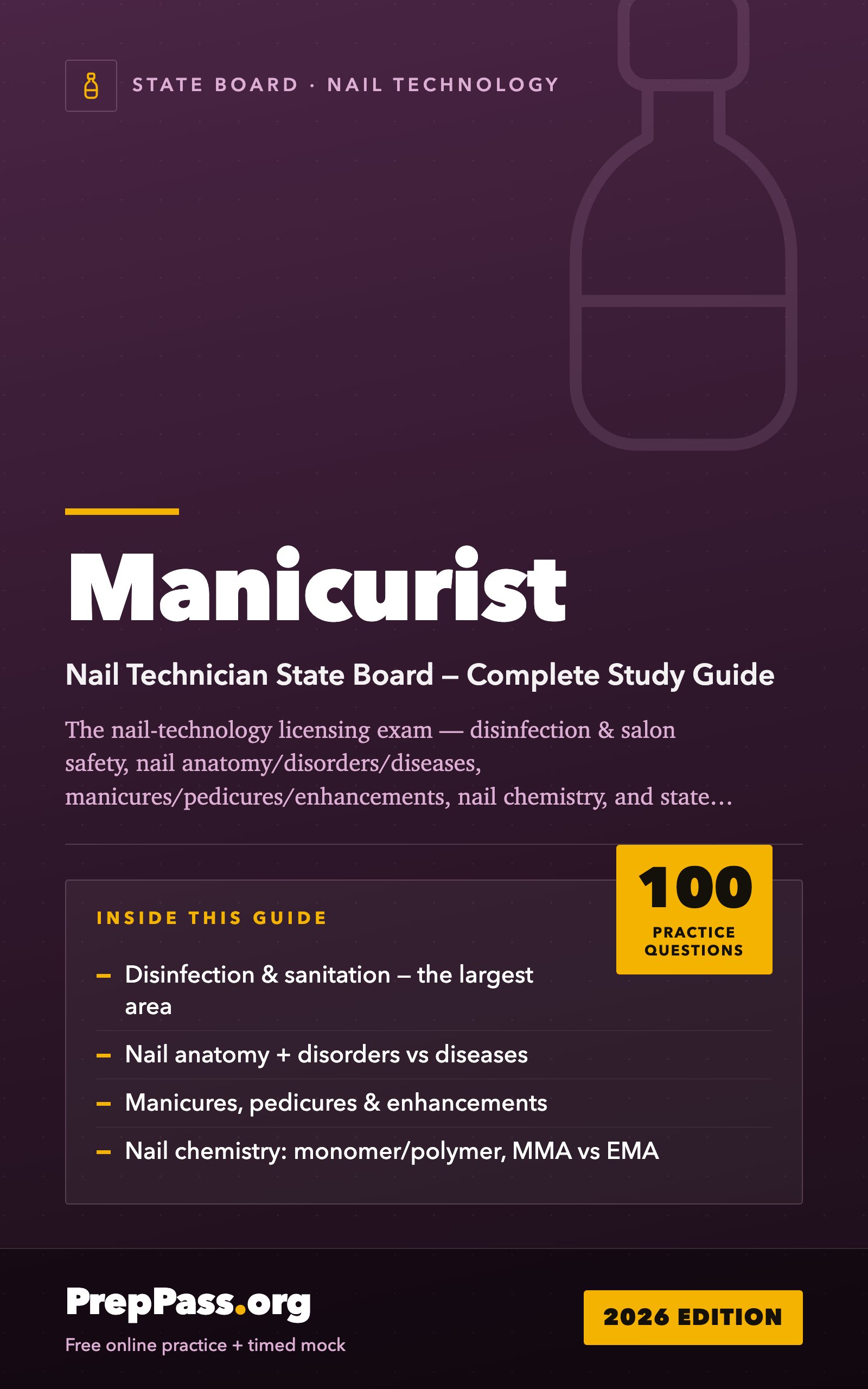
Manicurist / Nail Technician (State Board) · 2026 Edition
Manicurist / Nail Technician State Board Exam — Complete Study Guide (2026)
The nail-technology licensing exam — disinfection & salon safety, nail anatomy/disorders/diseases, manicures/pedicures/enhancements, nail chemistry, and state law.
- 55 practice questions inside the book, with a full answer key
- 61 pages of teaching, chapter by chapter — not a question dump
- Cross-referenced against standard nail-technology references / EPA disinfection / CA BBC (16 CCR §979) / Cal-OSHA / state board outlines
PDF + EPUB · English · 61 pages · $14.99 one-time
This book is written in English.
Instant download after payment — no account needed, no subscription. Refund policy
Look inside the book
Three real pages, rendered straight from the PDF you download — a teaching page, a worked question, and a reference page. Nothing here was redrawn to look better.
- How it's taughtPractice Exam — 55 Questions · PDF page 46
An explanation page: the material taught in prose, in the order the exam tests it.
- How it's taughtPractice Exam — 55 Questions · PDF page 47
An explanation page: the material taught in prose, in the order the exam tests it.
- How it's taughtPractice Exam — 55 Questions · PDF page 49
An explanation page: the material taught in prose, in the order the exam tests it.
What's included — and what isn't
Included
- Disinfection, sanitation & salon safety (the largest exam area)
- Nail anatomy + disorders vs diseases, and when to refuse & refer
- Manicures, pedicures, and artificial enhancements
- Nail chemistry: monomer/polymer, MMA vs EMA, primers
- 55 original practice questions with answer explanations
- PDF (print & tab it) + EPUB (phone / e-reader)
Not included
- No printed copy is shipped — this is a file you download and can print yourself
- No video course, instructor or tutoring comes with the book — the free videos on the site are separate
- Not your exam registration or the testing centre's fee, which you still pay to the official body
Contents
See 12 chapters and the page each one starts on
- Part C — Foot spas: after each client, daily, and weeklyp. 9
- Part D — Blood spills and bodily fluidsp. 10
- Part C — Cuticle care and the living-tissue rulep. 18
- Part D — Polish, gel, and light-cured systemsp. 19
- Part C — Disorders you may service with carep. 25
- Part D — Conditions you must refuse and referp. 25
- Part C — Solvents, removers, and pHp. 32
- Part D — Overexposure, sensitization, and allergyp. 32
- Part C — Manicurist scope of practicep. 38
- Part D — Establishment requirements and health & safetyp. 38
- Practice Exam — 55 Questionsp. 44
- Answer Key & Explanationsp. 56
Taken from the PDF you download, with the page each one starts on — not typed here.
Read a chapter free, in full
One complete chapter, exactly as it ships in the eBook. Scroll the window to read it right here; no download, no email.
Read chapter 1 here, without leaving the page
Introduction
Infection control is the single largest block on the manicurist written exam — roughly a third of the questions — and it is also the number-one reason salons get cited during an inspection. Everything in this chapter exists to stop one thing: passing an infection from one person to the next on a tool, a towel, a foot spa, or your own hands. Learn this chapter cold and you bank the largest single block of points on the exam. This chapter covers the three levels of decontamination, how to handle porous and non-porous implements, the foot-spa cleaning cycle, the blood-spill procedure, chemical safety, and the products and tools that are prohibited.
Learning objectives
After this chapter you should be able to:
- Distinguish sanitation, disinfection, and sterilization and state which level a nail salon is required to reach.
- Perform correct wet disinfection — clean first, immerse fully, hold the label contact time, cover, label, and replace the solution.
- Sort tools into porous single-use and non-porous reusable, and store clean and used items separately.
- Carry out the after-each-client, daily, and weekly foot-spa cleaning cycle and keep the required log.
- Follow the blood-exposure procedure in the correct order.
- Apply chemical-safety rules — SDS, labeling, ventilation, storage — and identify the prohibited products and tools (MMA and the credo blade).
Part A — The three levels of decontamination
Sanitation, disinfection, and sterilization are three different things, and the exam loves to mix them up.
- Sanitation (cleaning) simply reduces the number of germs on a surface, usually with soap, water, and scrubbing. It is always the first step and never the whole job.
- Disinfection kills most bacteria, fungi, and viruses on hard, non-porous surfaces. It does not kill bacterial spores. Disinfection is the level a nail salon is required to reach for its reusable tools.
- Sterilization destroys all microbial life, including bacterial spores. It requires an autoclave (steam under pressure) or a dry-heat unit. Sterilization is welcome but is not required and does not replace the required cleaning step.
The one-line takeaway the exam wants: clean → disinfect is the salon standard; only an autoclave sterilizes; and cleaning always comes before disinfection, because disinfectant cannot penetrate a layer of oil, dust, or product. A dirty tool dropped into solution is not disinfected.
Correct wet disinfection, step by step:
- Clean first — wash the implement with soap and warm water and scrub with a brush to remove all visible debris, oil, and product.
- Immerse fully in an EPA-registered, hospital-grade disinfectant that is labeled bactericidal, fungicidal, and virucidal. Household cleaners, alcohol wipes, and plain bleach water are not substitutes.
- Hold the full contact time printed on the manufacturer's label — commonly around ten minutes for immersion solutions, but the exact number is set by the label and your state (confirm with your state board). Dipping a tool in and pulling it right back out is a citation.
- Cover, label, and replace. Keep the solution in a covered container marked with the product name, mixed at the exact dilution on the label, and change it as directed or sooner if it becomes cloudy or contaminated.
Part B — Porous vs. non-porous implements
Whether a tool can be reused depends entirely on whether liquid can soak into it.
- Non-porous items — metal nippers, pushers, tweezers, and glass or metal files — have a hard, sealed surface. They can be cleaned, disinfected, and reused.
- Porous items absorb liquid and cannot be reliably disinfected, so they are single-use. Emery boards, buffing blocks, orangewood sticks, foam toe separators, cotton, gauze, and paper files must be given to the client or discarded after one service — never used on a second person.
Storage is tested just as often as the cleaning itself:
- Separate clean and used. Disinfected tools go in a clean, closed, labeled container marked clean or disinfected. Used tools go in a separate labeled container until they can be processed. Never drop a used tool back into the clean drawer.
- Electrical tools get a wipe-down. Items that cannot be immersed — e-file handpieces, lamps, table surfaces — are cleaned, then wiped or sprayed with an EPA-registered disinfectant and kept visibly wet for the full contact time. Removable e-file bits are cleaned and immersed like any other non-porous tool.
- Fresh linens. Towels and coverings are used once, then laundered in hot water with detergent and stored clean and dry. The table, lamp, and arm rest are disinfected between every client.
Part C — Foot spas: after each client, daily, and weekly
Pedicure spas are the highest-risk equipment in a nail salon, because warm water, skin debris, and hidden jets or pipes are a perfect home for bacteria such as mycobacteria — the organisms behind well-documented outbreaks of leg infections traced to nail salons. The required cleaning has three tiers, and all of it is written down in a log. (The exact schedule below follows California's rules as a worked example; your state's specific daily and weekly requirements may differ — confirm with your state board.)
- After every client: drain all water; remove and scrub visible debris from the basin and screen with soap and water; rinse; refill with clean water and the correct dose of EPA-registered hospital-grade disinfectant; circulate or let it stand for the full label contact time; then drain and rinse.
- End of each day: remove the screen, filter, jet, or impeller assembly; scrub each part; soak the removable parts in disinfectant; clean the inlet; then refill with water and disinfectant and run the unit so solution circulates through the lines before draining.
- At least once a week: fill the basin, add disinfectant at the label dose, circulate it through the system, then shut the unit off and let the solution sit in the lines for the time the label allows (commonly overnight) before draining and rinsing.
- Keep the foot-spa log. For every spa, record the date, time, type of cleaning, and the initials of who did it. Inspectors ask for this log, and missing records are treated as the cleaning not having been done.
- Liners and pipeless spas still need the full cycle. A disposable liner is discarded after one client, but the basin underneath is still cleaned and disinfected. Pipeless and no-jet spas follow the same after-client, daily, and weekly schedule.
- No shaving, no broken skin. Advise clients not to shave their legs for at least 24 hours before a pedicure, and never place a foot with open cuts, sores, or a fresh wound into a spa.
Part D — Blood spills and bodily fluids
Even a careful nail tech occasionally nicks a client. A blood-exposure incident has its own required procedure, and the exam tests the order of the steps. The core idea: stop, protect yourself, contain the contamination, and treat everything that touched blood as infectious. (In California these steps sit under the Cal-OSHA Bloodborne Pathogens Standard, 8 CCR §5193.)
- Stop the service and glove up — end the service immediately and put on disposable gloves before touching the client or any contaminated item.
- Control and cover — apply light pressure with a clean disposable pad, then apply an antiseptic and a fresh adhesive bandage or finger guard from a first-aid kit. Do not blow on the site or use bare fingers.
- Bag contaminated disposables — place all blood-contaminated cotton, pads, gloves, files, and buffers in a sealed plastic bag marked as contaminated waste and discard it. Porous items that touched blood can never be reused.
- Clean and disinfect non-porous tools — any metal implement that contacted blood is scrubbed clean and then immersed in an EPA-registered disinfectant labeled effective against HIV and hepatitis B for the full contact time. Disinfect the table and any spattered surface the same way.
- Restock — keep a blood-spill kit at every station: gloves, antiseptic, adhesive dressings, disposable pads, and a sealable bag.
Part E — Chemical safety, ventilation, and prohibited products
Nail products are legal chemicals used in small, enclosed spaces, so they are regulated under both cosmetology rules and workplace-safety rules (Cal-OSHA's Hazard Communication Standard, 8 CCR §5194, in California).
- Safety Data Sheets (SDS). Obtain an SDS for every chemical product from the manufacturer and keep it where employees can read it at any time during their shift. It lists hazards, handling, first aid, and fire response.
- Label and store every container. Every container, including spray bottles and refilled jars, must be labeled with its contents. Store products upright, capped, away from heat and open flame — monomers and solvents are flammable.
- Ventilation and dust control. Use local source-capture ventilation at the table when available, keep the room ventilated to the outside, and keep containers closed when not in use. A dust mask helps with filing dust but does not protect against vapors.
- No eating, drinking, or smoking in the area where chemicals are used.
Two prohibited items are near-guaranteed questions:
- Methyl methacrylate (MMA) liquid monomer. MMA bonds too aggressively to the natural plate and can tear the nail from the bed. It is prohibited or strongly discouraged in most states, and California prohibits its use on clients; the legal alternative is ethyl methacrylate (EMA). Whether MMA is banned by statute, by board rule, or discouraged by guidance is state-set — confirm with your state board.
- The credo blade / razor-type callus shaver. Any razor-type instrument used to cut or shave calluses is outside a licensee's scope in California and most states. Calluses are only softened and smoothed with a file or foot paddle; cutting living tissue is the practice of medicine. (Confirm your own state's rule.)
Key facts — cram box
| Item | Fact |
|---|---|
| Three levels (low → high) | Sanitation/cleaning → Disinfection → Sterilization |
| Cleaning | Removes debris & most germs; always first, before disinfection |
| Disinfection | Kills most microbes on hard non-porous tools; does NOT kill spores; the salon standard for reusables |
| Sterilization | Kills all life including spores; needs an autoclave |
| Salon disinfectant | EPA-registered, hospital-grade, labeled bactericidal + fungicidal + virucidal |
| Contact time | Set by the label & your state (often ~10 min immersion) — fully immerse the tool (confirm with your board) |
| Porous = single-use | Emery boards, buffers, orangewood sticks, foam separators, cotton → discard |
| Non-porous = reusable | Metal nippers/pushers, glass files → clean + disinfect between clients |
| Foot spa | After every client + end of day + weekly, all logged (date/time/type/initials) |
| Blood spill order | Stop → glove → control/cover → bag porous waste → disinfect non-porous tools |
| Bloodborne pathogens | Treat all blood as infectious (HIV, HBV, HCV); Cal-OSHA 8 CCR §5193 |
| SDS | Manufacturer sheet listing hazards/handling/first-aid; kept accessible to staff |
| Prohibited (CA) | MMA monomer (use EMA) and the credo blade — both state-set (confirm with your board) |
Worked scenario
A nail tech finishes a manicure. The metal nippers still have a film of oil and cuticle debris on them, and the next client is due in three minutes. The tech dips the nipper tips in the disinfectant for a moment, wipes them, and starts the next service. Midway, the nipper nicks the new client's finger and it bleeds. What went wrong, and what is the correct sequence?
Three errors. First, disinfection skipped cleaning: the nippers still had oil and debris, so the disinfectant could not reach the metal — the tool was never disinfected. The correct order is clean with soap and water first, then fully immerse for the label's contact time. Second, the contact time was ignored: a momentary dip with only the tips wet does nothing; the whole tool must be submerged for the full time. Third, once the finger bled, an exposure incident began: the tech should stop, glove up, control and cover the wound, bag the blood-contaminated disposables, and clean and disinfect the nippers (with a product effective against HIV and HBV) before they ever touch another person. The three-minute schedule pressure is the trap — the contact time is fixed by the label, not by the clock.
Exam traps
- "Disinfect the emery board." No — porous items are single-use and discarded, not disinfected.
- Sterilization is not the salon standard. Disinfection is; only an autoclave sterilizes, and spores survive disinfection.
- Cleaning ≠ disinfection. Cleaning is the first step, not the whole job.
- Alcohol and household spray are not salon disinfectants. The product must be EPA-registered, hospital-grade.
- A quick dip is not disinfection. Fully immerse for the full label contact time.
- "Missing foot-spa log." Treated as cleaning not done — the log is required.
- A dust mask stops dust, not vapors. Vapors need ventilation.
- MMA and the credo blade are the two prohibited items examiners love — know both.
Chapter sources: State manicuring / nail-technology content outlines; NIC Nail Technology blueprint (infection control and safety). U.S. EPA (registration of antimicrobial disinfectants). OSHA / Cal-OSHA Bloodborne Pathogens Standard (29 CFR 1910.1030; 8 CCR §5193) and Hazard Communication Standard (Safety Data Sheets; 8 CCR §5194). California Board of Barbering and Cosmetology sanitation regulations (16 CCR §979) as a worked example. Milady Standard Nail Technology. Exact contact-time minutes, foot-spa schedule specifics, and prohibited-product legality are set by individual state boards.
Before you buy
- How do I get it?
- Pay, and the download appears on this page straight away. The links are also emailed to you. No account is required.
- What if it isn't for me?
- Email us within 14 days for a full refund, no questions asked.
- Is the free practice going away?
- No. Every practice question, the timed mock and the free chapters on this site stay free. This book is the studying half, not a gate around the free half.
- Can I read it on my phone?
- Yes — the EPUB is for phones and e-readers, the PDF is for printing and tabbing. You get both.
The details
The nail-technology licensing exam — disinfection & salon safety, nail anatomy/disorders/diseases, manicures/pedicures/enhancements, nail chemistry, and state law.
- Format: PDF + EPUB download · 61 pages
- 55 practice questions in the book, with a full answer key
- 100 free practice questions for this exam on PrepPass, included at no cost
- $14.99 one-time — no subscription
- 14-day money-back guarantee · refund policy
- Cross-referenced against: standard nail-technology references / EPA disinfection / CA BBC (16 CCR §979) / Cal-OSHA / state board outlines
- Last updated: September 2026
- Verified from the official source(standard nail-technology references / EPA disinfection / CA BBC (16 CCR §979) / Cal-OSHA / state board outlines)
- Instant download, yours for life
Why buy the book when the practice is free?
Our practice questions and timed mock stay free — nothing on the site moves behind this book. The $14.99 book is the studying half: the material itself, taught in order, in a file you own.
- Systematic teaching — every exam section explained chapter by chapter, start to finish, not just questions
- Print it & tab it — a paper-ready PDF you can highlight, mark up, and bring to your study table
- Study anywhere, offline — EPUB on your phone or e-reader; no wifi, no browser tabs
- Everything in one place — chapters, per-chapter cram sheets, and practice questions in one file
- Yours for life — one-time $14.99, instant download, no subscription
And it's risk-free: 14-day money-back guarantee — not satisfied? Email us for a full refund, no questions asked. See the refund policy.
14-day money-back guarantee · full refund, no questions asked.
One-time purchase, lifetime access to the download. The eBook is the full Manicurist / Nail Technician (State Board) study guide in PDF and EPUB. Educational summary, not professional or legal advice — always confirm the current rules with the official source. Last updated: September 2026.