Study guide · 2026 Edition
Master Plumber Exam — Complete Study Guide (2026)
PrepPass's independent 2026 study guide for the Master Plumber Exam is 75 pages including 25 practice questions with a full answer key, PDF + EPUB, $14.99 one-time; it is not affiliated with the exam provider. The book does not include PrepPass's separate online timed mock for this exam (100 questions, 300 minutes).
- Length
- 75 pages
- Practice questions in the book
- 25
- PrepPass online timed mock
- 100 questions · 300 min
- File last updated
- October 2026
- Delivery
- PDF + EPUB · English · instant download
Please read before you buy: This is an independent study aid, not affiliated with or endorsed by any licensing board or the exam vendor.
Read the rest of this notice
It is authored from the IPC/UPC model plumbing codes (with IFGC/NFPA 54/58 for gas and OSHA for safety). Plumbing codes vary by state and locality and change with each edition — this guide teaches the rules, flags IPC-vs-UPC differences, and marks changeable figures 'verify with your AHJ'; it is general educational information, not legal advice. Always verify against your jurisdiction's currently adopted code and amendments.
What is in the Master Plumber Exam study guide?
The master plumber exam, taught from the IPC/UPC model codes — water-supply & DWV sizing, venting, backflow prevention, gas, storm drainage, business, and jobsite safety — with the sizing math worked and IPC-vs-UPC differences flagged.
Exam facts, who it suits and what changed
Look inside the book
Three real pages, rendered straight from the PDF you download — a reference page, a teaching page, and a worked question, always in that order. Nothing here was redrawn to look better.
- Quick referenceChapter 5 — Check Yourself · PDF page 62
A page you can turn back to: the numbers, deadlines or terms gathered in one place.
- How it's taughtChapter 5 — Job-Site Safety and Public Health (15%) · PDF page 59
An explanation page: the material taught in prose, in the order the exam tests it.
- A question, workedChapter 5 — Check Yourself · PDF page 68
A practice question with its answer and the reasoning behind it — not just a key.
Exam inside two weeks?
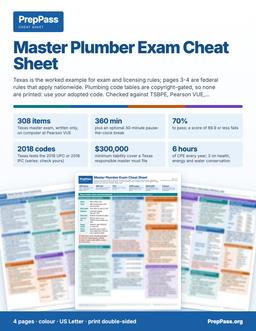
This guide is the teaching, read over weeks. If your exam is inside two weeks, the printable colour cheat sheet is the other product: the figures the exam turns on, laid out by section.
See the Master Plumber Exam cheat sheet PDF — $9.99 →
4 pages · US Letter · printable PDF · yours to keep
What's included — and what isn't
Included
- All areas at real weight, grounded in the IPC/UPC (differences flagged)
- Water-supply & DWV sizing worked step-by-step (WSFU/DFU)
Not included
- No printed copy is shipped — this is a file you download and can print yourself
- No video course, instructor or tutoring comes with the book — the free videos on the site are separate
Everything included, and everything that isn't
Included
- Venting methods + the backflow/cross-connection hierarchy
- Gas sizing, storm drainage, business math, and jobsite safety
- 25 practice questions printed in the book, with explanations (400+ more free on the site)
- A sizing quick-reference + fittings cheat-sheet — PDF + EPUB
Not included
- Not your exam registration or the testing centre's fee, which you still pay to the official body
Contents
See 9 sections and the page each one starts on
- Chapter 1 — Design and Sizing (29%)p. 12
- Chapter 1 — Check Yourselfp. 25
- Chapter 2 — Advanced Systems and Code (25%)p. 26
- Chapter 2 — Check Yourselfp. 35
- Chapter 3 — Fuel-Gas and Specialty Gas Systems (16%)p. 37
- Chapter 4 — Code Administration, Plans, and Business (15%)p. 46
- Chapter 4 — Check Yourselfp. 52
- Chapter 5 — Job-Site Safety and Public Health (15%)p. 53
- Chapter 5 — Check Yourselfp. 60
Taken from the PDF you download, with the page each one starts on — not typed here.
Read a chapter free, in full
One complete chapter, exactly as it ships in the eBook. Scroll the window to read it right here; no download, no email.
Read chapter 1 here, without leaving the page
This is the largest domain and the one that separates master-level candidates from journeymen. It is almost entirely calculation, and calculation is the good news: unlike a memory question, a sizing problem can be derived on the exam if you know the procedure. Four conversions carry most of the domain:
- WSFU to gpm (water supply),
- DFU to pipe size and slope to fall (drainage and venting),
- BTU/hr to cfh to pipe size (fuel gas), and
- roof area × rainfall to gpm (storm).
Master these four and you have earned the single biggest block of points on the exam.
1.1 Water Supply Sizing by Fixture Units
Teach. Water distribution is sized in three moves: total the load, convert the load to a flow, choose a pipe that keeps velocity in bounds.
The load is measured in water supply fixture units (WSFU), a probability-weighted number the code assigns to each fixture so that a lavatory and a flushometer water closet can be added on one scale. You total the WSFU that a given section of pipe must carry, then convert that single total to a design flow in gallons per minute (gpm) using a demand curve derived from Hunter's probability work. The curve's whole purpose is to discount the near-impossibility that every fixture runs simultaneously.
The rule that trips people: add fixture units first, convert to gpm once. Converting each branch to gpm and adding the flows badly overstates demand, because the curve has already discounted simultaneous use. Also, flush-valve (flushometer) fixtures ride a different, higher demand curve than flush-tank fixtures, because a flushometer draws a heavy momentary flow while a tank sips through a small refill valve.
Once you have design gpm, choose the pipe so velocity stays in bounds — generally about 8 ft/s for cold water and 5 ft/s for continuously circulated hot water — using:
v = 0.408 × Q / d² where v is velocity (ft/s), Q is flow (gpm), and d is the actual inside diameter (inches).
High velocity causes erosion-corrosion, noise, and water hammer; hot water is chemically more aggressive, so its limit is lower.
Worked Example 1A — total, convert, size.
A branch serves, using illustrative WSFU values (confirm against your adopted table):
- 3 lavatories at 1.0 WSFU each = 3.0
- 2 water closets, flush tank, at 3.0 WSFU each = 6.0
- 1 kitchen sink at 1.5 WSFU = 1.5
- 1 shower at 2.0 WSFU = 2.0
Total = 3.0 + 6.0 + 1.5 + 2.0 = 12.5 WSFU.
Convert once on a flush-tank demand curve. Using an illustrative demand relationship (again, verify against the adopted curve): 12.5 WSFU on the flush-tank curve corresponds to roughly 10 gpm of design flow.
Now size the pipe to keep cold-water velocity at or under 8 ft/s. Rearrange the velocity formula for the minimum diameter:
d = √(0.408 × Q / v) = √(0.408 × 10 / 8) = √(4.08 / 8) = √0.51 = 0.714 in
A nominal ¾-in tube has an inside diameter close to 0.785–0.811 in depending on type, which is larger than 0.714 in, so ¾-in copper holds the velocity below 8 ft/s. Check it: v = 0.408 × 10 / (0.785²) = 4.08 / 0.616 = 6.6 ft/s — under the limit. Good.
Worked Example 1B — why you convert only once.
Suppose two branches each carry 20 WSFU and meet at a main. On a flush-tank curve, 20 WSFU is about 16 gpm. The wrong method adds the flows: 16 + 16 = 32 gpm. The right method adds the fixture units first — 20 + 20 = 40 WSFU — then converts once: 40 WSFU is about 30 gpm, not 32. The single conversion is lower because the curve keeps discounting as the population grows. On a big system the error compounds badly, so the exam loves this trap.
Worked Example 1C — velocity limit sets a floor on size.
A hot-water recirculation return must carry 8 gpm and must stay at or under 5 ft/s (continuous circulation). Minimum diameter:
d = √(0.408 × 8 / 5) = √(3.264 / 5) = √0.653 = 0.808 in
So a nominal ¾-in line (ID ~0.785 in) is too small here — it would run slightly over 5 ft/s and invite erosion of the hot line. Step up to 1-in and recheck: v = 0.408 × 8 / (1.025²) = 3.264 / 1.05 = 3.1 ft/s. Comfortable.
Key-Code Callout — Water Supply Sizing - Demand/WSFU: UPC Table 610.3 / §610.0; IPC Appendix E (equivalent fixture-unit values and Hunter demand curve). Confirm your jurisdiction adopts Appendix E if you rely on it. - Velocity: hold cold ≈ 8 ft/s, hot ≈ 5 ft/s (UPC §610.12). Formula v = 0.408 Q / d². - A supply main never reduces in the direction of flow toward fixtures it must still feed. - Minimum fixture flow pressures (≈ 8 psi lavatory to ≈ 25 psi flushometer) feed the pressure budget (next section).
Common Traps - Adding gpm instead of WSFU. Always total units, then convert once. - Using the flush-tank curve for flushometers (or vice versa). Flushometers draw more. - Using nominal size as the diameter in the velocity formula. Use the actual inside diameter; type M, L, and K copper differ. - IPC vs UPC: the IPC houses the demand data in Appendix E, which is only enforceable if the jurisdiction adopts the appendix; the UPC carries it in the body of Chapter 6. Same physics, different citation.
1.2 The Pressure Budget
Teach. Every water system is a budget: the pressure available at the source must pay for everything between the source and the most remote, highest fixture. The four consumers are:
- Elevation (static lift): 0.433 psi per foot of rise. (Equivalently, 2.31 ft of water = 1 psi.)
- Fixed device losses: the water meter, softener, filter, and backflow assembly, each read from a manufacturer's chart at the design flow.
- Pipe friction: expressed as psi per 100 ft at the design flow.
- Minimum residual pressure at the fixture: commonly 8 to 25 psi.
The procedure is subtraction. Start from the minimum guaranteed street pressure, subtract elevation, subtract device losses, subtract the fixture's required residual, and whatever remains is the budget available for friction. Divide that remaining pressure by the developed length of the critical run and multiply by 100 to get the allowable friction loss per 100 ft. Carry that value across a friction chart at the design gpm to pick each pipe.
Developed length, not tape length: add the equivalent length of every fitting, valve, and the meter to the straight pipe, because a run full of elbows behaves as if it were much longer.
Worked Example 1D — the full budget.
Given:
- Minimum street (static) pressure: 60 psi
- Highest fixture is 30 ft above the meter
- Meter loss: 8 psi
- Backflow assembly loss: 9 psi
- Required residual at the critical fixture (flush tank): 15 psi
- Developed length of the critical run: 120 ft
Step 1 — elevation loss: 30 ft × 0.433 psi/ft = 12.99 ≈ 13.0 psi.
Step 2 — subtract all fixed consumers: 60 − 13.0 − 8 − 9 − 15 = 15.0 psi left for friction.
Step 3 — allowable friction loss per 100 ft: (15.0 psi ÷ 120 ft) × 100 = 12.5 psi per 100 ft.
Now enter the friction chart at the design gpm and pick the smallest pipe whose loss at that flow is ≤ 12.5 psi/100 ft. If the trial pipe exceeds 12.5, go up one size and recheck.
Worked Example 1E — how tall can gravity go?
A building has 55 psi minimum street pressure. The top fixture needs 15 psi residual, and meter plus backflow eat 15 psi. Ignoring friction for a first cut, the pressure available for elevation is 55 − 15 − 15 = 25 psi. Convert to height: 25 psi ÷ 0.433 psi/ft = 57.7 ft of rise — roughly five stories — before a booster pump is needed. Add friction and the real ceiling is lower, which is exactly why tall buildings pump.
Worked Example 1F — developed length matters.
A run measures 80 ft of straight pipe but includes fittings whose equivalent lengths total 40 ft. The developed length is 120 ft, not 80. If you had 15 psi for friction and used the tape length, you would compute 15/80 × 100 = 18.75 psi/100 ft and undersize the pipe; using the correct 120 ft gives 12.5 psi/100 ft and the right, larger pipe.
Key-Code Callout — Pressure Budget - Elevation: 0.433 psi/ft; 2.31 ft = 1 psi. - Subtract elevation + meter + device + residual from static supply; the remainder ÷ developed length × 100 = allowable psi/100 ft. - Use developed length (straight pipe + fitting equivalents), not measured length. - Both UPC and IPC accept the segmented friction-loss method; the IPC also permits a simplified prescriptive table for small systems.
Common Traps - Forgetting the residual. The fixture still needs 8–25 psi to work; that pressure is spent, not available. - Using measured instead of developed length, which undersizes the pipe. - Mixing units: psi vs feet of head. Convert with 2.31 ft/psi. - Assuming static = working pressure. Under flow, pressure drops; size to the minimum available.
1.3 Drainage and Vent Sizing by Fixture Units
Teach. Sanitary drainage is sized from drainage fixture units (DFU), a value that scales with a fixture's discharge rate and its potential to load the drain. The DFU tables are split into columns that must never be interchanged:
- horizontal fixture branch,
- vertical stack (often qualified by branch intervals), and
- building drain and sewer at a stated slope.
Total the DFU a section carries and pick the smallest pipe whose column capacity meets or exceeds the load. Two override rules bind no matter the count:
- A drain is never smaller than the largest trap or trap arm it serves.
- Any drain receiving a water closet is at least 3 inches.
Slope is the other axis. Both codes set a minimum of ¼ in per foot for pipe 2½ in and smaller and ⅛ in per foot for 3 in and larger (with 1/16 in/ft for very large sewers only by special approval). Total fall = slope × developed run.
Vents are sized in parallel: a vent is not less than half the diameter of the drain it serves, never smaller than 1¼ in, and is further limited by developed length. The trap arm — the distance from a trap to its vent — is capped by pipe size (roughly 6 ft for a 2-in arm; verify the table).
Worked Example 1G — size a building drain.
Using illustrative DFU values (verify against your table): 2 water closets at 4 DFU (8), 3 lavatories at 1 DFU (3), 2 showers at 2 DFU (4), 1 kitchen sink at 2 DFU (2), 1 clothes washer at 3 DFU (3).
Total = 8 + 3 + 4 + 2 + 3 = 20 DFU.
Because water closets discharge here, the drain must be at least 3 in regardless of count. Check a 3-in building drain at ¼ in/ft against an illustrative capacity of ~35 DFU: 20 ≤ 35, so 3-in works. If the same load were on a stack with several branch intervals, read the stack column, not the building-drain column — the capacities differ for the same nominal size.
Worked Example 1H — slope to fall.
A 4-in building drain runs 80 ft at the ⅛-in/ft minimum. Total fall = 0.125 in/ft × 80 ft = 10 inches of drop from start to end. If it ran at ¼ in/ft, fall = 0.25 × 80 = 20 inches — which may not fit under a slab, a real design constraint that pushes you to the flatter allowed slope on long runs.
Worked Example 1I — vent and trap arm.
A 3-in drain needs a vent of at least half its diameter: 3 ÷ 2 = 1.5, so a 1½-in vent minimum. A 4-in drain needs at least a 2-in vent. Separately, a 2-in trap arm (a 2-in fixture drain from trap to vent) is limited to roughly 6 ft of developed length; run it longer and the trap can self-siphon, so you must relocate the vent or upsize the arm.
Key-Code Callout — DWV Sizing - DFU tables: UPC Chapter 7 (§703); IPC Chapter 7 (§710 sizing, §704 slope). Read the correct column. - Water closet → 3-in minimum drain (IPC §710.1). - Slope minimums: ¼ in/ft ≤ 2½ in; ⅛ in/ft ≥ 3 in (IPC §704.1). Fall = slope × run. - Vent ≥ ½ drain diameter, ≥ 1¼ in (UPC §904).
Common Traps - Interchanging table columns (branch vs stack vs building drain). - Reducing size downstream as more load is added — never legal. - Ignoring the trap/trap-arm override — a 3-in trap forces at least a 3-in drain even at low DFU. - IPC vs UPC: the two assign slightly different DFU values to some fixtures and tabulate trap-arm lengths differently. Size to the adopted code, and never mix a UPC DFU value into an IPC table.
Questions buyers ask
How do I get it?
Pay, and the download appears on this page straight away. The links are also emailed to you. No account is required.
What if it isn't for me?
Email us within 14 days for a full refund, no questions asked.
Is the free practice going away?
No. Every practice question, the timed mock and the free chapters on this site stay free. This book is the studying half, not a gate around the free half.
More questions (9)
Can I read it on my phone?
Yes — the EPUB is for phones and e-readers, the PDF is for printing and tabbing. You get both.
Is a study guide enough for the Master Plumber Exam, or do I need a course?
A book is exam review: it does not replace any education, training or experience your licensing body requires before you may sit the exam, so check those requirements first. For the exam content itself, this 75-page guide teaches the material chapter by chapter with 25 practice questions and explanations inside, and 410 more practice questions are free on PrepPass. A prep course adds live instruction and a set schedule; whether you need one beyond any required education is your call.
What is the cheapest way to prepare for the Master Plumber Exam?
Start with what costs nothing: 410 practice questions on PrepPass, with explanations and no signup. If you want it taught in one file you keep, the full study guide is $14.99 once; the printable cheat sheet for the last days is $9.99. No subscription on any of them.
Does the Master Plumber Exam study guide come as a PDF?
Yes — Master Plumber Exam — Complete Study Guide (2026) downloads as PDF and EPUB, 75 pages. The download link is emailed the moment payment clears and does not expire.
How much does the Master Plumber Exam study guide cost?
$14.99, once. There is no subscription and no account to create; the PDF and EPUB files are yours to keep.
Are there free Master Plumber Exam practice questions?
Yes — 410 of them, free to use with no signup and an explanation on every one. They are separate from this study guide, which is what you are buying here. The same free, no-account system also has practice modes (adaptive, new questions, spaced review of misses, weak-topic focus, saved, my mistakes); a timed mock exam (100 questions, 300 minutes) with a score report by topic; a 10-question readiness check (about 5 minutes); 5 study chapters. None of it needs this study guide.
Can I read part of the Master Plumber Exam study guide before buying?
Yes. A full chapter is free to read on this page — not a summary of one, the chapter itself.
What is the difference between the Master Plumber Exam study guide and the cheat sheet?
The study guide ($14.99) teaches the material chapter by chapter and is meant to be read over weeks. The cheat sheet ($9.99, 4 pages) drops the teaching and keeps the figures: every number on the exam grouped by value so the confusable ones sit together, each reference page paired with a recall page that blanks the answers, and four routes by days left — 14, 7, 3, or tonight. They are separate purchases; neither replaces the other.
Is this the official Master Plumber Exam study guide?
No. This is an independent study guide and is not affiliated with or endorsed by the exam's awarding body. It is written from the IPC/UPC model plumbing codes (+ IFGC/NFPA). Always confirm current requirements with the body that issues your licence.
Why buy the book when the practice is free?
Our practice questions and timed mock stay free — nothing on the site moves behind this book. The $14.99 book is the studying half: the material itself, taught in order, in a file you own.
- Systematic teaching — every exam section explained chapter by chapter, start to finish, not just questions
- Print it & tab it — a paper-ready PDF you can highlight, mark up, and bring to your study table
- Study anywhere, offline — EPUB on your phone or e-reader; no wifi, no browser tabs
- Everything in one place — the chapters and the practice questions in one file
- Yours for life — one-time $14.99, instant download, no subscription
The details
- Verified from the official source(the IPC/UPC model plumbing codes (+ IFGC/NFPA))
- 410 free practice questions
A master plumber exam prep course runs $150–$600. This book teaches the same exam — same rules, verified to current standards — for a one-time $14.99 you keep for life.
Also free on PrepPass for Master Plumber Exam
Beside this guide, PrepPass has a free study system for the same exam. It needs no account, and buying the guide does not unlock or change it: 410 practice questions with explanations; practice modes (adaptive, new questions, spaced review of misses, weak-topic focus, saved, my mistakes); a timed mock exam (100 questions, 300 minutes) with a score report by topic; a 10-question readiness check (about 5 minutes); 5 study chapters.
Progress is saved in your browser; a free account keeps it across devices. The readiness gauge reflects your own practice, not a prediction of the real exam result. How the practice works
One-time purchase, lifetime access to the download. The eBook is the full Master Plumber Exam study guide in PDF and EPUB. Educational summary, not professional or legal advice — always confirm the current rules with the official source. Last updated: October 2026.