Study guide · 2026 Edition
NHA CPT Phlebotomy Study Guide — 2026 Edition
PrepPass's independent 2026 study guide for the NHA Certified Phlebotomy Technician exam is 222 pages including 236 practice questions with a full answer key, PDF + EPUB, $14.99 one-time; it is not affiliated with the exam provider. The book does not include PrepPass's separate online timed mock for this exam (100 questions, 130 minutes). The book also prints its own practice exam, which is separate.
Edition: Rewritten Sept 2026 for NHA's new CPT exam (Jan 7, 2026): Special Collections now 12 of 100 scored items.
- Length
- 222 pages
- Practice questions in the book
- 236
- PrepPass online timed mock
- 100 questions · 130 min
- Exam facts last checked
- September 2026
- File last updated
- October 2026
- Delivery
- PDF + EPUB · English · instant download
What is in the NHA Certified Phlebotomy Technician (CPT) study guide?
Exam facts last checked September 2026 against the exam body's published sources.
The real exam: Certified Phlebotomy Technician (CPT) Certification Examination — 120 questions (100 scored, 20 unscored pretest) · 120 minutes · Passing score: Scaled score of 390 on a 200–500 scale.
Written to NHA's current CPT test plan, with a full-length 120-item practice exam at the real exam's length
Examination application: $134 per attempt, paid to National Healthcareer Association. A retake pays it again. This guide: $14.99, one time.
Exam facts, who it suits and what changed
To prepare for the NHA Certified Phlebotomy Technician (CPT) exam, start with what the exam body publishes: CPT test plan from National Healthcareer Association (NHA) — the official list of what the CPT exam covers, free (PDF). That is enough if you only need to see what the exam covers; this book is for learning it and practising it. The exam itself (Certified Phlebotomy Technician (CPT) Certification Examination): 120 questions (100 scored, 20 unscored pretest), 120 minutes, scaled score of 390 on a 200–500 scale to pass. Choose this book if you want the order of draw, tube additives, specimen handling and safety rules taught in writing, alongside your training and the free practice questions.
About the exam itself
| Administering body | National Healthcareer Association (NHA) — exam delivered by a PSI testing center, a live remote proctoring provider, or the candidate's own school or employer |
|---|---|
| Questions | 120 questions (100 scored, 20 unscored pretest) Source: NHA — Test Plan for the Certified Phlebotomy Technician (CPT) Exam (2024 job analysis, PDF) |
| Time limit | 120 minutes Source: NHA — Test Plan for the Certified Phlebotomy Technician (CPT) Exam (2024 job analysis, PDF) |
| Passing score | Scaled score of 390 on a 200–500 scale |
| Fees |
Source: NHA store — Certified Phlebotomy Technician (CPT) Exam Application |
| Languages offered | English |
Look inside the book
Three real pages, rendered straight from the PDF you download — a reference page, a teaching page, and a worked question, always in that order. Nothing here was redrawn to look better.
- Quick referenceSection 1 (items 1–31) → Chapters 2 and 3. Section 2 (items 32–55) → · PDF page 194
A page you can turn back to: the numbers, deadlines or terms gathered in one place.
- How it's taughtChapter 5. Routine Blood Collections I: Equipment, Tubes and the Order of Draw · PDF page 102
An explanation page: the material taught in prose, in the order the exam tests it.
- A question, workedChapter 8. Processing · PDF page 22
A practice question with its answer and the reasoning behind it — not just a key.
Exam inside two weeks?
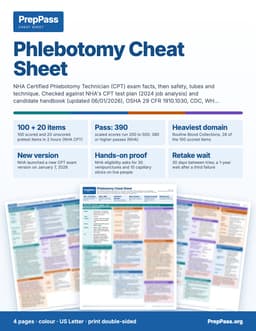
This guide is the teaching, read over weeks. If your exam is inside two weeks, the printable colour cheat sheet is the other product: the figures the exam turns on, laid out by section.
See the NHA Certified Phlebotomy Technician cheat sheet PDF — $9.99 →
4 pages · US Letter · printable PDF · yours to keep
How this book compares
NHA publishes the CPT test plan for free and sells its own online study guide and practice tests, and states that buying its preparation materials is not required to sit the exam. This book is an independent written review with a practice exam.
| Resource | Price | What you get | Choose it if |
|---|---|---|---|
| This bookNHA CPT Phlebotomy Study Guide — 2026 EditionPrepPass | $14.99 | Downloadable review for phlebotomy technician certification exams
| Choose this book if you want the order of draw, tube additives, specimen handling and safety rules taught in writing, alongside your training and the free practice questions. |
| From the exam bodyCPT test plan (opens the publisher's page in a new tab)National Healthcareer Association (NHA) | Free (PDF) | The official list of what the CPT exam covers | Read it in any case to check every topic the exam covers. |
| From the exam bodyCPT Online Study Guide and Practice Tests (opens the publisher's page in a new tab)National Healthcareer Association (NHA) | Price not listed on the page we checked | The exam body's own interactive study materials
| Choose NHA's materials if you want practice tests from the organization that writes the CPT exam. |
| AlternativeNHA Phlebotomy Study Guide 2026-2027 (opens the publisher's page in a new tab)Mometrix Test Preparation | $23.99 ebook; $28.99 printed book | Study guide with practice questions | Choose Mometrix if you want a printed copy. |
This book
NHA CPT Phlebotomy Study Guide — 2026 Edition
PrepPass
- Price
- $14.99
- What you get
Downloadable review for phlebotomy technician certification exams
- 236 practice questions with explanations
- 222 pages, PDF + EPUB
- Choose it if
- Choose this book if you want the order of draw, tube additives, specimen handling and safety rules taught in writing, alongside your training and the free practice questions.
From the exam body
CPT test plan (opens the publisher's page in a new tab)
National Healthcareer Association (NHA)
- Price
- Free (PDF)
- What you get
The official list of what the CPT exam covers
- Choose it if
- Read it in any case to check every topic the exam covers.
From the exam body
CPT Online Study Guide and Practice Tests (opens the publisher's page in a new tab)
National Healthcareer Association (NHA)
- Price
- Price not listed on the page we checked
- What you get
The exam body's own interactive study materials
- An online study guide with interactive games, quizzes and flashcards, and a phlebotomy practice test with up to six attempts
- Choose it if
- Choose NHA's materials if you want practice tests from the organization that writes the CPT exam.
Alternative
NHA Phlebotomy Study Guide 2026-2027 (opens the publisher's page in a new tab)
Mometrix Test Preparation
- Price
- $23.99 ebook; $28.99 printed book
- What you get
Study guide with practice questions
- Choose it if
- Choose Mometrix if you want a printed copy.
Other resources' prices and contents are as listed on each publisher's or seller's own page, checked September 24, 2026. Prices change; confirm on the linked page before you buy. This book's price and contents come from our own catalog.
Sources (2)
- https://www.nhanow.com/certification/nha-certifications/certified-phlebotomy-technician-(cpt) — read September 24, 2026
- https://www.mometrix.com/studyguides/phlebotomy/ — read September 24, 2026
What's included — and what isn't
Included
- 236 original questions with explanations, including a 120-item practice exam built to NHA's domain weights
- The order of draw, additives and inversions from the tube manufacturer's own documents
Not included
- No printed copy is shipped — this is a file you download and can print yourself
- No video course, instructor or tutoring comes with the book — the free videos on the site are separate
Everything included, and everything that isn't
Included
- A full chapter on Special Collections — blood cultures, newborn screening, tolerance tests, blood alcohol and drug screens
- Processing: clotting times, centrifuge settings, ice/warm/light handling and Category B shipping
- Sixteen worked case studies and an item-by-item test plan crosswalk
- What changed in the 2026 exam and in CLSI's renumbered standards (PRE02, PRE04, PRE01)
Not included
- Not your exam registration or the testing centre's fee, which you still pay to the official body
Contents
See 17 sections and the page each one starts on
- Chapter 8. Processingp. 9
- Chapter 1. Core Knowledge: The Phlebotomist, the Circulatory System and Bloodp. 11
- Chapter 2. Safety and Compliance I: Infection Control, Exposure and Emergenciesp. 28
- Chapter 3. Safety and Compliance II: Regulations, Privacy, Ethics and Quality Controlp. 46
- Chapter 4. Patient Preparationp. 63
- Chapter 5. Routine Blood Collections I: Equipment, Tubes and the Order of Drawp. 85
- Chapter 6. Routine Blood Collections II: Venipuncture, Capillary Collection and Complicationsp. 104
- Chapter 7. Special Collectionsp. 125
- Section 1. Safety and Compliance (31 items)p. 164
- Section 2. Patient Preparation (24 items)p. 170
- Section 3. Routine Blood Collections (34 items)p. 176
- Section 4. Special Collections (14 items)p. 182
- Section 5. Processing (17 items)p. 185
- Section 1 (items 1–31) → Chapters 2 and 3. Section 2 (items 32–55) →p. 189
- Appendix A. Test Plan Crosswalkp. 207
- Appendix B. Terms to Use Preciselyp. 212
- Appendix C. Quick Referencep. 214
Taken from the PDF you download, with the page each one starts on — not typed here.
Read a chapter free, in full
One complete chapter, exactly as it ships in the eBook. Scroll the window to read it right here; no download, no email.
Read chapter 5 here, without leaving the page
We didn't give you the easy intro — the free chapter opens on one of the hardest-working parts of the book, so you can judge the teaching where the exam gets difficult.
Test plan coverage: Domain 3, Routine Blood Collections — 28 of 100 scored items, the largest domain[1]. This chapter covers tasks 3A, 3B, 3D, 3J and 3N and knowledge k47, k54–k59 and k66: selecting and checking equipment, needles, evacuated tubes and their additives, the order of draw, fill levels and inversions. Chapter 6 covers the draw itself, capillary collection and complications.
A reminder from the edition notes at the front of this book: the order of draw below is the CLSI order as published in the dated, freely readable sources named here. CLSI's current venous standard is PRE02 (8th edition, February 13, 2025), which replaced GP41[2]. BD's own chart, dated June 2023, is headed "CLSI-recommended order of draw (GP41-A7)"[3]. Always follow your facility's order where it is written down; BD's chart itself says "Always follow your facility's protocol for order of draw."[3]
5.1 The three collection systems (task 3A; k54)
| System | Parts | When it is used |
|---|---|---|
| Evacuated tube system | double-ended needle, tube holder, vacuum tubes | Routine venipuncture; multiple tubes from one puncture |
| Winged (butterfly) set | short needle with plastic wings, flexible tubing, holder or syringe | Small, fragile or hand veins; children; older adults |
| Needle and syringe | hypodermic needle, syringe, then a transfer device into tubes | Very fragile veins where vacuum would collapse the vein |
WHO explains why closed systems are preferred: "Closed systems for blood sampling are preferable because they have proven to be safer than open systems."[4] Vacuum tube systems reduce "the risk of direct exposure to blood and has made it easier to take multiple samples from a single venepuncture"[4]. In the evacuated system the tube "is under vacuum. Once the needle is in the vein, the tube is pressed on to the needle and the blood is drawn automatically into the sample tube by vacuum until the required amount is collected"[4].
Do not push the tube on early. WHO: "Do not push the laboratory tube onto the needle inside the barrel until the needle is in the blood vessel, or the vacuum will be lost."[4]
Syringe transfers. When a syringe is used, fill tubes with a transfer device, not by pushing a needle through the stopper by hand. WHO warns not to "press the syringe plunger because additional pressure increases the risk of haemolysis"[4], and a hospital procedure says to transfer "as soon as possible using a Blood Transfer Device, as a delay could cause improper coagulation"[5].
5.2 Needles: gauge, length and safety features (k55, k56, k66)
Gauge runs backward. The larger the gauge number, the smaller the needle's bore. A 21-gauge needle is larger than a 23-gauge.
WHO's Table 3.1 gives recommended gauges by use[4]:
| Gauge | Use in WHO's table |
|---|---|
| 16–18 | Blood donation |
| 21 (1–1.5 inch) | Adults |
| 22 (1 inch) | Adults; children, older adults and small veins |
| 23 | Adults; winged set for children, older adults, small veins and neonates |
Why not smaller? WHO lists "use of a needle of too small a gauge (23 or under), or too large a gauge for the vessel" among causes of hemolysis[4]. "If the needle is too large for the vein for which it is intended, it will tear the vein and cause bleeding (haematoma); if the needle is too small, it will damage the blood cells during sampling"[4].
Choosing the device (k55). The test plan lists the factors: "current health status, stated history, vein size, requisition requirements"[1]. WHO: "Choose the gauge of hypodermic needle that fits comfortably into the most prominent vein with little discomfort"[4].
Safety features (k66). Needles must have engineered sharps-injury protection where available — OSHA defines these as devices "with a built-in safety feature or mechanism that effectively reduces the risk of an exposure incident"[6]. They come as hinged shields, sliding sheaths and retractable needles. WHO notes that some systems have "a mechanism that can be activated once the needle has been used; the mechanism retracts the used needle into the barrel and snaps it shut"[4]. Activate the feature immediately as the needle leaves the skin (Chapter 6).
5.3 Checking equipment before you use it (task 3B; k58)
Task 3B is to "Verify quality of equipment (e.g., sterility, expiration date, and manufacturer's defects)"[1]; k58 adds "inspection of needles, check for cracks in tubes, and check expiration dates"[1]. BD's package insert gives the manufacturer's rules:
- "Do not use tubes after their expiration date. Tubes expire on the last day of the month and year indicated."[7] An expired tube may have lost vacuum or have a degraded additive.
- "Do not use tubes or needles if foreign matter is present."[7]
- "Do not use needle if label has been torn before venipuncture."[7] The paper seal shows the needle is still sterile.
- "Tube interiors are sterile."[7]
- Cracked or chipped tubes can break in the centrifuge and release "sample, droplets, and an aerosol into the centrifuge bowl"[7].
Also tap tubes gently before use: BD instructs collectors to "Gently tap tubes containing additives to dislodge any material that may be adhering to the stopper"[7].
5.4 Tubes and additives (k57; k47)
The stopper color tells you the additive. Colors are standardized by the manufacturer, not by law, so always read the label as well. The table combines BD's tube guide and WHO's order-of-draw table.
| Stopper | Additive | What it does | Specimen | Typical use |
|---|---|---|---|---|
| Yellow (SPS) or blood culture bottles | Sodium polyanethol sulfonate (SPS) / broth | Preserves microorganisms | Whole blood | "SPS for blood culture specimen collections in microbiology"[8] |
| Light blue | Buffered sodium citrate, 0.109 M (3.2%) in plastic[8] | "Forms calcium salts to remove calcium"[4] | Plasma | "For coagulation determinations"[8] |
| Red | None (glass) or clot activator (plastic)[8] | Blood clots | Serum | Chemistry, serology |
| Gold / red-gray (SST) | Clot activator and gel[8] | Gel forms a barrier between serum and cells | Serum | "For serum determinations in chemistry"[8] |
| Orange (RST) | Thrombin-based clot activator | Fast clotting — "Blood clotting time: 5 minutes"[8] | Serum | STAT chemistry |
| Green | Sodium or lithium heparin | "Inactivates thrombin and thromboplastin"[4] | Plasma | "For plasma determinations in chemistry"[8] |
| Light green (PST) | Lithium heparin and gel[8] | Anticoagulates; gel separates plasma | Plasma | Chemistry |
| Lavender | K2EDTA or K3EDTA[8] | Removes calcium | Whole blood | "for whole blood hematology determinations"[8] |
| Pink | K2EDTA | Removes calcium | Whole blood | Blood bank; crossmatch label "required by the AABB"[8] |
| Gray | Potassium oxalate/sodium fluoride[8] | "Sodium fluoride is the antiglycolytic agent"[8] | Plasma | "For glucose determinations"[8] |
| Royal blue | Clot activator or K2EDTA; low trace elements[8] | Stopper formulated for "low levels of trace elements" | Serum or whole blood | "For trace-element, toxicology, and nutritional-chemistry determinations"[8] |
| Tan | K2EDTA | Certified low lead | Whole blood | "For lead determinations"[8] |
| Yellow (ACD) | Acid citrate dextrose | Preserves cells | Whole blood | "ACD for use in blood bank studies, HLA phenotyping, and DNA and paternity testing"[8] |
| White (PPT) | K2EDTA and gel | Separates plasma | Plasma | "molecular diagnostic test methods"[8] |
Three additive facts that turn into exam questions
- Lithium heparin and lithium levels. BD: "Do not use BD Vacutainer® Tubes containing lithium heparin for lithium measurement."[7] WHO's table says "For lithium level use sodium heparin"[4].
- Why EDTA wrecks a potassium or calcium result. K2EDTA and K3EDTA are potassium salts of EDTA, and EDTA works by removing calcium[4]. Carry a little of it into a chemistry tube and the potassium reads falsely high while the calcium reads falsely low. That is the main reason EDTA comes near the end of the order of draw.
- Fluoride stops glycolysis. Red cells keep consuming glucose in the tube; sodium fluoride, "the antiglycolytic agent"[8], stops them, and WHO notes it "preserves glucose up to five days"[4].
Matching the test to the tube (k47)
The test plan's example for k47 is "blue stopper for coagulation"[1]. Exam items usually give a test and ask for the tube, or give a tube and ask what it cannot be used for. Work from the department the test belongs to:
| Department or test type | Tube | What the sources say |
|---|---|---|
| Coagulation (PT/INR, PTT) | Light blue citrate | "For coagulation determinations"[8]; full draw required[4] |
| Routine chemistry (metabolic panels, lipids, liver tests) | Gold SST, red, or light green PST | SST "For serum determinations in chemistry"[8]; PST for "plasma determinations in chemistry"[8] |
| STAT chemistry | Orange RST | "For stat serum determinations in chemistry"[8] |
| Serology and immunology | Red or gold | WHO lists "immunology and serology" among clot-tube uses[4] |
| Hematology (CBC, hemoglobin, hematocrit) | Lavender EDTA | "For whole blood hematology determinations"[8]; WHO: "Haematology"[4] |
| Blood bank (type and crossmatch) | Pink EDTA (or lavender per facility) | Crossmatch label "required by the AABB"[8]; K2EDTA "may be used for routine immunohematology testing"[8] |
| Glucose, lactate (per lab) | Gray fluoride/oxalate | "For glucose determinations"[8] |
| Lithium level | Not lithium heparin | [7] |
| Ammonia | Heparin per WHO's table ("for ammonia level use either" heparin salt) or EDTA per some reference labs | [4] |
| Lead | Tan K2EDTA | "For lead determinations"[8] |
| Trace elements, toxicology | Royal blue | [8] |
| HLA typing, paternity, DNA | Yellow ACD | WHO: "HLA tissue typing ... paternity testing ... DNA studies"[4] |
| Molecular (PCR) | White PPT | [8] |
| Blood cultures | Culture bottles or yellow SPS | [8] |
Your laboratory's test directory has the final word: the same test can be validated on different tubes in different laboratories — ammonia is the classic example, drawn on heparin in some laboratories and EDTA in others[4, 9].
5.5 The order of draw (task 3J; k59)
Why it exists
WHO: "Draw blood collection tubes in the correct order, to avoid cross-contamination of additives between tubes."[4] The additive on the outside of the needle that punctures one stopper can be carried into the next tube.
The order
The CLSI order, as BD's 2023 chart and the CLSI 7th-edition summary give it[3, 10]:
- Blood cultures — blood culture bottles or the yellow SPS tube (sterile specimens first)
- Sodium citrate — light blue (coagulation)
- Serum tubes — red, gold/SST, orange/RST (with or without clot activator or gel)
- Heparin — green or light green (with or without gel)
- EDTA — lavender, pink, white (with or without gel)
- Sodium fluoride/potassium oxalate — gray (glucose)
A university hospital procedure gives the same six and adds the yellow ACD tube after gray[5]. BD's package insert states the principle in four groups: "1. Tubes for sterile samples. 2. Tubes for coagulation studies (e.g., citrate). 3. BD SST™ and Serum Tubes. 4. Tubes with other additives (e.g., heparin, EDTA, fluoride)."[7]
One way to remember it: say what each tube is for, in order — germs, clotting, serum, then the three anticoagulant families (heparin, EDTA, fluoride). If a mnemonic helps you, make one from the stopper colors; the order is what matters.
Rules that go with the order
- Same order for every method. "The order of draw is the same whether the specimens are collected by evacuated tube method or by syringe and is also the same for plastic or glass tubes."[10]
- What may come before the light-blue tube. "Only blood cultures, glass non additive tubes or plastic tubes without clot activator may be collected before the coagulation tube (light blue)."[10]
- The discard tube with a winged set. "When a winged blood collection set is used for venipuncture and a citrate tube is the first tube needed, a discard tube must first be collected. The discard tube is used to remove air from the tubing of the collection set, to ensure the proper volume of blood is drawn into the tube." It "should be a nonadditive or coagulation tube."[3] It "does not need to be filled completely"[7]. BD warns that its plastic serum tubes contain clot activator and "are not to be used as discard tubes before drawing citrate tubes"[7].
- Coagulation tube alone with a straight needle. WHO: "If a routine coagulation assay is the only test ordered, then a single light blue top tube may be drawn."[4]
- Blood cultures with a winged set. "When a winged blood collection set is used, the aerobic blood culture bottle is filled first, followed by the anaerobic bottle."[3]
- Trace elements. "Syringes must not be used for trace element collections that include testing for cobalt and chromium because the plunger tip contributes such elements to the specimen."[10]
- Capillary collections use a different order (Chapter 6).
Sources cited in this excerpt
- NHA Certified Phlebotomy Technician (CPT) Test Plan for the CPT Exam (based on a job analysis completed in 2024). National Healthcareer Association, 2024-06-24. https://info.nhanow.com/hubfs/Test%20Plans/nha-2025-cpt-test-plan.pdf
- CLSI PRE02, Collection of Diagnostic Venous Blood Specimens, 8th ed. (product page). Clinical and Laboratory Standards Institute, 2025-02-13. https://clsi.org/shop/standards/pre02/
- The BD Vacutainer Blood Collection System: Order of draw for multiple tube collections (BD-47766, June 2023), copy hosted by a hospital laboratory test directory. Becton, Dickinson and Company, 2023-06. https://www.testmenu.com/lifespan/TestDirectory/SiteFile?fileName=sidebar\BD+Blood+Collection+Tubes+Order+of+Draw++2025.pdf
- WHO guidelines on drawing blood: best practices in phlebotomy. World Health Organization, 2010. https://iris.who.int/server/api/core/bitstreams/10682984-b7a0-4e4b-bd32-0cbc7d22136b/content
- Routine Venipuncture Guidelines (UF Health Pathology Laboratories procedure). University of Florida Health Pathology Laboratories, 2019-10. https://pathlabs.ufl.edu/wordpress/files/2019/10/uf-health-pathology-laboratories-venipuncture-procedure.pdf
- 29 CFR 1910.1030, Bloodborne pathogens (eCFR, current). Office of the Federal Register / eCFR, 2026-09-24. https://www.ecfr.gov/current/title-29/subtitle-B/chapter-XVII/part-1910/subpart-Z/section-1910.1030
- Vacutainer Evacuated Blood Collection System For In Vitro Diagnostic Use (BD package insert, document VDP40436, valid from 12-Aug-2021), as posted by FDA. Becton, Dickinson and Company / U.S. Food and Drug Administration, 2021-08-12. https://www.fda.gov/media/151687/download
- BD Vacutainer Venous Blood Collection Tube Guide (VS5229-13, 07/10), copy hosted by a health-system laboratory. Becton, Dickinson and Company, 2010-07. https://www.chihealth.com/content/dam/chihealthcom/documents/services/laboratory/bd-tube-guide.pdf
- NH3V - Overview: Ammonia, Plasma (Mayo Clinic Laboratories test catalog). 2026-09-24. https://www.mayocliniclabs.com/test-catalog/overview/35130
- New CLSI Venipuncture Guidelines (ACAreer newsletter, vol. 22 issue 2), summarizing CLSI GP41 7th ed. American Certification Agency for Healthcare Professionals, 2017. https://acacert.com/files/newsletter/ACAreerSummer_Fall2017.pdf
Questions buyers ask
How do I get it?
Pay, and the download appears on this page straight away. The links are also emailed to you. No account is required.
What if it isn't for me?
Email us within 14 days for a full refund, no questions asked.
Is the free practice going away?
No. Every practice question, the timed mock and the free chapters on this site stay free. This book is the studying half, not a gate around the free half.
More questions (17)
Can I read it on my phone?
Yes — the EPUB is for phones and e-readers, the PDF is for printing and tabbing. You get both.
What has changed on the NHA Certified Phlebotomy Technician (CPT) exam?
Rewritten Sept 2026 for NHA's new CPT exam (Jan 7, 2026): Special Collections now 12 of 100 scored items.
Which NHA Certified Phlebotomy Technician (CPT) study guide should I use?
It depends on what you already have. National Healthcareer Association (NHA): CPT test plan, free (PDF) — read it in any case to check every topic the exam covers. Mometrix Test Preparation: NHA Phlebotomy Study Guide 2026-2027, $23.99 ebook; $28.99 printed book — choose Mometrix if you want a printed copy. This PrepPass guide: 222 pages, 236 practice questions with explanations, PDF + EPUB, $14.99 one-time — choose this book if you want the order of draw, tube additives, specimen handling and safety rules taught in writing, alongside your training and the free practice questions. Prices were checked on 2026-09-24; confirm them with each seller.
Is a study guide enough for the NHA Certified Phlebotomy Technician (CPT) exam, or do I need a course?
A book is exam review: it does not replace any education, training or experience National Healthcareer Association (NHA) requires before you may sit the exam, so check those requirements first. For the exam content itself, this 222-page guide teaches the material chapter by chapter with 236 practice questions and explanations inside, and 300 more practice questions are free on PrepPass. A prep course adds live instruction and a set schedule; whether you need one beyond any required education is your call.
What is the cheapest way to prepare for the NHA Certified Phlebotomy Technician (CPT) exam?
Start with what costs nothing: CPT test plan from National Healthcareer Association (NHA) — free (PDF) and 300 practice questions on PrepPass, with explanations and no signup. If you want it taught in one file you keep, the full study guide is $14.99 once; the printable cheat sheet for the last days is $9.99. No subscription on any of them.
Who administers the Certified Phlebotomy Technician (CPT) Certification Examination?
National Healthcareer Association (NHA) — exam delivered by a PSI testing center, a live remote proctoring provider, or the candidate's own school or employer. NHA states that where live remote proctoring is used, the proctoring provider is selected for the candidate at registration.
How many questions are on the Certified Phlebotomy Technician (CPT) Certification Examination?
120 questions (100 scored, 20 unscored pretest). NHA states that pretest questions do not affect the score and that only the scored questions count towards it.
How long is the Certified Phlebotomy Technician (CPT) Certification Examination?
120 minutes. NHA's CPT certification page restates the same allowance as a two-hour exam.
What is the passing score for the Certified Phlebotomy Technician (CPT) Certification Examination?
Scaled score of 390 on a 200–500 scale. This is a scaled score, not a percentage. NHA weights items by difficulty and does not publish the raw-to-scaled conversion, so it cannot be restated as a percentage or as a number of correct answers. Score reports additionally rate each content area as above, near or below the passing standard.
How much does the Certified Phlebotomy Technician (CPT) Certification Examination cost?
$134 — Examination application (National Healthcareer Association, per attempt); $195 — Recertification (National Healthcareer Association, every two years). NHA's store renders its prices client-side, so the price is visible to a human opening the linked product page but is absent from the page's HTML. The figure here was read from NHA's own store system on the retrieval date. An examination fee is charged for every attempt, so a retake costs another exam fee.
What languages is the Certified Phlebotomy Technician (CPT) Certification Examination offered in?
English. English only, stated affirmatively in the handbook rather than merely absent from it: NHA does not provide translated forms, translation aids or interpreters.
Does the NHA Certified Phlebotomy Technician (CPT) study guide come as a PDF?
Yes — NHA CPT Phlebotomy Study Guide — 2026 Edition downloads as PDF and EPUB, 222 pages. The download link is emailed the moment payment clears and does not expire.
How much does the NHA Certified Phlebotomy Technician (CPT) study guide cost?
$14.99, once. There is no subscription and no account to create; the PDF and EPUB files are yours to keep.
Are there free NHA Certified Phlebotomy Technician (CPT) practice questions?
Yes — 300 of them, free to use with no signup and an explanation on every one. They are separate from this study guide, which is what you are buying here. The same free, no-account system also has practice modes (adaptive, new questions, spaced review of misses, weak-topic focus, saved, my mistakes); a timed mock exam (100 questions, 130 minutes) with a score report by topic; a 10-question readiness check (about 5 minutes); 5 study chapters. None of it needs this study guide.
Can I read part of the NHA Certified Phlebotomy Technician (CPT) study guide before buying?
Yes. A full chapter is free to read on this page — not a summary of one, the chapter itself.
What is the difference between the NHA Certified Phlebotomy Technician (CPT) study guide and the cheat sheet?
The study guide ($14.99) teaches the material chapter by chapter and is meant to be read over weeks. The cheat sheet ($9.99, 4 pages) drops the teaching and keeps the figures: every number on the exam grouped by value so the confusable ones sit together, each reference page paired with a recall page that blanks the answers, and four routes by days left — 14, 7, 3, or tonight. They are separate purchases; neither replaces the other.
Is this the official NHA Certified Phlebotomy Technician (CPT) study guide?
No. This is an independent study guide and is not affiliated with or endorsed by the exam's awarding body. It is written from NHA CPT Test Plan (2024 job analysis) and NHA Candidate Handbook (updated 06/01/2026), read 2026-09-24. Always confirm current requirements with the body that issues your licence.
Why buy the book when the practice is free?
Our practice questions and timed mock stay free — nothing on the site moves behind this book. The $14.99 book is the studying half: the material itself, taught in order, in a file you own.
- Systematic teaching — every exam section explained chapter by chapter, start to finish, not just questions
- Print it & tab it — a paper-ready PDF you can highlight, mark up, and bring to your study table
- Study anywhere, offline — EPUB on your phone or e-reader; no wifi, no browser tabs
- Everything in one place — the chapters and the practice questions in one file
- Yours for life — one-time $14.99, instant download, no subscription
The details
- Verified from the official source(NHA CPT Test Plan (2024 job analysis) and NHA Candidate Handbook (updated 06/01/2026), read 2026-09-24)
- 300 free practice questions
A phlebotomy training program runs $1,599–$2,295. This book teaches the same exam — same rules, verified to current standards — for a one-time $14.99 you keep for life.
Also free on PrepPass for NHA Certified Phlebotomy Technician (CPT)
Beside this guide, PrepPass has a free study system for the same exam. It needs no account, and buying the guide does not unlock or change it: 300 practice questions with explanations; practice modes (adaptive, new questions, spaced review of misses, weak-topic focus, saved, my mistakes); a timed mock exam (100 questions, 130 minutes) with a score report by topic; a 10-question readiness check (about 5 minutes); 5 study chapters.
Progress is saved in your browser; a free account keeps it across devices. The readiness gauge reflects your own practice, not a prediction of the real exam result. How the practice works
One-time purchase, lifetime access to the download. The eBook is the full NHA Certified Phlebotomy Technician (CPT) study guide in PDF and EPUB. Educational summary, not professional or legal advice — always confirm the current rules with the official source. Last updated: October 2026.