Study guide · 2026 Edition
Florida Real Estate Sales Associate Exam — Complete Study Guide (2026)
PrepPass's independent 2026 study guide for the Florida Real Estate Sales Associate Exam is 87 pages including 30 practice questions with a full answer key, PDF + EPUB, $14.99 one-time; it is not affiliated with the exam provider. The book does not include PrepPass's separate online timed mock for this exam (100 questions, 210 minutes).
- Length
- 87 pages
- Practice questions in the book
- 30
- PrepPass online timed mock
- 100 questions · 210 min
- Exam facts last checked
- September 2026
- Delivery
- PDF + EPUB · English · instant download
Please read before you buy: This is an independent study aid, not affiliated with or endorsed by the Florida DBPR, FREC, or the exam vendor.
Read the rest of this notice
It is authored from Florida Statutes Chapter 475, FREC rules, and standard real-estate principles. FL real-estate rules and figures (license/CE requirements, fees, documentary-stamp & intangible taxes) change — this guide teaches the rules and flags changeable figures to 'verify current with FREC/DBPR'; it is general educational information, not legal advice.
What is in the Florida Real Estate Sales Associate Exam study guide?
The real exam: Florida Real Estate Sales Associate Examination — 100 questions · 210 minutes · Passing score: 75 of 100 correct.
The FL sales associate exam, taught from Florida Statutes Chapter 475 and FREC rules — licensing & agency (the transaction-broker default), escrow, contracts, finance, valuation, and the real-estate math you'll be tested on.
Exam facts, who it suits and what changed
About the exam itself
| Administering body | Florida Department of Business and Professional Regulation (DBPR), for the Florida Real Estate Commission — exam delivered by Pearson VUE |
|---|---|
| Questions | 100 questions |
| Time limit | 210 minutes |
| Passing score | 75 of 100 correct |
| Fees |
|
| Languages offered | English · Spanish |
Look inside the book
Three real pages, rendered straight from the PDF you download — a reference page, a teaching page, and a worked question, always in that order. Nothing here was redrawn to look better.
- Quick referenceCHAPTER 2 — Florida License Law and Brokerage Relationships · PDF page 33
A page you can turn back to: the numbers, deadlines or terms gathered in one place.
- How it's taughtCHAPTER 5 — Property Valuation and Appraisal · PDF page 64
An explanation page: the material taught in prose, in the order the exam tests it.
- A question, workedCHAPTER 1 — Real Estate Principles and Property Ownership · PDF page 19
A practice question with its answer and the reasoning behind it — not just a key.
Exam inside two weeks?
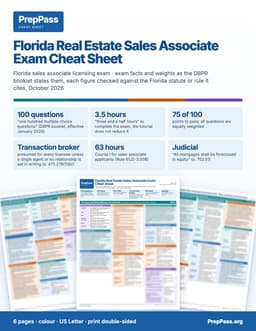
This guide is the teaching, read over weeks. If your exam is inside two weeks, the printable colour cheat sheet is the other product: the figures the exam turns on, laid out by section.
See the Florida Real Estate Sales Associate Exam cheat sheet PDF — $9.99 →
6 pages · US Letter · printable PDF · yours to keep
What's included — and what isn't
Included
- All exam areas at real weight, with FL specifics (Ch. 475, FREC)
- The transaction-broker default (§475.278) + escrow timelines
Not included
- No printed copy is shipped — this is a file you download and can print yourself
- No video course, instructor or tutoring comes with the book — the free videos on the site are separate
Everything included, and everything that isn't
Included
- Homestead (all three senses) + Save Our Homes; construction liens (Ch. 713)
- Worked FL math (doc-stamp on deed+note, intangible tax, prorations, millage)
- In-book practice questions with explanations (400+ more free on the site)
- A key-figures reference (changeable figures flagged verify-current) — PDF + EPUB
Not included
- Not your exam registration or the testing centre's fee, which you still pay to the official body
Contents
See 6 sections and the page each one starts on
- CHAPTER 1 — Real Estate Principles and Property Ownershipp. 9
- CHAPTER 2 — Florida License Law and Brokerage Relationshipsp. 21
- CHAPTER 3 — Real Estate Contracts and Listing Agreementsp. 35
- CHAPTER 4 — Real Estate Finance and Mortgagesp. 46
- CHAPTER 5 — Property Valuation and Appraisalp. 57
- CHAPTER 6 — Real Estate Mathematicsp. 67
Taken from the PDF you download, with the page each one starts on — not typed here.
Read a chapter free, in full
One complete chapter, exactly as it ships in the eBook. Scroll the window to read it right here; no download, no email.
Read chapter 6 here, without leaving the page
Real-estate math is the part most candidates fear — so that's the chapter you can read free: the exam's math patterns, worked step by step. If the teaching works here, it works everywhere.
About 13% of the exam. Math appears throughout the test and in daily practice. This chapter drills the calculations you must own: commissions and splits, seller's net, financing math (down payment, LTV, interest, points), area and land measurement, prorations (365-day and 360-day), and property taxes and percentages. Work every example on paper — the exam rewards doing, not reading.
The rule: convert, then apply the base formula
Almost every problem reduces to part = whole × rate, with the rate in decimal form (move the decimal two places left: 6% → 0.06). Rearranged: whole = part ÷ rate and rate = part ÷ whole. The single most valuable habit is to plug your answer back into the relationship to check it.
Worked example — commission and splits
A home sells for $325,000 at a 6% total commission. The listing and selling brokerages split it 50/50, and the listing agent keeps 60% of the brokerage's share.
- Total commission = 325,000 × 0.06 = $19,500.
- Each brokerage's side = 19,500 × 0.50 = $9,750.
- Listing agent = 9,750 × 0.60 = $5,850; brokerage keeps 9,750 − 5,850 = $3,900.
Work whole → part: total first, then split the sides, then split each side between brokerage and agent.
Worked example — seller's net (working backward)
A seller wants to net $188,000 after a 6% commission and no other costs.
- Price = net ÷ (1 − rate) = 188,000 ÷ (1 − 0.06) = 188,000 ÷ 0.94 = $200,000.
- Check: 200,000 × 0.06 = $12,000 commission; 200,000 − 12,000 = $188,000. ✓
Do not multiply the net by the rate and add it back — that understates the price.
Worked example — down payment, LTV, and points
A buyer purchases a $250,000 home (appraised at value) at 80% LTV with 2 points.
- Loan = 250,000 × 0.80 = $200,000.
- Down payment = 250,000 − 200,000 = $50,000.
- Points = 200,000 × 0.02 = $4,000 (on the loan).
To find LTV from a loan and value: LTV = loan ÷ value. A $180,000 loan on a $240,000 property = 180,000 ÷ 240,000 = 0.75 = 75%.
Worked example — simple interest, annual and monthly
A $200,000 loan at 5% interest, interest-only.
- Annual interest = 200,000 × 0.05 = $10,000.
- Monthly interest = 10,000 ÷ 12 = $833.33.
Interest = principal × rate × time. For part of a year, multiply by the fraction of the year (for example, 90 days ÷ 360, or ÷ 365 if the problem so specifies).
Worked example — area, acres, and the survey system
- A lot 80 ft × 120 ft = 80 × 120 = 9,600 sq ft.
- One acre = 43,560 sq ft. A 21,780 sq ft parcel = 21,780 ÷ 43,560 = 0.5 acre. A 3-acre tract = 3 × 43,560 = 130,680 sq ft.
- Cost estimate: a 2,000 sq ft house at $120/sq ft = 2,000 × 120 = $240,000.
- Government survey: a section = 1 square mile = 640 acres; a quarter-section = 640 ÷ 4 = 160 acres; a quarter of a quarter = 160 ÷ 4 = 40 acres.
- Triangle (corner lot): area = ½ × base × height.
Keep units consistent before multiplying (convert yards/inches to feet first) and label the result.
Worked example — proration on a 365-day year (taxes in arrears)
Annual taxes are $3,650, and the seller owned the property 120 days of the year through the day before closing. Florida taxes are paid in arrears, so the seller credits the buyer.
- Daily rate = 3,650 ÷ 365 = $10.00/day.
- Seller's share = 10.00 × 120 = $1,200, credited to the buyer at closing.
On a 360-day (banker's) year, the daily rate would be 3,650 ÷ 360 = $10.14/day — which is why the problem must state the method. Confirm who is charged for the closing date (contract or custom).
Worked example — property tax by millage
A property has a taxable value of $200,000 and a millage rate of 20 mills (recall 1 mill = $1 per $1,000).
- Tax = (200,000 ÷ 1,000) × 20 = 200 × 20 = $4,000 (equivalently, 200,000 × 0.020 = $4,000).
In Florida, taxable value = assessed value minus exemptions (like homestead); use the figure the problem provides, and remember exemption amounts and caps change — verify current with the county property appraiser.
Worked example — percentage change
A property rose from $250,000 to $280,000.
- Change = 280,000 − 250,000 = $30,000.
- Percent change = change ÷ original = 30,000 ÷ 250,000 = 0.12 = 12% increase.
To recover the original after a known increase: original = new ÷ (1 + rate) = 280,000 ÷ 1.12 = $250,000. Always divide the change by the original, never the new, amount.
The rule: the T-method for any part-whole problem
Many candidates organize percentage problems with a T (or circle): the total on top, the part and the rate on the bottom. Cover the unknown and the T shows the operation: part = total × rate; total = part ÷ rate; rate = part ÷ total. It works for commissions (price, rate, commission), interest (principal, rate, interest), and taxes (value, rate, tax). Label which number is the whole, which is the part, and which is the rate, then read the operation off the T. This single tool converts a large share of the math section into mechanical steps.
Worked example — profit and loss
An investor buys a property for $200,000, spends $30,000 on improvements, and sells for $276,000. What is the percent profit on total cost?
- Total cost = 200,000 + 30,000 = $230,000.
- Profit = 276,000 − 230,000 = $46,000.
- Percent profit = profit ÷ cost = 46,000 ÷ 230,000 = 0.20 = 20%.
Always divide profit by cost (the original investment), not by the sale price.
Worked example — appreciation
A home worth $250,000 appreciates 4% per year. Its value after two years:
- Compounded: Year 1 = 250,000 × 1.04 = $260,000; Year 2 = 260,000 × 1.04 = $270,400.
- Simple (add 4% of the original twice): 250,000 + 2 × (250,000 × 0.04) = 250,000 + 20,000 = $270,000.
Read whether the problem compounds or not — the answers differ.
Worked example — combined Florida transfer taxes
A property sells for $360,000 with a new $288,000 mortgage. Using common rates (deed $0.70/$100, note $0.35/$100, intangible 2 mills — verify current):
- Deed doc stamps: 360,000 ÷ 100 = 3,600 × $0.70 = $2,520.
- Note doc stamps: 288,000 ÷ 100 = 2,880 × $0.35 = $1,008.
- Intangible tax: 288,000 × 0.002 = $576.
- Total = 2,520 + 1,008 + 576 = $4,104.
Keep the bases straight: the deed tax is on the price; the note and intangible taxes are on the loan.
Worked example — prorating rent at closing
A rented property closes on the 20th of a 30-day month; the tenant paid $1,500 for the full month to the seller. The buyer owns from the 20th through the 30th (11 days, if the buyer is charged the closing date).
- Daily rent = 1,500 ÷ 30 = $50.00.
- Buyer's share = 50.00 × 11 = $550, credited to the buyer at closing (the seller collected rent for days the buyer will own).
Confirm the day count and whether the buyer or seller is charged for the closing date; prepaid rent means the seller credits the buyer for the unused days.
Worked example — mortgage payoff with accrued interest
A seller pays off a $120,000 loan balance at closing; interest is 6% and 15 days have accrued since the last payment (30-day-month convention).
- Monthly interest = 120,000 × 0.06 ÷ 12 = $600.
- 15 days = half a month = $300 accrued interest.
- Payoff = principal + accrued interest = 120,000 + 300 = $120,300 (plus any fees).
The payoff exceeds the balance because interest accrues to the payoff date.
Worked example — area of an irregular (L-shaped) lot
A lot is an L shape: a 100 ft × 60 ft rectangle with a 40 ft × 30 ft corner removed.
- Full rectangle = 100 × 60 = 6,000 sq ft.
- Removed corner = 40 × 30 = 1,200 sq ft.
- Area = 6,000 − 1,200 = 4,800 sq ft. In acres: 4,800 ÷ 43,560 = 0.11 acre.
Alternatively, split the L into two rectangles and add them — same result.
Worked example — graduated commission split
An agent is on a 70/30 split up to $50,000 of company-earned commission this year, then 100% after the cap. This deal earns the brokerage $9,000 gross, and the agent has already generated $46,000 toward the cap.
- The agent's 70% applies to the first $4,000 (reaching the $50,000 cap): 4,000 × 0.70 = $2,800.
- The remaining $5,000 is past the cap at 100%: 5,000 × 1.00 = $5,000.
- Agent total from this deal = 2,800 + 5,000 = $7,800.
Split-cap problems apply each rate to the portion in its tier — work in pieces, like a tax bracket.
Worked example — seller net with costs and a loan payoff
A seller wants to net $100,000 cash. They owe $180,000 on their mortgage and will pay a 6% commission and $4,000 in other closing costs. What sale price is needed?
- Required proceeds before commission = net $100,000 + payoff $180,000 + costs $4,000 = $284,000.
- Commission is 6% of price, so price × (1 − 0.06) = 284,000 → price × 0.94 = 284,000.
- Price = 284,000 ÷ 0.94 = $302,127.66, about $302,128.
Build the required proceeds first, then divide by (1 − commission rate). Check: commission ≈ $18,128; price − commission = $284,000; minus loan and costs leaves ≈ $100,000. ✓
Worked example — solving for the interest rate
A borrower pays $9,600 in interest in the first year on a $160,000 interest-only loan. What is the rate?
- Rate = interest ÷ principal = 9,600 ÷ 160,000 = 0.06 = 6%.
Rearranging interest = principal × rate × time lets you solve for any one unknown when you know the other three.
Worked example — square footage and price per square foot
A house has a main floor of 40 ft × 30 ft and a second floor of 40 ft × 20 ft. It is listed at $396,000.
- Main floor = 40 × 30 = 1,200 sq ft.
- Second floor = 40 × 20 = 800 sq ft.
- Total living area = 1,200 + 800 = 2,000 sq ft.
- Price per square foot = 396,000 ÷ 2,000 = $198/sq ft.
To compare with a comparable listed at $210/sq ft, multiply that rate by this home's area: 210 × 2,000 = $420,000 — showing the subject is priced below the comparable per foot. Add multi-level areas before dividing.
Worked example — the seller's net after commission and payoff (quick form)
A property sells for $400,000. The seller pays a 6% commission, owes $220,000 on the mortgage, and pays $3,000 in other costs. What does the seller net?
- Commission = 400,000 × 0.06 = $24,000.
- Seller's proceeds = price − commission − payoff − costs = 400,000 − 24,000 − 220,000 − 3,000 = $153,000.
Work top-down: start with the price, subtract each cost and the loan payoff. (Compare this to the reverse "net-to-price" problem, where you divide the required proceeds by (1 − rate).)
Worked example — capitalization to find value, income, or rate
The income approach's core relationship — Value = Net Operating Income ÷ Capitalization Rate — rearranges three ways:
- Value: NOI $90,000 at an 8% cap rate → 90,000 ÷ 0.08 = $1,125,000.
- NOI: a $1,000,000 property at a 7% cap rate → 1,000,000 × 0.07 = $70,000 of NOI.
- Cap rate: $84,000 NOI on an $1,200,000 property → 84,000 ÷ 1,200,000 = 0.07 = 7%.
Cover the unknown in the IRV triangle (Income on top, Rate and Value on the bottom) and read the operation: I = R × V, V = I ÷ R, R = I ÷ V.
Questions buyers ask
How do I get it?
Pay, and the download appears on this page straight away. The links are also emailed to you. No account is required.
What if it isn't for me?
Email us within 14 days for a full refund, no questions asked.
Is the free practice going away?
No. Every practice question, the timed mock and the free chapters on this site stay free. This book is the studying half, not a gate around the free half.
More questions (15)
Can I read it on my phone?
Yes — the EPUB is for phones and e-readers, the PDF is for printing and tabbing. You get both.
Is a study guide enough for the Florida Real Estate Sales Associate Exam, or do I need a course?
A book is exam review: it does not replace any education, training or experience Florida Department of Business and Professional Regulation (DBPR), for the Florida Real Estate Commission requires before you may sit the exam, so check those requirements first. For the exam content itself, this 87-page guide teaches the material chapter by chapter with 30 practice questions and explanations inside, and 416 more practice questions are free on PrepPass. A prep course adds live instruction and a set schedule; whether you need one beyond any required education is your call.
What is the cheapest way to prepare for the Florida Real Estate Sales Associate Exam?
Start with what costs nothing: 416 practice questions on PrepPass, with explanations and no signup. If you want it taught in one file you keep, the full study guide is $14.99 once; the printable cheat sheet for the last days is $9.99. No subscription on any of them.
Who administers the Florida Real Estate Sales Associate Examination?
Florida Department of Business and Professional Regulation (DBPR), for the Florida Real Estate Commission — exam delivered by Pearson VUE. DBPR has retained Pearson VUE to schedule, administer, score and report the exam, which must be taken in a physical test centre. Before applying, a candidate must complete a FREC-approved 63-hour sales associate pre-licensing course, valid for 2 years; a 45-hour post-licensing course is due before the first license expires.
How many questions are on the Florida Real Estate Sales Associate Examination?
100 questions. One Florida exam, covering 19 content areas of real estate principles, practices, law and mathematics. The booklet says a small number of unidentified pilot questions may be included; they are not scored, extra time is given for them, and no count is published.
How long is the Florida Real Estate Sales Associate Examination?
210 minutes. The booklet states “a total of three and a half hours”. Candidates should arrive 30 minutes early; the on-screen tutorial may take up to 15 minutes before the exam starts.
What is the passing score for the Florida Real Estate Sales Associate Examination?
75 of 100 correct. DBPR's wording: the exam is “graded based on 100 points for a perfect examination” and “a grade of 75 points or higher” passes; all questions are equally weighted. Results are given at the test centre. A failing candidate may request a review of the questions answered incorrectly within 21 days; Pearson VUE requires an override to book a retake within 21 days of a review.
How much does the Florida Real Estate Sales Associate Examination cost?
$57.75 — Sales associate examination administration fee (Pearson VUE, per attempt); $35 — Exam review after a fail (optional) (Pearson VUE, per attempt). DBPR's fee table sets administration fees effective January 3, 2023, and the exam fee is paid to the testing vendor separately from the DBPR application fee. The application fee is not shown here: the only DBPR document stating it is an application form dated June 2015.
What languages is the Florida Real Estate Sales Associate Examination offered in?
English · Spanish. DBPR: examinations it develops are available in English and Spanish at no extra cost; Spanish is requested when booking with Pearson VUE. Word-for-word translation dictionaries are permitted after inspection.
Does the Florida Real Estate Sales Associate Exam study guide come as a PDF?
Yes — Florida Real Estate Sales Associate Exam — Complete Study Guide (2026) downloads as PDF and EPUB, 87 pages. The download link is emailed the moment payment clears and does not expire.
How much does the Florida Real Estate Sales Associate Exam study guide cost?
$14.99, once. There is no subscription and no account to create; the PDF and EPUB files are yours to keep.
Are there free Florida Real Estate Sales Associate Exam practice questions?
Yes — 416 of them, free to use with no signup and an explanation on every one. They are separate from this study guide, which is what you are buying here. The same free, no-account system also has practice modes (adaptive, new questions, spaced review of misses, weak-topic focus, saved, my mistakes); a timed mock exam (100 questions, 210 minutes) with a score report by topic; a 10-question readiness check (about 5 minutes); 6 study chapters; a day-by-day study plan. None of it needs this study guide.
Can I read part of the Florida Real Estate Sales Associate Exam study guide before buying?
Yes. A full chapter is free to read on this page — not a summary of one, the chapter itself.
What is the difference between the Florida Real Estate Sales Associate Exam study guide and the cheat sheet?
The study guide ($14.99) teaches the material chapter by chapter and is meant to be read over weeks. The cheat sheet ($9.99, 6 pages) drops the teaching and keeps the figures: every number on the exam grouped by value so the confusable ones sit together, each reference page paired with a recall page that blanks the answers, and four routes by days left — 14, 7, 3, or tonight. They are separate purchases; neither replaces the other.
Is this the official Florida Real Estate Sales Associate Exam study guide?
No. This is an independent study guide and is not affiliated with or endorsed by the exam's awarding body. It is written from Florida Statutes Chapter 475 + FREC rules. Always confirm current requirements with the body that issues your licence.
Why buy the book when the practice is free?
Our practice questions and timed mock stay free — nothing on the site moves behind this book. The $14.99 book is the studying half: the material itself, taught in order, in a file you own.
- Systematic teaching — every exam section explained chapter by chapter, start to finish, not just questions
- Print it & tab it — a paper-ready PDF you can highlight, mark up, and bring to your study table
- Study anywhere, offline — EPUB on your phone or e-reader; no wifi, no browser tabs
- Everything in one place — the chapters and the practice questions in one file
- Yours for life — one-time $14.99, instant download, no subscription
The details
- Verified from the official source(Florida Statutes Chapter 475 + FREC rules)
- 416 free practice questions
An FL 63-hour pre-license course runs $100–$400. This book teaches the same exam — same rules, verified to current standards — for a one-time $14.99 you keep for life.
Also free on PrepPass for Florida Real Estate Sales Associate Exam
Beside this guide, PrepPass has a free study system for the same exam. It needs no account, and buying the guide does not unlock or change it: 416 practice questions with explanations; practice modes (adaptive, new questions, spaced review of misses, weak-topic focus, saved, my mistakes); a timed mock exam (100 questions, 210 minutes) with a score report by topic; a 10-question readiness check (about 5 minutes); 6 study chapters; a day-by-day study plan.
Progress is saved in your browser; a free account keeps it across devices. The readiness gauge reflects your own practice, not a prediction of the real exam result. How the practice works
One-time purchase, lifetime access to the download. The eBook is the full Florida Real Estate Sales Associate Exam study guide in PDF and EPUB. Educational summary, not professional or legal advice — always confirm the current rules with the official source.