Study guide · 2026 Edition
Series 6 — Funds & Variable Contracts Study Guide (2026)
PrepPass's independent 2026 study guide for the Series 6 exam is 788 pages (287 teaching + question bank) with 1,096 practice questions and a full answer key, PDF + EPUB, $24.99 one-time; it is not affiliated with the exam provider. The book does not include PrepPass's separate online timed mock for this exam (50 questions, 90 minutes).
- Length
- 788 pages (287 teaching + question bank)
- Practice questions in the book
- 1,096
- PrepPass online timed mock
- 50 questions · 90 min
- Exam facts checked, file updated
- October 2026
- Delivery
- PDF + EPUB · English · instant download
Please read before you buy: This is an independent study aid, not affiliated with or endorsed by FINRA, the SEC, MSRB, or any test-delivery vendor (including Prometric).
Read the rest of this notice
Securities rules change and many dollar figures (contribution limits, phase-outs) are indexed or were recently updated; every rule and figure here is written to the current level, but confirm the current-year figures before you rely on any of them.
What is in the Series 6 study guide?
The real exam: Investment Company and Variable Contracts Products Representative Qualification Examination (Series 6) — 55 questions (50 scored, 5 unscored pretest) · 90 minutes · Passing score: Not published by FINRA (scale range).
Seventeen chapters written to FINRA's Series 6 content outline: mutual funds, variable annuities and life, 529s and the 1940 Act, with the pricing and suitability math worked step by step.
Exam fee: $100 per attempt, paid to FINRA. A retake pays it again. This guide: $24.99, one time.
Exam facts, who it suits and what changed
About the exam itself
| Administering body | Financial Industry Regulatory Authority (FINRA) Source: FINRA — Series 6 – Investment Company and Variable Contracts Products Representative Exam (IR) |
|---|---|
| Questions | 55 questions (50 scored, 5 unscored pretest) |
| Time limit | 90 minutes |
| Passing score | Not published by FINRA (scale range) What we read and found nothing in: FINRA — Series 6 – Investment Company and Variable Contracts Products Representative Exam (IR) |
| Fees |
Source: FINRA — Series 6 – Investment Company and Variable Contracts Products Representative Exam (IR) |
| Languages offered | Not published by FINRA What we read and found nothing in: FINRA — Series 6 – Investment Company and Variable Contracts Products Representative Exam (IR) |
Look inside the book
Three real pages, rendered straight from the PDF you download — a reference page, a teaching page, and a worked question, always in that order. Nothing here was redrawn to look better.
- Quick referenceAppendix — Question Bank 1,096 practice questions with answers and explanations · PDF page 722
A page you can turn back to: the numbers, deadlines or terms gathered in one place.
- How it's taughtAppendix — Question Bank 1,096 practice questions with answers and explanations · PDF page 731
An explanation page: the material taught in prose, in the order the exam tests it.
- A question, workedChapter 1 — Bringing Securities to Market: Registration, Prospectuses and Exemptions · PDF page 22
A practice question with its answer and the reasoning behind it — not just a key.
Exam inside two weeks?
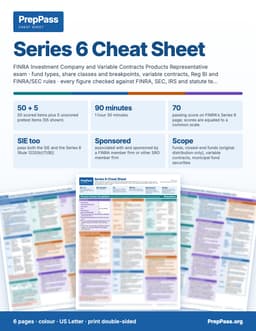
This guide is the teaching, read over weeks. If your exam is inside two weeks, the printable colour cheat sheet is the other product: the figures the exam turns on, laid out by section.
See the Series 6 cheat sheet PDF — $9.99 →
6 pages · US Letter · printable PDF · yours to keep
What's included — and what isn't
Included
- Seventeen chapters organised by topic, from new issues and communications to complaints and arbitration, with a table mapping them to FINRA's outline
- Every chapter closes with a key-facts box and a named exam-traps list
Not included
- No printed copy is shipped — this is a file you download and can print yourself
- No video course, instructor or tutoring comes with the book — the free videos on the site are separate
Everything included, and everything that isn't
Included
- Mutual-fund pricing worked step by step: NAV, public offering price, sales charges, breakpoints, letters of intent and rights of accumulation
- Variable annuities and variable life: the separate account, accumulation and annuity units, the assumed interest rate and 1035 exchanges
- Dated 2026 changes called out: the $300 gift limit, the new intraday margin standards, the ABLE account limit, FINRA Rule 3290
- 287 pages of teaching, then a question bank of 1096 practice questions, grouped by topic, with answers and explanations
- PDF (print & tab it) + EPUB (phone / e-reader)
Not included
- Not your exam registration or the testing centre's fee, which you still pay to the official body
Contents
See 19 sections and the page each one starts on
- Chapter 1 — Bringing Securities to Market: Registration, Prospectuses and Exemptionsp. 11
- Chapter 2 — Communications with the Public: Advertising, Sales Literature, Seminars and Giftsp. 26
- Chapter 3 — The Investment Company Act of 1940: How a Fund Is Built and Policedp. 42
- Chapter 4 — Mutual Funds: Types, Structure, Objectives and Feesp. 58
- Chapter 5 — NAV, Offering Price and Sales Charges: Pricing and Breakpoint Mathp. 73
- Chapter 6 — Redemption, Exchanges, Withdrawal Plans, and How Funds and Shareholders Are Taxedp. 86
- Chapter 7 — Closed-End Funds, Unit Investment Trusts, ETFs, Other Packaged Products and Government Poolsp. 101
- Chapter 8 — Variable Annuitiesp. 116
- Chapter 9 — Variable Life Insurancep. 132
- Chapter 10 — Municipal Fund Securities, 529 Plans and ABLE Accountsp. 140
- Chapter 11 — Retirement Plans, Employer Plans, ERISA, Wealth Events, and Gift and Estate Taxp. 154
- Chapter 12 — Opening Accounts, Authorizations, Privacy and Supervisionp. 172
- Part 1. Privacy notices and opt-out (17 CFR 248.4 to 248.15):p. 189
- Chapter 13 — Suitability, Regulation Best Interest and Portfolio Analysisp. 195
- Chapter 14 — Securities Products, Tax Rules and Financial Statementsp. 221
- Chapter 15 — Records, Confirmations, Statements and Account Transfersp. 244
- Chapter 16 — Orders, Execution, Settlement and Marginp. 259
- Chapter 17 — Errors, Complaints, Arbitration and the Regulatory Processp. 277
- Appendix — Question Bank 1,096 practice questions with answers and explanationsp. 288
Taken from the PDF you download, with the page each one starts on — not typed here.
Read a chapter free, in full
One complete chapter, exactly as it ships in the eBook. Scroll the window to read it right here; no download, no email.
Read chapter 14 here, without leaving the page
We didn't give you the easy intro — the free chapter opens on one of the hardest-working parts of the book, so you can judge the teaching where the exam gets difficult.
The Series 6 outline lists equities, debt, options, Treasuries, agency securities and money market instruments under the product knowledge section, and it lists the tax and financial statement topics beside them. A representative who cannot explain these cannot make a suitable recommendation, so this chapter works through each product, then the tax rules that apply to gains and losses, then the financial statements.
14.1 Equity securities
Common stock
Common stock is ownership. Holders have residual claims on assets and earnings, voting rights (statutory or cumulative), preemptive rights if the charter grants them, the right to inspect the books, and a share of dividends if declared. They are paid last in a liquidation, after creditors and preferred holders. Dividends are not guaranteed; the board declares them.
| Term | Meaning |
|---|---|
| Authorized, issued, outstanding, treasury | Authorized is the maximum the charter allows; issued has been sold; outstanding = issued less treasury; treasury stock is repurchased stock that does not vote or receive dividends |
| Statutory voting | One vote per share per director seat, no cumulating |
| Cumulative voting | Shares x number of seats can be put all on one candidate, helping minority holders |
| Stock split | More shares, lower price; no change in total value or the company's equity |
| Reverse split | Fewer shares, higher price |
| Stock dividend | Additional shares paid to holders; same total value |
Example 1. Splits. A holder owns 300 shares at $90 ($27,000). In a 3-for-2 split the holder has 300 x 3/2 = 450 shares at $90 x 2/3 = $60 ($27,000). In a 1-for-5 reverse split the holder has 300 / 5 = 60 shares at $90 x 5 = $450 ($27,000).
Example 2. Dividend yield and the ex-date. A stock pays $0.60 each quarter and trades at $48. Annual dividend $2.40; yield = 2.40 / 48 = 5.0%. Under Rule 11140, the stock goes ex-dividend on the record date under the T+1 settlement cycle (for ordinary dividends below 25% of the stock's value); a buyer who purchases on or after the ex-date does not receive the dividend. Chapter 16 covers the dividend calendar.
Preferred stock
Preferred has a fixed dividend, ranks ahead of common in dividends and liquidation, usually has no vote, and trades mainly on yield and the issuer's credit.
| Type | Feature |
|---|---|
| Cumulative | Missed dividends accumulate as "arrears" and must be paid before any common dividend |
| Non-cumulative | Missed dividends are lost |
| Participating | Shares in extra earnings beyond the stated dividend |
| Convertible | Convertible into common at a set ratio |
| Callable | The issuer can redeem, usually at a premium |
| Putable | The holder can force redemption |
| Adjustable-rate | Dividend resets with a reference rate |
Preferred prices move opposite to interest rates, as bond prices do. The par value is typically $25 or $100.
Example 3. Preferred yield. A $100 par, 5% preferred pays $5 a year. At a market price of $80, current yield = 5 / 80 = 6.25%. If the price rises to $100, the yield is 5.00%.
Example 4. Convertible parity. A convertible bond with $1,000 par is convertible at $40 a share: conversion ratio = $1,000 / $40 = 25 shares. If the stock trades at $45, parity (conversion value) = 25 x $45 = $1,125. The bond will trade at or above parity. If the bond trades at $1,150 the premium over parity is $25.
ADRs, rights and warrants
- American depositary receipts (ADRs) are receipts issued by a US depositary bank for shares of a foreign company held by a custodian abroad. They trade in dollars, pay dividends in dollars, and carry currency risk and foreign-market risk. Sponsored ADRs involve the issuer; unsponsored do not. Foreign withholding tax may apply on dividends.
- Rights are short-term (usually 30 to 60 days) offers to existing holders to buy new shares at a subscription price below market, in proportion to existing holdings, protecting preemptive rights. They are issued on a rights offering.
- Warrants are long-term (years, sometimes perpetual) options to buy stock at a fixed price above the market price at issue. They are often attached to a bond or preferred issue as a "sweetener".
Example 5. Value of a right. The stock trades at $50 cum-rights. The subscription price is $40, and 4 rights plus $40 buy one share. Value of a right while the stock still carries the right = (50 - 40) / (4 + 1) = $2.00. After the stock goes ex-rights, it should trade near $48. Then the value of one right = (48 - 40) / 4 = $2.00. The holder who sells the rights gets the same economic value as exercising them.
14.2 Debt securities
A bond is a loan. The issuer promises to pay interest (the coupon) and return the principal (par, face) at maturity. Bonds are quoted as a percentage of par, so a quote of 98 is $980 per $1,000 bond.
| Term | Meaning |
|---|---|
| Coupon rate | Annual interest as a percentage of par |
| Current yield | Annual interest / current market price |
| Yield to maturity (YTM) | The annual return if held to maturity, including the gain or loss against par and reinvestment of coupons at the same rate |
| Yield to call (YTC) | The same, assuming the bond is called on the first call date |
| Nominal yield | Coupon yield |
| Discount / par / premium | Price below / equal / above par |
The relationships to memorize:
- Price and yield move in opposite directions.
- Premium bond: coupon rate > current yield > YTM (and YTC lower still if the call price is below the bond's price).
- Discount bond: coupon rate < current yield < YTM.
- Par bond: coupon = current yield = YTM.
- Longer maturity and lower coupon mean more price sensitivity (greater duration) for a given rate change.
- Callable bonds: the investor is hurt when rates fall because the bond is called at a time of lower rates (call risk and reinvestment risk), so callable bonds pay more.
- Basis point: 0.01%. A move of 50 basis points is 0.50%.
Example 6. Current yield and yield to maturity. A 6% coupon, 10-year bond with $1,000 par trades at 95 ($950).
- Annual interest = 6% x $1,000 = $60.
- Current yield = 60 / 950 = 6.32%.
- Approximate YTM = (60 + (1,000 - 950) / 10) / ((1,000 + 950) / 2) = (60 + 5) / 975 = 6.67%. The exact YTM, solved by present value, is 6.70%. The exam asks for the order (coupon 6.00% < current yield 6.32% < YTM 6.70%), not for the exact solve.
Example 7. Accrued interest. The bond above is a corporate bond with a 6% coupon paid January 1 and July 1, and the trade settles April 15. Corporate and municipal bonds count interest on a 30/360 basis (30-day months, 360-day year): January 1 to April 15 is 3 x 30 + 14 = 104 days. Accrued interest = $1,000 x 0.06 x 104 / 360 = $17.33 per bond. The buyer pays the price plus accrued interest, and receives the full coupon on July 1. Treasury notes and bonds use actual days/actual days. A bond that trades "flat" (bonds in default, income bonds) has no accrued interest added.
Types of corporate bonds.
| Type | Feature |
|---|---|
| Secured / mortgage / equipment trust | Backed by specific assets |
| Debenture | Unsecured; backed by the issuer's credit |
| Subordinated debenture | Ranks below other debt |
| Convertible | Convertible to stock |
| Zero-coupon | Sold at a deep discount; no interest paid; accretion is taxable each year as phantom income |
| Income / adjustment bond | Pays interest only if earned |
| Floating rate | Coupon resets |
| Callable / puttable / extendable | Call and put features |
| High yield ("junk") | Rated below BBB-/Baa3 |
| Investment grade | BBB-/Baa3 and above |
Seniority in liquidation: secured creditors, then unsecured creditors (debentures), then subordinated debt, then preferred stock, then common stock. Bondholders are creditors, with a claim in bankruptcy, while stockholders are owners.
Municipal bonds were covered in Chapter 1 (official statements, and the issuance process) and Chapter 10 (municipal fund securities). The key tax point: interest on most municipal bonds is exempt from federal income tax and, if the investor lives in the issuing state, from state tax. General obligation (GO) bonds are backed by taxing power; revenue bonds by the revenue of the project. Municipal bond interest is tax-exempt, but a gain on sale is taxable as a capital gain.
Bond ratings. Moody's Aaa/Aa/A/Baa are investment grade; Ba and below are speculative. S&P and Fitch use AAA/AA/A/BBB. A rating change moves price.
14.3 Options
An option is a contract giving the holder the right, but not the obligation, to buy (call) or sell (put) the underlying at the strike price until expiration. A standard equity option covers 100 shares. Standardized listed options are issued and guaranteed by the Options Clearing Corporation (OCC). The buyer pays a premium to the seller (writer).
| Position | Market view | Maximum gain | Maximum loss | Breakeven |
|---|---|---|---|---|
| Long call | Bullish | Unlimited | Premium paid | Strike + premium |
| Short (naked) call | Neutral to bearish | Premium received | Unlimited | Strike + premium |
| Long put | Bearish | Strike - premium (stock goes to zero) | Premium paid | Strike - premium |
| Short put | Neutral to bullish | Premium received | Strike - premium | Strike - premium |
In, at and out of the money. A call is in the money if the stock is above the strike; a put is in the money if the stock is below the strike. Intrinsic value = the amount in the money (zero if not). Time value (extrinsic value) = premium - intrinsic value; it goes to zero at expiration.
Example 8. Long call. A customer buys 2 contracts of an XYZ 50 call at 3.00.
- Cost = 2 x 100 x $3 = $600; this is the maximum loss.
- Breakeven = $50 + $3 = $53.
- If XYZ is $58 at expiration the intrinsic value is $8, so the profit is (8 - 3) x 200 = $1,000.
- If XYZ is $50 or lower at expiration the options expire worthless and the loss is $600.
Example 9. Long put. Buy a 50 put at 3.00. Breakeven = 50 - 3 = $47. The maximum gain (stock to zero) = (50 - 3) x 100 = $4,700 per contract; the maximum loss is $300.
Hedging and income strategies.
| Strategy | Construction | Purpose | Result |
|---|---|---|---|
| Covered call | Own the stock, sell a call | Income; limits upside | Breakeven = stock cost - premium; gain capped at strike + premium - cost |
| Protective put | Own the stock, buy a put | Insurance for a long position | Loss limited to cost + premium - strike; breakeven = stock cost + premium |
| Married put | Buy stock and put together | Same | Same |
| Collar | Own the stock, buy a put, sell a call | Protect downside, give up upside; may be low-cost | |
| Long straddle | Buy call and put, same strike and expiry | Profits from a big move either way | Two breakevens: strike plus total premium and strike minus total premium |
| Spread | Buy and sell options of the same type | Defined risk and reward |
Example 10. Covered call. An investor buys 100 XYZ at $48 and sells a 50 call for $2.
- Breakeven = 48 - 2 = $46.
- Maximum gain = (50 + 2 - 48) x 100 = $400 (if the stock is called away at 50).
- Maximum loss = (48 - 2) x 100 = $4,600 if the stock goes to zero.
Example 11. Straddle. Buy a 50 call at 3 and a 50 put at 2. Total premium $5. Breakevens: 50 + 5 = $55 and 50 - 5 = $45. The maximum loss is $500, at a stock price of exactly $50 at expiration.
Example 12. Bull call spread. Buy a 50 call at 5, sell a 60 call at 2. Net debit $3. Maximum loss = $300; maximum gain = (10 - 3) x 100 = $700; breakeven = 50 + 3 = $53. A debit spread has a maximum loss equal to the net debit.
Other rules. Options accounts require approval and the Options Disclosure Document, and approval by a Registered Options Principal or another principal the rule permits (Rule 2360(b)(16)); a suitability standard applies to each level. Exercise of a stock option settles in the standard stock cycle, which is one business day after exercise (OCC T+1 conversion, effective 2024-05-28). Index options settle in cash. LEAPS are long-dated options. Margin on options is in Chapter 16.
Questions buyers ask
How do I get it?
Pay, and the download appears on this page straight away. The links are also emailed to you. No account is required.
What if it isn't for me?
Email us within 14 days for a full refund, no questions asked.
Is the free practice going away?
No. Every practice question, the timed mock and the free chapters on this site stay free. This book is the studying half, not a gate around the free half.
More questions (16)
Can I read it on my phone?
Yes — the EPUB is for phones and e-readers, the PDF is for printing and tabbing. You get both.
Is a study guide enough for the Series 6 exam, or do I need a course?
A book is exam review: it does not replace any education, training or experience Financial Industry Regulatory Authority (FINRA) requires before you may sit the exam, so check those requirements first. For the exam content itself, this guide teaches the material chapter by chapter in 287 pages, then prints 1,096 practice questions with answers and explanations, grouped by topic. A prep course adds live instruction and a set schedule; whether you need one beyond any required education is your call.
What is the cheapest way to prepare for the Series 6 exam?
Start with what costs nothing: 1,096 practice questions on PrepPass, with explanations and no signup. If you want it taught in one file you keep, the full study guide is $24.99 once; the printable cheat sheet for the last days is $9.99. No subscription on any of them.
Who administers the Investment Company and Variable Contracts Products Representative Qualification Examination (Series 6)?
Financial Industry Regulatory Authority (FINRA). The SIE exam is a corequisite: candidates must pass both the SIE and the Series 6 to obtain the Investment Company and Variable Contracts Products registration.
How many questions are on the Investment Company and Variable Contracts Products Representative Qualification Examination (Series 6)?
55 questions (50 scored, 5 unscored pretest). FINRA allocates the 50 scored items across four job functions: 12, 8, 25 and 5 (Function 3, information and recommendations, is 25).
How long is the Investment Company and Variable Contracts Products Representative Qualification Examination (Series 6)?
90 minutes
What is the passing score for the Investment Company and Variable Contracts Products Representative Qualification Examination (Series 6)?
Not published by FINRA (scale range). FINRA's Series 6 page lists "Passing Score 70", and the content outline says scores are equated onto a common scale; neither states that scale's range, so PrepPass does not render 70 as a percentage.
How much does the Investment Company and Variable Contracts Products Representative Qualification Examination (Series 6) cost?
$100 — Exam fee (FINRA, per attempt)
What languages is the Investment Company and Variable Contracts Products Representative Qualification Examination (Series 6) offered in?
Not published by FINRA. FINRA's exam page, content outline and Limited English Proficiency page name no exam language; the only language provision is extra time for eligible candidates whose primary language is not English.
Does the Series 6 study guide come as a PDF?
Yes — Series 6 — Funds & Variable Contracts Study Guide (2026) downloads as PDF and EPUB, 788 pages in all: 287 pages of teaching plus 1,096 practice questions with answers and explanations. The download link is emailed the moment payment clears and does not expire.
How much does the Series 6 study guide cost?
$24.99, once. There is no subscription and no account to create; the PDF and EPUB files are yours to keep.
Are there free Series 6 practice questions?
Yes — 1,096 of them, free to use with no signup and an explanation on every one. This study guide has 1,096 practice questions with answers and explanations. The same free, no-account system also has practice modes (adaptive, new questions, spaced review of misses, weak-topic focus, saved, my mistakes); a timed mock exam (50 questions, 90 minutes) with a score report by topic; a 10-question readiness check (about 5 minutes); 4 study chapters. None of it needs this study guide.
Can I read part of the Series 6 study guide before buying?
Yes. A full chapter is free to read on this page — not a summary of one, the chapter itself.
What is the difference between the Series 6 study guide and the cheat sheet?
The study guide ($24.99) teaches the material chapter by chapter and is meant to be read over weeks. The cheat sheet ($9.99, 6 pages) drops the teaching and keeps the figures: every number on the exam grouped by value so the confusable ones sit together, each reference page paired with a recall page that blanks the answers, and four routes by days left — 14, 7, 3, or tonight. They are separate purchases; neither replaces the other.
Is there a cheaper way to buy the Series 6 study guide with anything else?
Yes. FINRA SIE + Series 6 is $34.99 for 4 files in one checkout — 49% less than the $69.96 those items cost bought separately today. It adds SIE — Securities Industry Essentials Study Guide (2026), FINRA SIE — Cheat Sheet (2026), Series 6 — Cheat Sheet (2026). The saving is measured against the items' real current prices; there is no struck-through "original" price on this site.
Is this the official Series 6 study guide?
No. This is an independent study guide and is not affiliated with or endorsed by the exam's awarding body. It is written from FINRA content outline / SEC rules / Investment Company Act of 1940. Always confirm current requirements with the body that issues your licence.
Why buy the book when the practice is free?
Our practice questions and timed mock stay free — nothing on the site moves behind this book. The $24.99 book is the studying half: the material itself, taught in order, in a file you own.
- Systematic teaching — every exam section explained chapter by chapter, start to finish, not just questions
- Print it & tab it — a paper-ready PDF you can highlight, mark up, and bring to your study table
- Study anywhere, offline — EPUB on your phone or e-reader; no wifi, no browser tabs
- Everything in one place — the chapters and the practice questions in one file
- Yours for life — one-time $24.99, instant download, no subscription
The details
- Verified from the official source(FINRA content outline / SEC rules / Investment Company Act of 1940)
- 1,096 free practice questions
A Series 6 exam prep course runs $150–$500. This book teaches the same exam — same rules, verified to current standards — for a one-time $24.99 you keep for life.
Also free on PrepPass for Series 6
Beside this guide, PrepPass has a free study system for the same exam. It needs no account, and buying the guide does not unlock or change it: 1,096 practice questions with explanations; practice modes (adaptive, new questions, spaced review of misses, weak-topic focus, saved, my mistakes); a timed mock exam (50 questions, 90 minutes) with a score report by topic; a 10-question readiness check (about 5 minutes); 4 study chapters.
Progress is saved in your browser; a free account keeps it across devices. The readiness gauge reflects your own practice, not a prediction of the real exam result. How the practice works
One-time purchase, lifetime access to the download. The eBook is the full Series 6 study guide in PDF and EPUB. Educational summary, not professional or legal advice — always confirm the current rules with the official source. Last updated: October 2026.