Study guide · 2026 Edition
Sterile Processing Technician (CRCST) — Complete Study Guide (2026)
PrepPass's independent 2026 study guide for the Sterile Processing Technician exam is 368 pages including 470 practice questions with a full answer key, PDF + EPUB, $14.99 one-time; it is not affiliated with the exam provider. The book does not include PrepPass's separate online timed mock for this exam (150 questions, 180 minutes). The book also prints its own practice exam, which is separate.
- Length
- 368 pages
- Practice questions in the book
- 470
- PrepPass online timed mock
- 150 questions · 180 min
- Exam facts last checked
- September 2026
- File last updated
- October 2026
- Delivery
- PDF + EPUB · English · instant download
What is in the Sterile Processing Technician (CRCST) study guide?
Exam facts last checked September 2026 against the exam body's published sources. Inside: a memorise-cold numbers box, a named-traps list and a worked scenario closing every one of the seven chapters; a full practice exam at the back, weighted to the seven areas, with the reasoning behind every answer.
The real exam: Certified Registered Central Service Technician (CRCST) Examination — 150 questions (125 scored, 25 unscored pretest) · 180 minutes · Passing score: Not published by HSPA.
The central-service / SPD certification — one chapter per HSPA content area: departmental considerations; decontamination; preparation & packaging; sterilization; sterile storage & transport; patient care equipment; professional practice.
CRCST examination: $140 per attempt, paid to HSPA. A retake pays it again. This guide: $14.99, one time.
Exam facts, who it suits and what changed
To prepare for the Sterile Processing Technician (CRCST) exam, start with what the exam body publishes: CRCST Exam Content Outline from Healthcare Sterile Processing Association (HSPA) — the official outline of the exam's content areas, free (PDF). That is enough if you only need to see what the exam covers; this book is for learning it and practising it. The exam itself (Certified Registered Central Service Technician (CRCST) Examination): 150 questions (125 scored, 25 unscored pretest), 180 minutes, passing score not published by HSPA. Choose this book if you want a short review of each content area with a practice exam before you sit the test.
About the exam itself
| Administering body | Healthcare Sterile Processing Association (HSPA), formerly IAHCSMM — exam delivered by Prometric Source: HSPA — Certification Handbook (PDF, revised January 2026) |
|---|---|
| Questions | 150 questions (125 scored, 25 unscored pretest) Source: HSPA — Certification Handbook (PDF, revised January 2026) |
| Time limit | 180 minutes Source: HSPA — Certification Handbook (PDF, revised January 2026) |
| Passing score | Not published by HSPA What we read and found nothing in: HSPA — Certification Handbook (PDF, revised January 2026) |
| Fees |
Source: HSPA — Certification Handbook (PDF, revised January 2026) |
| Languages offered | English Source: HSPA — Certification Handbook (PDF, revised January 2026) |
Look inside the book
Three real pages, rendered straight from the PDF you download — a reference page, a teaching page, and a worked question, always in that order. Nothing here was redrawn to look better.
- Quick referenceAppendix B — The One-Page Cram Sheet · PDF page 136
A page you can turn back to: the numbers, deadlines or terms gathered in one place.
- How it's taughtChapter 3 — Preparation and Packaging · PDF page 47
An explanation page: the material taught in prose, in the order the exam tests it.
- How it's taughtChapter 3 — Preparation and Packaging · PDF page 52
An explanation page: the material taught in prose, in the order the exam tests it.
Exam inside two weeks?
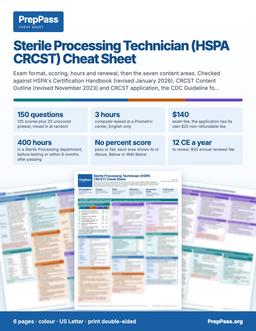
This guide is the teaching, read over weeks. If your exam is inside two weeks, the printable colour cheat sheet is the other product: the figures the exam turns on, laid out by section.
See the Sterile Processing Technician cheat sheet PDF — $9.99 →
6 pages · US Letter · printable PDF · yours to keep
How this book compares
HSPA publishes the CRCST exam content outline for free and names its Sterile Processing Technical Manual as the reference for the current exam. This book is a shorter review with a practice exam, to use alongside the manual or your work experience.
| Resource | Price | What you get | Choose it if |
|---|---|---|---|
| This bookSterile Processing Technician (CRCST) — Complete Study Guide (2026)PrepPass | $14.99 | Downloadable review for the CRCST exam
| Choose this book if you want a short review of each content area with a practice exam before you sit the test. |
| From the exam bodyCRCST Exam Content Outline (opens the publisher's page in a new tab)Healthcare Sterile Processing Association (HSPA) | Free (PDF) | The official outline of the exam's content areas | Read it in any case to check every content area. |
| From the exam bodySterile Processing Technical Manual, 9th Edition (opens the publisher's page in a new tab)Healthcare Sterile Processing Association (HSPA) | Textbook $90 ($80 members); eBook $79 ($69 members); workbook and boxed course sold separately | HSPA's textbook, named as a reference for the current exam
| Choose the manual if you want the full reference text HSPA points candidates to. |
This book
Sterile Processing Technician (CRCST) — Complete Study Guide (2026)
PrepPass
- Price
- $14.99
- What you get
Downloadable review for the CRCST exam
- 470 practice questions with explanations
- 368 pages, PDF + EPUB
- Choose it if
- Choose this book if you want a short review of each content area with a practice exam before you sit the test.
From the exam body
CRCST Exam Content Outline (opens the publisher's page in a new tab)
Healthcare Sterile Processing Association (HSPA)
- Price
- Free (PDF)
- What you get
The official outline of the exam's content areas
- Choose it if
- Read it in any case to check every content area.
From the exam body
Sterile Processing Technical Manual, 9th Edition (opens the publisher's page in a new tab)
Healthcare Sterile Processing Association (HSPA)
- Price
- Textbook $90 ($80 members); eBook $79 ($69 members); workbook and boxed course sold separately
- What you get
HSPA's textbook, named as a reference for the current exam
- More than 300 color photographs and charts
- Choose it if
- Choose the manual if you want the full reference text HSPA points candidates to.
Other resources' prices and contents are as listed on each publisher's or seller's own page, checked September 24, 2026. Prices change; confirm on the linked page before you buy. This book's price and contents come from our own catalog.
Sources (2)
- https://myhspa.org/certification/certification-overview/certified-registered-central-service-technician-crcst/ — read September 24, 2026
- https://myhspa.org/education/publications/sterile-processing-technical-manual/ — read September 24, 2026
What's included — and what isn't
Included
- One chapter per HSPA content area — all seven, including departmental considerations and patient care equipment
- Sterilization methods & parameters (steam, dry heat, EO, H2O2, ozone)
Not included
- No printed copy is shipped — this is a file you download and can print yourself
- No video course, instructor or tutoring comes with the book — the free videos on the site are separate
Everything included, and everything that isn't
Included
- Decontamination, cleaning, and the Spaulding classification
- Monitoring & QA: biological/chemical indicators, Bowie-Dick, load release
- Sterile storage, transport, inventory, and distribution
- A 70-question practice exam weighted to the seven areas, with a written explanation for every answer
- A question bank of 400 practice questions, grouped by topic, with answers and explanations
- An appendix naming every exam figure this book will not state, and where HSPA publishes it
- PDF (print & tab it) + EPUB (phone / e-reader)
Not included
- Not your exam registration or the testing centre's fee, which you still pay to the official body
Contents
See 19 sections and the page each one starts on
- Chapter 1 — Departmental Considerations HSPA Section 1 — published weight 15%.p. 11
- Chapter 2 — Cleaning, Decontamination and Disinfectionp. 25
- Chapter 3 — Preparation and Packagingp. 40
- Chapter 4 — Sterilization Processp. 54
- Chapter 5 — Sterile Storage, Transport and Inventory Managementp. 69
- Chapter 6 — Patient Care Equipment and Distribution HSPA Section 6 — published weight 5%.p. 77
- Chapter 7 — Professional Development and Human Relation Skillsp. 84
- Practice Exam — 70 Questionsp. 92
- Answer Key with Explanationsp. 113
- Appendix A — HSPA’s Seven Sections, and Where Each Topic Is Taught Herep. 129
- Section 1 — Departmental Considerations (15%)p. 129
- Section 2 — Cleaning, Decontamination and Disinfection (21%)p. 129
- Section 3 — Preparation and Packaging (21%)p. 130
- Section 4 — Sterilization Process (21%)p. 131
- Section 5 — Sterile Storage, Transport and Inventory Management (9%)p. 133
- Section 6 — Patient Care Equipment and Distribution (5%)p. 133
- Section 7 — Professional Development and Human Relation Skills (8%)p. 134
- Appendix B — The One-Page Cram Sheetp. 136
- Appendix — Question Bank 400 practice questions with answers and explanationsp. 141
Taken from the PDF you download, with the page each one starts on — not typed here.
Read a chapter free, in full
One complete chapter, exactly as it ships in the eBook. Scroll the window to read it right here; no download, no email.
Read chapter 6 here, without leaving the page
We didn't give you the easy intro — the free chapter opens on one of the hardest-working parts of the book, so you can judge the teaching where the exam gets difficult.
HSPA Section 6 — published weight 5%.
Sterile processing does not only process instruments. In most facilities the department also cleans, tracks, stages, and distributes the reusable patient care equipment the rest of the hospital runs on: IV poles and infusion pumps, stretchers and wheelchairs, suction regulators, sequential compression device (SCD) controllers, feeding pumps, blood pressure cuffs, specialty carts, and the case carts that carry a surgical case to the operating room.
This is the smallest section on the exam and the fastest to learn, because most of it follows from one classification decision you already know. Do not skip it — five percent of a scored exam is real, and this material is concrete.
6.1 Classification and Cleaning
Almost all reusable patient care equipment is noncritical: it contacts intact skin only, or no patient tissue at all. The required minimum is therefore cleaning followed by low-level disinfection with an EPA-registered hospital disinfectant used exactly per its label — under federal pesticide law, label instructions are not advisory. High-level disinfectants and liquid chemical sterilants are never used on noncritical items.
Two qualifications matter. Use changes the category: a blood pressure cuff placed over nonintact skin or a wound is no longer a noncritical use, and items with brief nonintact-skin contact such as bed side rails are commonly handled with intermediate-level disinfection. Contact precautions raise the bar: absent dedicated or disposable equipment, an item used on a patient under contact precautions is disinfected before use on another patient, not at the end of the shift.
The variable that decides whether disinfection actually happened is contact time, which runs from application until the surface has dried. The surface must therefore stay visibly wet for the full labeled time. If a wipe dries in twenty seconds on a warm pump housing and the label calls for two minutes, that surface was cleaned, not disinfected, and the disinfectant is reapplied. This single idea produces more correct answers in this section than any other.
The rest of the routine follows the shape of the item. Remove and discard all single-use components first — disposable tubing, suction liners, SCD sleeves, probe covers, feeding-pump sets, disposable batteries — into the correct waste stream. Clean before you disinfect, since visible soil blocks a disinfectant exactly as it blocks a sterilant. Do not immerse electrical equipment: powered devices are wiped, and the model's own IFU is the authority. The Kendall SCD controller illustrates why — its manual states that the system cannot be sterilized by liquid immersion, autoclaving, or ethylene oxide without irreparable damage, and publishes its own list of acceptable cleaning agents. Approved-chemical lists are model-specific, so the durable rule is "check that model's IFU." Finally, label the finished item with a clean tag, sticker, or cover, so the next person can tell a processed item from one awaiting cleaning.
Two specific cases recur. Case carts are cleaned after each use, mechanically in a cart washer where one exists; a cart washer cleans and provides low- to intermediate-level thermal disinfection, and like any mechanical cleaning equipment it is tested on installation, on each day of use, and after major repairs. Carts are received on the decontamination side and return to the clean side for restocking. Suction splits cleanly: the liner is a single-use disposable, never emptied and reused, while the rigid outer canister and the wall regulator are reusable noncritical equipment. A liner whose contents would release blood or other potentially infectious material in a liquid or semi-liquid state is regulated medical waste and goes into a closable, leak-proof, labeled container.
6.2 Inspection, PM Tags, and Electrical Safety
Every item is inspected before distribution, and HSPA names the triad: cleanliness, frayed cords, and damage.
Electrical safety carries real regulatory teeth. OSHA requires portable cord- and plug-connected equipment to be visually inspected before use on any shift for external defects and evidence of internal damage, and states that if a defect or damage might expose an employee to injury, the item shall be removed from service until repairs and tests have made it safe. A frayed cord therefore comes out of service immediately, is tagged, is not distributed, and goes to Biomedical Engineering. It is never taped and never sent out "just for a short case."
Preventive maintenance (PM) tags are the second checkpoint, and what is actually required here is commonly overstated. Accreditation standards require a medical equipment inventory, written inspection, testing and maintenance frequencies based on the manufacturer's recommendations and risk, safety and functional checks before initial use, and documentation of all of it. No standard requires a physical sticker — but the sticker is the near-universal, surveyor-expected evidence that the program was carried out. The technician's rule is what HSPA tests: equipment with a missing or expired PM label does not go out. It is pulled from ready stock, tagged, and routed to Biomedical Engineering, which owns the PM program.
6.3 Tracking, Rentals, and Distribution
Tracking systems run from manual logs through computerized databases, barcode scanning, RFID, and hybrid combinations. What they buy is answers to four questions: where is that pump now, how much of the fleet is in use, what is due for PM, and — when a manufacturer issues a recall — exactly which units are affected and where they are.
Rental and loaned equipment adds two events. On receipt, equipment from outside the facility is treated as contaminated regardless of what the supplier says, then cleaned, inspected, and tested per its IFU before distribution. Before return, it is decontaminated again — and this one is federal law. OSHA's Bloodborne Pathogens standard requires equipment that may have become contaminated to be examined prior to servicing or shipping and decontaminated as necessary; where decontaminating a portion is not feasible, a readily observable label must state which portions remain contaminated, and that must be communicated to affected employees, the servicing representative, and the manufacturer before anyone handles or ships it. Returning a rental pump to a vendor is shipping.
Clean equipment is stored dry, clean, and secure, separated from equipment awaiting cleaning, with adequate charging stations; the department's one-way flow applies here exactly as it does to instruments. Batteries matter enough that flawed battery charging practices made ECRI's Top 10 Health Technology Hazards for 2019: keep chargeable equipment plugged in while in stock, check the charge indicator before distribution, and replace batteries on the manufacturer's schedule through Biomedical Engineering. Finally, equipment is assembled with the disposables it needs, tested per the manufacturer's IFU before it leaves the department, transported clean and protected to the requesting unit — HSPA names the operating room, the emergency department, and labor and delivery — and its delivery is recorded.
Key Numbers & Facts — Chapter 6 (memorize cold)
| Item | Value / rule |
|---|---|
| Patient care equipment | Noncritical → clean + low-level disinfection |
| Nonintact skin contact | Raises the category — no longer a noncritical use |
| Contact precautions | Disinfect between patients if not dedicated or disposable |
| Never on noncritical items | High-level disinfectants / liquid chemical sterilants |
| Disinfectant | EPA-registered hospital disinfectant, used per its label |
| Contact time | Surface must stay visibly wet the entire labeled time — reapply if it dries |
| First step | Remove and discard all consumables and single-use components |
| Electrical equipment | Do not immerse; wipe per the model's own IFU |
| SCD | Sleeves are single-patient-use; controller is wiped, never immersed or autoclaved |
| Suction | Liner single-use — never emptied and reused; canister and regulator reusable |
| Regulated waste | Liquid or semi-liquid blood/OPIM → closable, leak-proof, labeled container |
| Case carts | Cleaned after each use; cart washer = low-to-intermediate thermal disinfection |
| Cart washer testing | Installation, each day of use, after major repairs |
| Inspection triad | Cleanliness, frayed cords, damage |
| Frayed cord | Out of service, tagged, to Biomedical Engineering — OSHA, not preference |
| Cord inspection | Visually before use on any shift |
| PM label missing/expired | Do not distribute → tag → Biomedical Engineering |
| What's actually required | A documented PM program; the sticker is the expected evidence |
| Tracking systems | Manual, computer, RFID, hybrid |
| Rental/loaned on receipt | Treated as contaminated regardless of supplier assurances |
| Rental/loaned before return | Decontaminate before shipping — OSHA Bloodborne Pathogens |
| Clean equipment storage | Dry, clean, secure, separated from soiled, status visible |
| Batteries | Keep charged in stock; check the indicator before distribution |
| Before it leaves | Test per the IFU |
| Delivered to | OR, ED, Labor and Delivery — and the delivery is recorded |
Worked Scenario — The Pump on the Ready Rack
The emergency department calls for an infusion pump. The technician pulls one from the clean equipment rack and finds three things: the PM sticker expired last month, there is a shallow nick in the outer jacket of the power cord, and the housing has a dried streak of something near the handle. The charge nurse says the department is desperate, the pump "worked fine last week," and asks that it be sent now and let Biomed sort it out afterward.
Reason it through. All three findings independently disqualify the pump, which is what makes this scenario useful — a technician who fixes only the obvious one still sends out an unsafe device.
The damaged cord is the most serious and the least negotiable, because it is backed by federal law rather than professional guidance: a defect that might expose an employee to injury means the item shall be removed from service until repaired and tested. "Worked fine last week" is neither a repair nor a test, and tape is not an insulator. The expired PM label means the facility can no longer demonstrate that required inspection, testing, and maintenance were performed on this unit; the label is not itself the requirement, but it is the visible evidence that the program has lapsed here. The dried streak means the pump never completed cleaning, or reached the clean rack without being processed — which raises a question about everything else on that rack. It goes back to be cleaned and then disinfected, kept visibly wet for the full labeled contact time.
The right response to the charge nurse is the one from Chapter 7: acknowledge the real problem, decline the unsafe action, offer an alternative, and escalate. Find another pump, say how long that will take, tag this one, notify Biomed, and tell the supervisor the ED is short. Sending it and letting Biomed sort it out afterward inverts the entire purpose of an inspection step.
Exam Traps — Chapter 6
- The one-swipe trap. A surface that dries before the labeled contact time elapses was cleaned, not disinfected — reapply.
- The high-level-disinfectant trap. Noncritical equipment gets low-level disinfection; high-level disinfectants and liquid chemical sterilants are wrong for it.
- The immersion trap. Powered patient care equipment is wiped, not immersed, autoclaved, or gas sterilized — and the model's IFU is the authority.
- The reusable-liner trap. A suction liner is never emptied and reused; only the outer canister and the regulator are reusable.
- The "tape the cord" trap. A damaged cord is removed from service and repaired — under OSHA, not as a matter of preference.
- The "Biomed can check it later" trap. Equipment failing inspection does not go out first and get resolved afterward.
- The PM-sticker trap. The sticker itself is not what a standard requires — the documented PM program is — but equipment with a missing or expired label still does not get distributed.
- The vendor-assurance trap. Rental and loaned equipment is processed on receipt regardless of what the supplier says, and decontaminated again before it is shipped back.
Questions buyers ask
How do I get it?
Pay, and the download appears on this page straight away. The links are also emailed to you. No account is required.
What if it isn't for me?
Email us within 14 days for a full refund, no questions asked.
Is the free practice going away?
No. Every practice question, the timed mock and the free chapters on this site stay free. This book is the studying half, not a gate around the free half.
More questions (17)
Can I read it on my phone?
Yes — the EPUB is for phones and e-readers, the PDF is for printing and tabbing. You get both.
Which Sterile Processing Technician (CRCST) study guide should I use?
It depends on what you already have. Healthcare Sterile Processing Association (HSPA): CRCST Exam Content Outline, free (PDF) — read it in any case to check every content area. This PrepPass guide: 368 pages, 470 practice questions with explanations, PDF + EPUB, $14.99 one-time — choose this book if you want a short review of each content area with a practice exam before you sit the test. Prices were checked on 2026-09-24; confirm them with each seller.
Is a study guide enough for the Sterile Processing Technician (CRCST) exam, or do I need a course?
A book is exam review: it does not replace any education, training or experience Healthcare Sterile Processing Association (HSPA), formerly IAHCSMM requires before you may sit the exam, so check those requirements first. For the exam content itself, this 368-page guide teaches the material chapter by chapter with 470 practice questions and explanations inside, 400 of them in a question bank grouped by topic. A prep course adds live instruction and a set schedule; whether you need one beyond any required education is your call.
What is the cheapest way to prepare for the Sterile Processing Technician (CRCST) exam?
Start with what costs nothing: CRCST Exam Content Outline from Healthcare Sterile Processing Association (HSPA) — free (PDF) and 400 practice questions on PrepPass, with explanations and no signup. If you want it taught in one file you keep, the full study guide is $14.99 once; the printable cheat sheet for the last days is $9.99. No subscription on any of them.
Who administers the Certified Registered Central Service Technician (CRCST) Examination?
Healthcare Sterile Processing Association (HSPA), formerly IAHCSMM — exam delivered by Prometric. The examination is delivered worldwide at Prometric test centers.
How many questions are on the Certified Registered Central Service Technician (CRCST) Examination?
150 questions (125 scored, 25 unscored pretest). HSPA calls the unscored items pretest questions and states that they cannot be distinguished from the scored ones during the exam.
How long is the Certified Registered Central Service Technician (CRCST) Examination?
180 minutes. The Prometric tutorial does not consume exam time: HSPA states the test clock does not begin until after it.
What is the passing score for the Certified Registered Central Service Technician (CRCST) Examination?
Not published by HSPA. Pass or fail is decided on the number of scored questions answered correctly. HSPA states that the passing point was set by the Angoff procedure supplemented by the Beuk relative-absolute compromise method and approved by its Certification Council, that it does not publish the number, and that it does not provide percentage scores — section results are reported only as “At or Above”, “Below” or “Well Below”.
How much does the Certified Registered Central Service Technician (CRCST) Examination cost?
$140 — CRCST examination (HSPA, per attempt); $50 — Annual certification renewal (plus 12 continuing-education credits a year) (HSPA, per year). A retake costs the same as a first sitting. HSPA also states that every application includes a $25 non-refundable submission fee, but the handbook does not say whether that is carved out of the examination fee or added to it, so no combined total is stated here.
What languages is the Certified Registered Central Service Technician (CRCST) Examination offered in?
English. English only, and stated twice in the handbook. HSPA notes that the programme is open to international candidates but does not offer translated forms or ESL accommodations.
Does the Sterile Processing Technician (CRCST) study guide come as a PDF?
Yes — Sterile Processing Technician (CRCST) — Complete Study Guide (2026) downloads as PDF and EPUB, 368 pages. The download link is emailed the moment payment clears and does not expire.
How much does the Sterile Processing Technician (CRCST) study guide cost?
$14.99, once. There is no subscription and no account to create; the PDF and EPUB files are yours to keep.
Are there free Sterile Processing Technician (CRCST) practice questions?
Yes — 400 of them, free to use with no signup and an explanation on every one. This study guide has 470 practice questions with answers and explanations. The same free, no-account system also has practice modes (adaptive, new questions, spaced review of misses, weak-topic focus, saved, my mistakes); a timed mock exam (150 questions, 180 minutes) with a score report by topic; a 10-question readiness check (about 5 minutes); 7 study chapters. None of it needs this study guide.
Can I read part of the Sterile Processing Technician (CRCST) study guide before buying?
Yes. A full chapter is free to read on this page — not a summary of one, the chapter itself.
What is the difference between the Sterile Processing Technician (CRCST) study guide and the cheat sheet?
The study guide ($14.99) teaches the material chapter by chapter and is meant to be read over weeks. The cheat sheet ($9.99, 6 pages) drops the teaching and keeps the figures: every number on the exam grouped by value so the confusable ones sit together, each reference page paired with a recall page that blanks the answers, and four routes by days left — 14, 7, 3, or tonight. They are separate purchases; neither replaces the other.
Is there a cheaper way to buy the Sterile Processing Technician (CRCST) study guide with anything else?
Yes. Sterile Processing Technician (CRCST) + Cheat Sheet is $17.99 for 2 files in one checkout — 27% less than the $24.98 those items cost bought separately today. It adds Sterile Processing Technician — Cheat Sheet (2026). The saving is measured against the items' real current prices; there is no struck-through "original" price on this site.
Is this the official Sterile Processing Technician (CRCST) study guide?
No. This is an independent study guide and is not affiliated with or endorsed by the exam's awarding body. It is written from ANSI/AAMI ST79 / ANSI/ASHRAE/ASHE 170 / CDC sterilization guidelines / OSHA / device IFUs. Always confirm current requirements with the body that issues your licence.
Why buy the book when the practice is free?
Our practice questions and timed mock stay free — nothing on the site moves behind this book. The $14.99 book is the studying half: the material itself, taught in order, in a file you own.
- Systematic teaching — every exam section explained chapter by chapter, start to finish, not just questions
- Print it & tab it — a paper-ready PDF you can highlight, mark up, and bring to your study table
- Study anywhere, offline — EPUB on your phone or e-reader; no wifi, no browser tabs
- Everything in one place — the chapters and the practice questions in one file
- Yours for life — one-time $14.99, instant download, no subscription
The details
- Verified from the official source(ANSI/AAMI ST79 / ANSI/ASHRAE/ASHE 170 / CDC sterilization guidelines / OSHA / device IFUs)
- 400 free practice questions
Also free on PrepPass for Sterile Processing Technician (CRCST)
Beside this guide, PrepPass has a free study system for the same exam. It needs no account, and buying the guide does not unlock or change it: 400 practice questions with explanations; practice modes (adaptive, new questions, spaced review of misses, weak-topic focus, saved, my mistakes); a timed mock exam (150 questions, 180 minutes) with a score report by topic; a 10-question readiness check (about 5 minutes); 7 study chapters.
Progress is saved in your browser; a free account keeps it across devices. The readiness gauge reflects your own practice, not a prediction of the real exam result. How the practice works
One-time purchase, lifetime access to the download. The eBook is the full Sterile Processing Technician (CRCST) study guide in PDF and EPUB. Educational summary, not professional or legal advice — always confirm the current rules with the official source. Last updated: October 2026.