PrepPass team · Verified against CRCC · How we review
Free · printable · no signup
CRC Exam (Certified Rehabilitation Counselor) Exam Cheat Sheet (2026)
A free, printable CRC Exam (Certified Rehabilitation Counselor) exam cheat sheet: the 126 highest-yield points to know, grouped into 12 sections that follow the exam's content areas, each section with its published weight.
- Free to read, print and keep — no signup, no email, no paywall.
- 126 of the 126 points carry a citation to the rule they come from.
- The real CRC Exam (Certified Rehabilitation Counselor) exam: 175 questions · 210 minutes.
- Prints from your browser (Ctrl-P, or Cmd-P on a Mac) — the navigation, buttons and links drop out of the printed copy.
- 107 free CRC Exam (Certified Rehabilitation Counselor) practice questions on the same material, every one explained.
- Last updated: September 2026.
Studying in order?
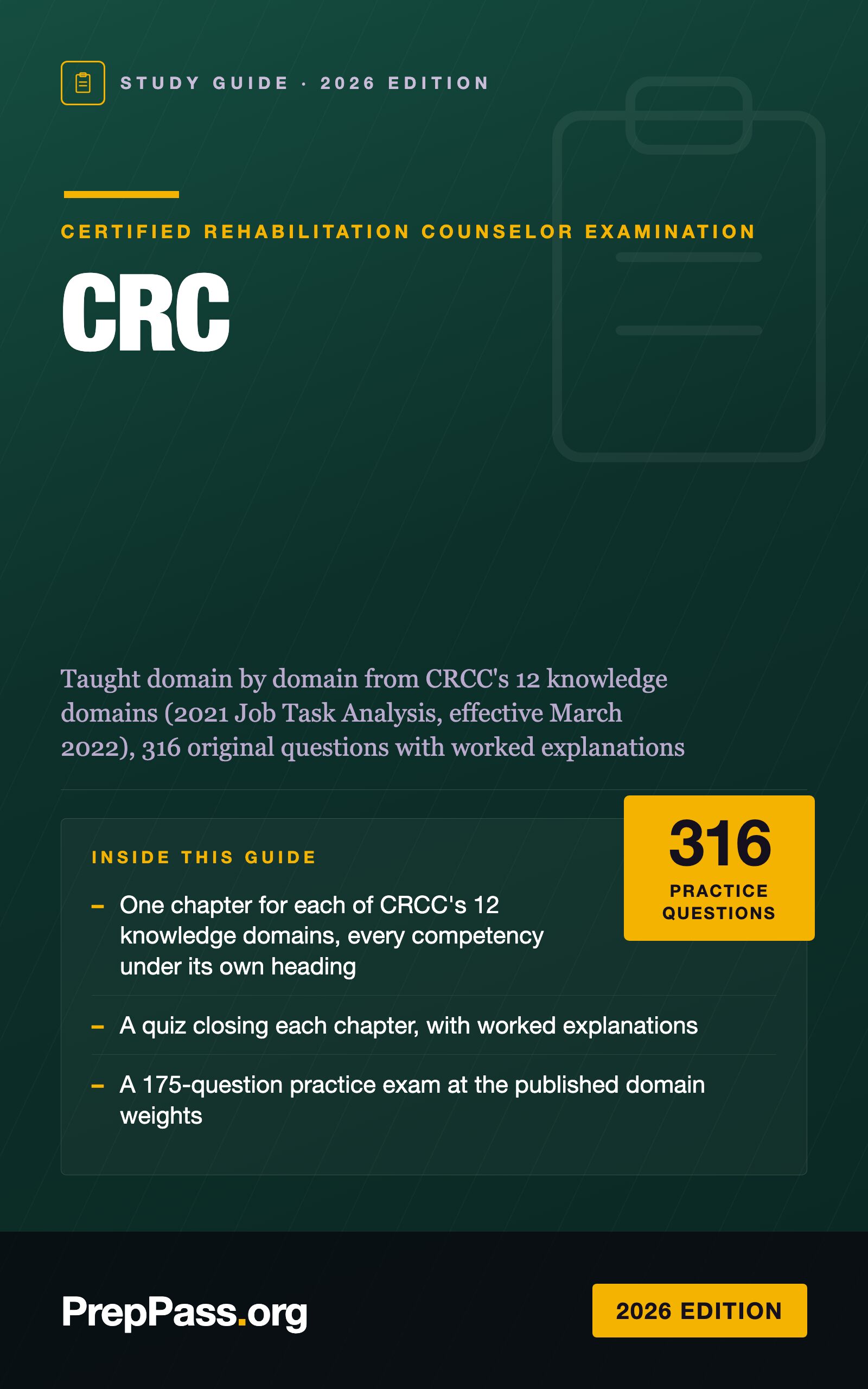
Practice stays free. The full CRC — Certified Rehabilitation Counselor Examination study guide is the material itself, taught start to finish — a downloadable PDF + EPUB you keep.
Professional Orientation and Ethical Practice
10.7% of the exam- Six principles
- Autonomy, beneficence, fidelity, justice, nonmaleficence, and veracity underpin the enforceable standards; autonomy means respecting the client's right to be self-governing within his or her cultural framework.· CRCC Code of Professional Ethics (2023), Preamble
- Former clients
- Romantic or sexual relationships with former clients are prohibited for five years after the last professional contact, and afterward the CRC must be able to show that no coercion or harm occurred.· CRCC Code of Professional Ethics (2023), A.4.b
- Vulnerable former clients
- The prohibition is permanent for former clients with a trauma history, psychosis, personality disorder, marked cognitive impairment, chronic treatment needs, or inability to consent.· CRCC Code of Professional Ethics (2023), A.4.c
- Gifts
- Gifts are declined unless culturally appropriate or therapeutically relevant; the CRC weighs cultural practice, value, and motives and follows employer policy.· CRCC Code of Professional Ethics (2023), A.4.j
- Serious and foreseeable harm
- Confidentiality yields when disclosure is required to protect clients or identified others from serious and foreseeable harm, after the CRC assesses the risk.· CRCC Code of Professional Ethics (2023), B.2.a
- Disclosure to employers
- Written consent comes first, and only necessary job-relevant information goes to people with a need to know.· CRCC Code of Professional Ethics (2023), B.1.f
- Attorney subpoenas
- When a subpoena is not from a judge, the CRC informs the client and assesses potential harm before releasing anything, with proper signed releases.· CRCC Code of Professional Ethics (2023), B.2.c
- Minimal disclosure
- When disclosure is required, only the information actually requested and required is released.· CRCC Code of Professional Ethics (2023), B.2.d
- Revised tests
- New or revised tests are generally used within one year of publication unless a documented reason shows the earlier version fits the client better.· CRCC Code of Professional Ethics (2023), H.4.b
- Forensic fees
- Payment for forensic services is never contingent on the outcome of a case or award.· CRCC Code of Professional Ethics (2023), G.4.a; L.3.d
- Social media disclosure
- Informed consent includes an explicit statement that the CRC does not accept client friend or follow requests on personal accounts.· CRCC Code of Professional Ethics (2023), K.4.c
- Ethics versus law
- The CRC relies on the Code to try to resolve a conflict; if it cannot be resolved, the CRC adheres to the law.· CRCC Code of Professional Ethics (2023), M.1.c
- Three prongs
- Disability means an impairment that substantially limits a major life activity, a record of such an impairment, or being regarded as having one; accommodation is not owed under the regarded-as prong alone.· 29 CFR 1630.2(g), (o)(4)
- Broad construction
- 'Substantially limits' is construed broadly, is not a demanding standard, and is judged without regard to mitigating measures other than ordinary eyeglasses.· 29 CFR 1630.2(j)(1)
- FMLA eligibility
- An eligible employee has 12 months of employment, 1,250 hours in the prior 12 months, and works where the employer has 50 or more employees within 75 miles.· 29 CFR 825.110(a)
Counseling Theories, Techniques, and Evidence-Based Practice
11.3% of the exam- Person-centered
- Congruence, unconditional positive regard, and empathic understanding are the conditions for change.· Rogers (1957), Journal of Consulting Psychology
- REBT
- The A-B-C model holds that beliefs about events drive emotional consequences; the counselor disputes irrational 'musts'.· Ellis, Reason and Emotion in Psychotherapy (1962)
- Reality therapy
- WDEP asks about wants, current doing, self-evaluation, and planning, grounded in choice theory.· Glasser (1965, 1998); Wubbolding (1988)
- Solution-focused and narrative
- The miracle, scaling, and exception questions mark solution-focused therapy; externalizing the problem marks narrative therapy.· de Shazer (1988); White & Epston (1990)
- Systematic desensitization
- Relaxation is paired with a graduated hierarchy of feared situations, from least to most anxiety-provoking.· Wolpe, Psychotherapy by Reciprocal Inhibition (1958)
- MI spirit and skills
- Partnership, evocation, acceptance, and compassion; skills are open questions, affirmations, reflections, and summaries (OARS).· MINT, Understanding Motivational Interviewing
- Change talk
- Statements favoring change are change talk and are reinforced; statements favoring the status quo are sustain talk.· MINT, Understanding Motivational Interviewing
- Stages of change
- Precontemplation, contemplation, preparation, action, and maintenance describe readiness to change.· Prochaska, DiClemente & Norcross (1992)
- Integrated treatment
- Co-occurring substance use and mental disorders are best addressed together rather than one after the other.· SAMHSA TIP 42 (2020); NIDA
- Erikson in adolescence
- Adolescence is the stage of identity versus role confusion.· Erikson, Childhood and Society (1950)
- Discrimination model
- Supervisors act as teacher, counselor, or consultant while focusing on intervention, conceptualization, or personalization skills.· Bernard (1979), Counselor Education and Supervision
Group and Family Counseling
4.7% of the exam- Screening
- Prospective members are screened so their needs and goals are compatible with the group's, they do not impede the process, and they are not harmed by it.· CRCC Code of Professional Ethics (2023), A.6.a
- Group confidentiality
- The CRC states an expectation of confidentiality and explains that it cannot be guaranteed for other members.· CRCC Code of Professional Ethics (2023), B.4.a
- Protecting members
- The CRC takes reasonable precautions to protect members from physical, emotional, or psychological harm.· CRCC Code of Professional Ethics (2023), A.6.b
- Five group models
- Psychoeducational, skills development, cognitive-behavioral, support, and interpersonal process groups.· SAMHSA TIP 41, Ch. 2
- Psychoeducational groups
- Leader-focused groups that teach members about substance use and its consequences.· SAMHSA TIP 41, Figure 2-2
- Tuckman stages
- Forming, storming, norming, performing, and adjourning; storming is marked by conflict and challenges to the leader.· Tuckman (1965); Tuckman & Jensen (1977)
- Boundaries
- Structural family therapy places boundaries on a continuum from disengaged to enmeshed, with clear boundaries in between.· Minuchin, Families and Family Therapy (1974)
- Triangles
- Tension between two people is managed by drawing in a third, the basic unit of an emotional system.· Bowen, Family Therapy in Clinical Practice (1978)
- Differentiation of self
- Bowen's term for the ability to balance emotional connection with independent thinking.· Bowen (1978)
Crisis and Trauma Counseling and Interventions
6.0% of the exam- Protective disclosure
- The CRC assesses ideation, intent, and plan and discloses as needed to prevent serious and foreseeable harm.· CRCC Code of Professional Ethics (2023), B.2.a
- Safety plan steps
- Warning signs, internal coping, social distraction, people to ask for help, professionals and agencies, and making the environment safe.· Stanley-Brown Safety Planning Intervention
- 988 Lifeline
- Available 24/7/365 by call, text, or chat, with a Deaf and Hard of Hearing option.· 988 Suicide & Crisis Lifeline
- Six principles
- Safety; trustworthiness and transparency; peer support; collaboration and mutuality; empowerment, voice, and choice; cultural, historical, and gender issues.· SAMHSA SMA 14-4884 (2014)
- PTSD duration
- An adult must have the required re-experiencing, avoidance, arousal, and mood symptoms for at least 1 month.· NIMH, Post-Traumatic Stress Disorder
- Polytrauma
- Two or more injuries to physical regions or organ systems, one of which may be life-threatening, causing physical, cognitive, psychological, or psychosocial impairment.· VHA Directive 1172.01
- Contingency planning
- CRCs plan for continued client services if disaster, violence, or a public health crisis interrupts them.· CRCC Code of Professional Ethics (2023), E.2.b
- Records in a disaster
- Reasonable precautions protect confidentiality if disaster, incapacity, or closure of practice occurs.· CRCC Code of Professional Ethics (2023), B.6.f
- Personal preparedness
- Individuals and families, including people with disabilities, should know local hazards, alerts, and evacuation plans.· Ready.gov, Disasters and Emergencies
Medical and Psychosocial Aspects of Chronic Illness and Disability
9.3% of the exam- SCI level
- Upper cord injuries can affect all four limbs (tetraplegia); lower injuries may affect the legs and lower body (paraplegia).· NINDS, Spinal Cord Injury
- Autonomic dysreflexia
- A life-threatening reflex reaction, mainly with neck or upper-back injuries, with pounding headache, flushing, and a sudden rise in blood pressure.· NINDS, Spinal Cord Injury
- MS courses
- Most people are first diagnosed with relapsing-remitting MS; primary-progressive worsens from onset without distinct attacks.· NINDS, Multiple Sclerosis
- Concussion
- A type of mild TBI that may take minutes to several months to heal.· NINDS, Traumatic Brain Injury
- Major depression
- Depressed mood or loss of interest most of the time for at least 2 weeks.· NIMH, Depression
- Persistent depressive disorder
- Less severe symptoms lasting at least 2 years.· NIMH, Depression
- Tardive dyskinesia
- Long-term use of typical antipsychotics can cause uncontrollable muscle movements.· NIMH, Mental Health Medications
- ICF model
- Disability results from interaction between a health condition and environmental and personal factors.· WHO, ICF (2001)
- Affirming language
- Use the person-first or identity-first language the client prefers.· CRCC Code of Professional Ethics (2023), D.3.e
- Attitudinal barriers
- CRCs recognize and address stigma, stereotyping, and discrimination in employment and community settings.· CRCC Code of Professional Ethics (2023), C.1.a
- Mitigating measures
- ADA coverage is judged without regard to medication or other mitigating measures; epilepsy substantially limits neurological function.· 29 CFR 1630.2(j)(1)(vi), (j)(3)(iii)
Assessment/Evaluation, Occupational Analysis, and Service Implementation
10.7% of the exam- Nonstandard administration
- When conditions are changed to accommodate a disability, the changes are noted in the interpretation.· CRCC Code of Professional Ethics (2023), H.6.a
- Norm-group caution
- Results normed on other populations are interpreted with caution for bias.· CRCC Code of Professional Ethics (2023), H.7.b
- Informal assessment
- Situational assessment, job shadowing, and community-based work assessment observe work behavior in realistic settings.· CRCC 2021 JTA, Domain 6.C
- Interest types
- O*NET uses six interest types: Realistic, Investigative, Artistic, Social, Enterprising, Conventional.· O*NET OnLine, Career Interest Types
- Exertional levels
- Sedentary 10 lb; light 20 lb with frequent 10 lb; medium 50/25; heavy 100/50.· 20 CFR 404.1567
- Transferability
- Most probable among jobs with the same or lesser skill, similar tools and machines, and similar materials, products, processes, or services.· 20 CFR 404.1568(d)
- Residual functional capacity
- The most a person can still do despite limitations.· 20 CFR 404.1545(a)
- Occupational Requirements Survey
- BLS data on physical demands, environmental conditions, preparation, and mental requirements, collected for SSA.· BLS, ORS
- Evidence of essential functions
- Includes the employer's judgment and written job descriptions prepared before advertising or interviewing.· 29 CFR 1630.2(n)(3)
- Interactive process
- The employer may need to engage the employee informally to identify limitations and accommodations.· 29 CFR 1630.2(o)(3)
- Job restructuring
- Reallocating marginal functions is a recognized accommodation; eliminating essential functions is not required.· 29 CFR 1630.2(o)(2); EEOC guidance (2002)
Career Development and Job Placement
9.3% of the exam- Trait-factor
- Know yourself, know the world of work, and reason about the fit between them.· Parsons, Choosing a Vocation (1909)
- Holland
- Six personality and environment types; congruence between them predicts satisfaction.· Holland, Making Vocational Choices (1997)
- Super
- Growth, exploration, establishment, maintenance, and disengagement across the life span.· Super (1980)
- Work adjustment
- Satisfaction is the worker's view; satisfactoriness is the employer's view of performance.· Dawis & Lofquist (1984)
- Supported employment
- Competitive integrated employment with ongoing supports for people with the most significant disabilities; VR services generally last up to 24 months.· 34 CFR 361.5(c)(53)-(54)
- Customized employment
- An individualized job negotiated with an employer around the person's strengths and the employer's needs.· 34 CFR 361.5(c)(11)
- IPS
- Zero exclusion, rapid job search, integration with treatment, benefits counseling, and time-unlimited support.· IPS Employment Center; SAMHSA IPS-25 Fidelity Scale
- Self-employment
- Self-employment and business ownership are recognized employment outcomes.· 34 CFR 361.5(c)(15); 361.48(b)(19)
- Pre-employment transition services
- Job exploration counseling, work-based learning, postsecondary counseling, workplace readiness training, and self-advocacy instruction, available without a VR application.· 34 CFR 361.48(a)
- Pre-offer questions
- Employers may ask about ability to perform job functions but not whether an applicant has a disability.· 29 CFR 1630.13(a); 1630.14(a)
- Youth definition
- A youth with a disability is aged 14 through 24.· 34 CFR 361.5(c)(58)
Business Engagement
7.6% of the exam- Dual customer role
- The blueprint names the employer and the person with a disability as dual customers.· CRCC 2021 JTA, Domain 8.F
- Employer engagement
- VR agencies engage with employers to increase job opportunities.· RSA, State VR Services Program
- Apprenticeship
- Registered programs combine on-the-job learning with organized related technical instruction (144 hours per year recommended).· 29 CFR 29.5(b)
- Plain English
- A request needs no legal words; describing a medical-related workplace problem is enough.· EEOC Enforcement Guidance (2002)
- Choosing among options
- The employee's preference gets primary consideration, but the employer may choose among effective accommodations.· EEOC Enforcement Guidance (2002)
- Limits
- No duty to eliminate essential functions or lower uniformly applied production standards; reassignment is the last resort.· EEOC Enforcement Guidance (2002)
- Net cost
- Undue hardship considers the net cost after tax credits, deductions, and outside funding, plus the employer's resources.· 29 CFR 1630.2(p)
- Direct threat
- Based on an individualized assessment of present ability, weighing duration, severity, likelihood, and imminence of harm.· 29 CFR 1630.2(r)
- Injured workers
- Inquiries of an employee with an occupational injury must be job-related, consistent with business necessity, and limited in scope.· EEOC, Workers' Compensation and the ADA
Community Resources and Partnerships
8.0% of the exam- Eligibility basis
- SSDI depends on work history; SSI is needs-based on income and resources.· SSA program pages
- Trial work period
- SSDI only: 9 service months, not necessarily consecutive, within a rolling 60-month period.· 20 CFR 404.1592; SSA TWP page
- Extended period of eligibility
- A 36-month re-entitlement period follows the trial work period; benefits can restart without a new application.· SSA Red Book
- Earned income exclusion
- SSI disregards $65 of earnings plus one-half of the rest, after any unused $20 general exclusion.· SSA Red Book
- PASS
- SSI income set aside for an approved work goal is not counted.· 20 CFR 416.1180
- IRWE
- Out-of-pocket costs of impairment-related items and services needed to work are deducted when judging SGA.· 20 CFR 404.1576
- Section 1619
- 1619(a) continues SSI cash at SGA-level earnings; 1619(b) continues Medicaid when earnings end cash payments.· SSA Red Book
- Ticket to Work
- Disability beneficiaries aged 18 to 64 may assign a ticket to one Employment Network or VR agency at a time.· 20 CFR 411.125; 411.140
- Client Assistance Program
- Advises and advocates for VR clients and applicants.· 34 CFR 370.1
- One-stop intake
- A common intake application at a one-stop center requesting VR services counts as a VR application.· 34 CFR 361.41(b)(2)
Case Management
10.0% of the exam- Eligibility
- Determined within 60 days of application unless an extension is agreed or trial work experiences are needed.· 34 CFR 361.41(b)
- IPE deadline
- Developed within 90 days after eligibility unless an extension is agreed.· 34 CFR 361.45(e)
- Annual review
- The IPE is reviewed at least annually.· 34 CFR 361.45(d)(5)
- Closure
- Employment must be maintained for at least 90 days and considered satisfactory by both parties.· 34 CFR 361.56
- SSDI/SSI presumption
- Recipients are presumed eligible and considered individuals with significant disabilities.· 34 CFR 361.42(a)(3)
- Trial work experiences
- Required before finding someone unable to benefit because of severity; clear and convincing evidence is needed.· 34 CFR 361.42(e)
- Order of selection
- If not all can be served, the most significant disabilities are served first.· 34 CFR 361.36
- Ineligibility review
- Reviewed within 12 months, then annually on request, when based on inability to achieve employment.· 34 CFR 361.43(e)
- Developing the IPE
- The client may write all or part of the plan alone or with help from others.· 34 CFR 361.45(c)(1)
- Comparable benefits
- Assessment, counseling, referral, job-related services, and rehabilitation technology are exempt from the search.· 34 CFR 361.53(b)
- Record corrections
- Alterations preserve the original and show the date, author, and reason.· CRCC Code of Professional Ethics (2023), L.2.a
- Interpreters
- Qualified interpreters or translators are arranged when needed for effective communication.· CRCC Code of Professional Ethics (2023), A.3.c
Health Care and Disability Management
7.3% of the exam- Medicaid structure
- Administered by states under federal requirements and funded jointly.· Medicaid.gov
- Extended Medicare
- Coverage continues for at least 93 months after the trial work period for most working SSDI beneficiaries.· SSA Red Book
- Medicare Buy-In
- Part A can be bought alone; Part B cannot be bought without Part A.· SSA Red Book
- Who administers
- DOL's OWCP runs federal programs; private and state and local government workers go to their state board.· U.S. DOL, Workers' Compensation
- Benefit types
- Wage replacement, medical treatment, and vocational rehabilitation.· U.S. DOL, Workers' Compensation
- Leave beyond FMLA
- After 12 weeks of FMLA leave, additional leave may be required as an ADA accommodation absent undue hardship.· EEOC Enforcement Guidance (2002); 29 CFR 825.200
- Episodic conditions
- An impairment that is episodic or in remission is a disability if it would substantially limit a major life activity when active.· 29 CFR 1630.2(j)(1)(vii)
- Minimum necessary
- Uses and disclosures of protected health information are limited to the minimum necessary, with exceptions such as treatment.· 45 CFR 164.502(b)
- Diagnosis codes
- ICD-10-CM is the HIPAA code set for diagnoses.· 45 CFR 162.1002
Research, Methodology, and Performance Management
5.3% of the exam- Test-retest reliability
- Consistency of scores when the same test is given twice.· AERA/APA/NCME Standards (2014)
- Standard error of measurement
- About 68% of true scores fall within plus or minus one SEM of the obtained score.· AERA/APA/NCME Standards (2014)
- T-scores
- Mean 50, standard deviation 10; T = 50 + 10z.· AERA/APA/NCME Standards (2014)
- Skew
- In a right-skewed distribution the mean is pulled above the median.· NIST/SEMATECH e-Handbook 1.3.5.1
- Robust measures
- The median and interquartile range are less affected by extreme values than the mean and standard deviation.· NIST/SEMATECH e-Handbook 1.3.5.1, 1.3.5.6
- Normal distribution
- Mean, median, and mode coincide in a symmetric normal distribution.· NIST/SEMATECH e-Handbook 1.3.5.1
- Levels of evidence
- Systematic reviews and meta-analyses are the gold standard; expert opinion is the lowest level.· CRCC 2021 JTA, Domain 12.C
- CDC evaluation steps
- Assess the context, describe the program, focus the design, gather credible evidence, generate conclusions, act on findings.· CDC Program Evaluation Framework (2024)
- Evaluation standards
- Relevance and utility, rigor, independence and objectivity, transparency, and ethics.· CDC Program Evaluation Framework (2024)
Now prove you know them
Reading an outline is not the same as recalling it under exam pressure. Drill the free CRC Exam (Certified Rehabilitation Counselor) questions to find the areas you keep missing, then sit a full timed mock.
Study aid, not a substitute for the official material — always confirm the current rule with CRCC.