CSLB Class A — General Engineering (Trade Exam) Practice Test
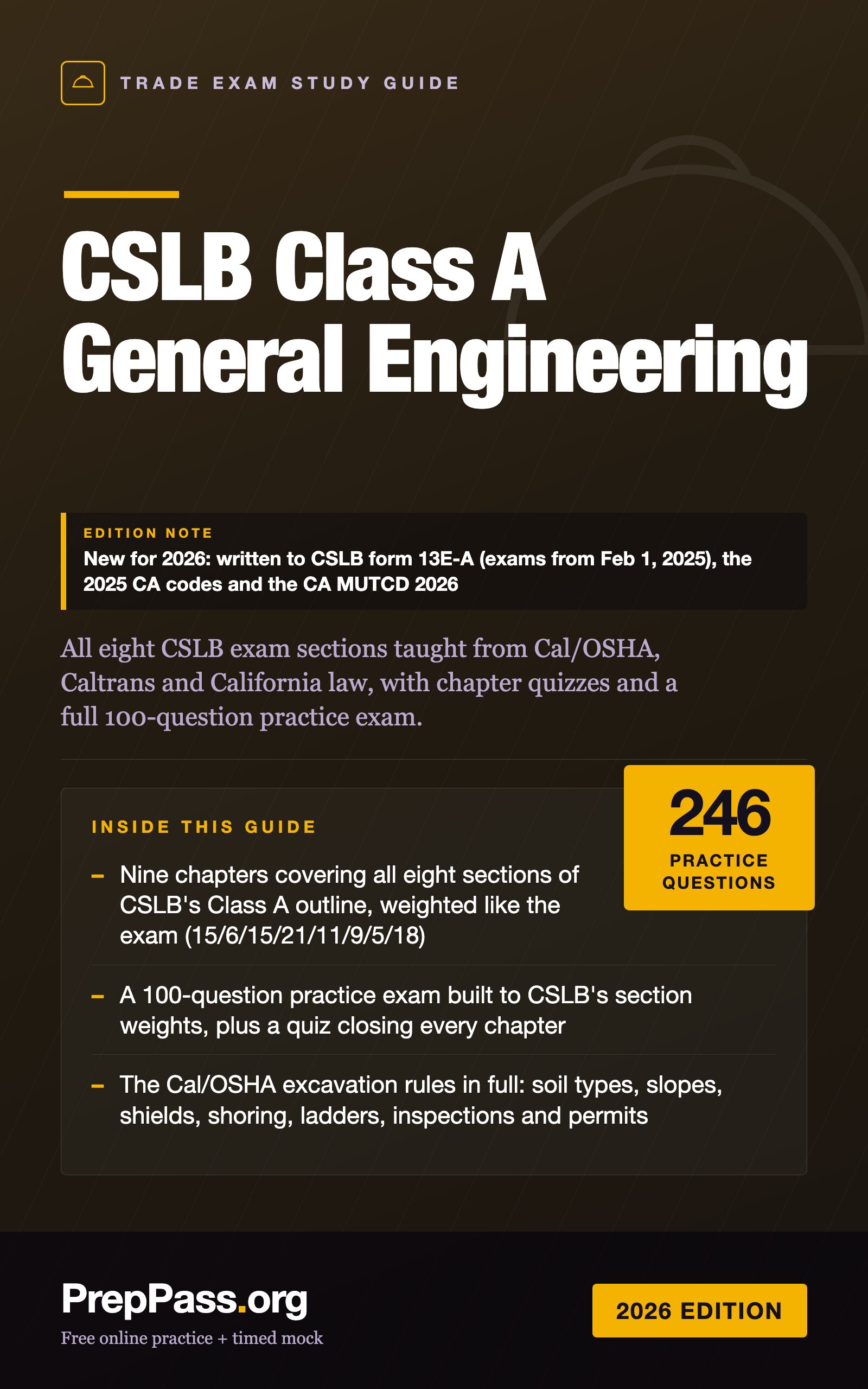
Practice stays free. The full CSLB Class A — General Engineering (Trade Exam) study guide is the material itself, taught start to finish — a downloadable PDF + EPUB you keep.
| Administering body | Contractors State License Board (CSLB), California Department of Consumer Affairs — exam delivered by PSI Services LLC |
|---|---|
| Questions | Not published by CSLB What we read and found nothing in: CSLB — Step 7: Studying for the Examination |
| Time limit | 210 minutes |
| Passing score | Not published by CSLB What we read and found nothing in: CSLB — Step 7: Studying for the Examination |
| Fees |
Source: CSLB — List of All CSLB Fees |
| Languages offered | English |
Frequently asked questions
How many CSLB Trade — General Engineering (A) practice questions are here?+
A full bank of original CSLB Trade — General Engineering (A) practice questions across the official content areas, weighted like the real exam, with explanations. Free, no signup.
What is the CSLB Trade — General Engineering (A) exam like?+
A multiple-choice exam, 210 minutes. Practice by topic here, then take the full timed mock exam to gauge readiness.
Are these the real exam questions?+
No. Every question is 100% original, written from public primary sources with explanations. We never copy real exam questions or paid prep material.
Can I study in Chinese or Spanish?+
PrepPass practice is in English, 中文 and Español. The official exam is in English — switch the question language to English any time to rehearse the exact terminology you'll see on test day.
Is there a study guide for the CSLB Trade — General Engineering (A)?+
Yes. PrepPass sells CSLB Class A General Engineering — Trade Exam Study Guide (2026), a PDF + EPUB download, $24.99 one-time; the practice on this page stays free without it. See the study guide →
Sample practice questions
A few sample questions from this free bank, with full explanations. Use the practice tool above for the whole set.
- 1. Planning and Estimating
A typical section on the plans shows 8 inches of base, but a written note on the same sheet says 10 inches. Which applies?
- a.Whichever the base supplier prefers
- b.9 inches, splitting the difference
- c.8 inches, from the drawn section
- d.10 inches, from the written note
Answer: d
Explanation: Written numbers and notes on a drawing govern over graphics. A drawn thickness can be distorted by scaling or reproduction; the written value was entered deliberately.
Source: Caltrans Standard Specifications (2025) 5-1.02
- 2. Earthwork and Surveying
Wet unit weight is 119.0 pcf at 8.0% moisture. What is the dry unit weight?
- a.111.0 pcf
- b.110.2 pcf
- c.109.5 pcf
- d.128.5 pcf
Answer: b
Explanation: Dry unit weight = wet ÷ (1 + w) = 119.0 ÷ 1.08 = 110.2 pcf.
Source: FHWA NHI-06-088
- 3. Foundation and Concrete Construction
What does Caltrans prohibit for holding forms in position?
- a.Form fasteners
- b.Twisted wire ties
- c.Wales
- d.Form oil
Answer: b
Explanation: Form fasteners prevent spreading; twisted wire ties are not used to hold forms in position.
Source: Caltrans Standard Specifications (2025) 51-1.03C
- 4. Safety
An operator must step off a moving dozer to talk to a laborer. What does Cal/OSHA say?
- a.Allowed at walking speed
- b.Not while it is moving
- c.Allowed with a spotter
- d.Allowed on level ground only
Answer: b
Explanation: The operator of any vehicle may not leave the controls while it is moving under its own engine power.
Source: Cal. Code Regs. tit. 8, 1592
- 5. Planning and Estimating
Caltrans defines the critical path as the longest continuous chain of activities with what feature?
- a.The most subcontractors
- b.The largest dollar value
- c.The least total float of all chains
- d.The earliest start date among the activities
Answer: c
Explanation: The specifications define it as the longest continuous chain with the least total float of all chains. Not "The largest dollar value": cost is not the definition. Not "The most subcontractors": the number of trades does not define it. Not "The earliest start date among the activities": start date does not define it.
Source: Caltrans Standard Specifications (2025) 1-1.07B (definition of critical path)
- 6. Earthwork and Surveying
On Caltrans clearing work, which tree branches over the roadway must be cut?
- a.Dead branches, since healthy ones may stay over the road
- b.Those hanging within 20 feet of finished grade
- c.Branches the engineer points out while walking the work
- d.Those within 2 feet of finished grade on the roadway side
Answer: b
Explanation: The specification says to cut tree branches that extend over the roadway and hang within 20 feet of finished grade. Not "Dead branches, since healthy ones may stay over the road": the specification requires cutting low-hanging branches. Not "Those within 2 feet of finished grade on the roadway side": the stated clearance is far greater. Not "Branches the engineer points out while walking the work": the specification states the rule directly.
Source: Caltrans Standard Specifications (2025) 17-2.03B
- 7. Subsurface, Surface, and Elevated Piping Work
How are fiber roll stakes driven for a Type 1 temporary check dam on Caltrans work?
- a.Above the roll so the rope can slide off the top of the stake
- b.Until the stake top is flush with the ground surface
- c.Until the notch is even with the top of the roll
- d.Two inches into the soil, so the roll can be moved easily
Answer: c
Explanation: Notched stakes are driven until the notch is even with the top of the fiber roll. Not "Until the stake top is flush with the ground surface": the notch, not the stake top, sets the depth. Not "Two inches into the soil, so the roll can be moved easily": this would not hold the roll against flow. Not "Above the roll so the rope can slide off the top of the stake": rope laced over the roll is held by the notch.
Source: Caltrans Standard Specifications (2025) 13-6.03B
- 8. Subsurface, Surface, and Elevated Piping Work
An existing Caltrans underground facility lies within 2 feet of a planned excavation. What must be done before power equipment is used?
- a.Use a backhoe carefully with a spotter watching
- b.Assume it lies 5 feet deeper than the plan shows
- c.Determine its exact location by hand excavation
- d.Skip locating it if it is not marked on the site plans
Answer: c
Explanation: If an existing facility is within 2 feet of an excavation, the exact location is determined by hand tools before power-operated equipment is used. Not "Use a backhoe carefully with a spotter watching": power equipment is not allowed first inside the zone. Not "Assume it lies 5 feet deeper than the plan shows": assumptions are not a substitute for locating it. Not "Skip locating it if it is not marked on the site plans": the facility shown must be located.
Source: Caltrans Standard Specifications (2025) 87-1.03A
- 9. Buildings, Structures, and Related Work
On a Caltrans irrigation job, how deep must supply pipe between the water meter and the backflow preventer be buried?
- a.At least 6 inches below grade, measured to the bottom of the pipe
- b.Laid on the surface and covered with mulch to keep it cool
- c.At least 5 feet, measured to the center of the pipe
- d.At least 18 inches below finished grade, measured to the top of the pipe
Answer: d
Explanation: Supply lines between the meter and backflow assembly are installed at least 18 inches below finished grade, measured to the top of the pipe. Not "At least 6 inches below grade, measured to the bottom of the pipe": too shallow for this supply line. Not "At least 5 feet, measured to the center of the pipe": far deeper than the specification asks. Not "Laid on the surface and covered with mulch to keep it cool": the line is buried at a set depth.
Source: Caltrans Standard Specifications (2025) 20-2.08C(1)
- 10. Safety
What is the maximum length of a downstream taper in a temporary traffic control zone?
- a.10 feet
- b.1,000 feet
- c.100 feet
- d.It must equal the merging taper
Answer: c
Explanation: The CA MUTCD table note states the maximum downstream taper length is 100 feet. Not "1,000 feet": far longer than the stated maximum. Not "10 feet": far shorter than the stated maximum. Not "It must equal the merging taper": the downstream taper is capped separately.
Source: CA MUTCD 2026, Table 6B-3