CSLB Class A — General Engineering (Trade Exam) Practice Test
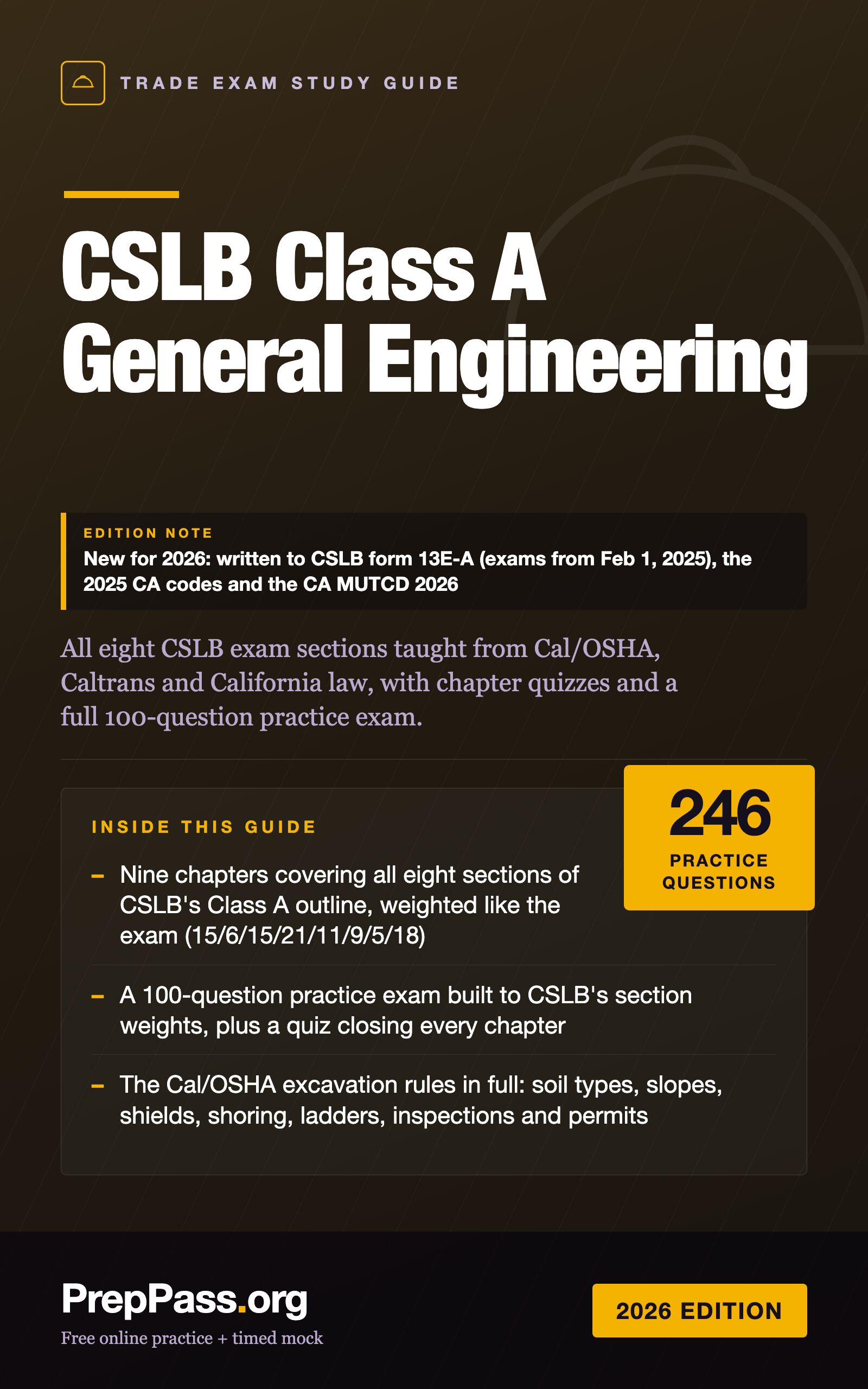
Practice stays free. The full CSLB Class A — General Engineering (Trade Exam) study guide is the material itself, taught start to finish — a downloadable PDF + EPUB you keep.
| Administering body | Contractors State License Board (CSLB), California Department of Consumer Affairs — exam delivered by PSI Services LLC |
|---|---|
| Questions | Not published by CSLB What we read and found nothing in: CSLB — Step 7: Studying for the Examination |
| Time limit | 210 minutes |
| Passing score | Not published by CSLB What we read and found nothing in: CSLB — Step 7: Studying for the Examination |
| Fees |
Source: CSLB — List of All CSLB Fees |
| Languages offered | English |
Frequently asked questions
How many CSLB Trade — General Engineering (A) practice questions are here?+
A full bank of original CSLB Trade — General Engineering (A) practice questions across the official content areas, weighted like the real exam, with explanations. Free, no signup.
What is the CSLB Trade — General Engineering (A) exam like?+
A multiple-choice exam, 210 minutes. Practice by topic here, then take the full timed mock exam to gauge readiness.
Are these the real exam questions?+
No. Every question is 100% original, written from public primary sources with explanations. We never copy real exam questions or paid prep material.
Can I study in Chinese or Spanish?+
PrepPass practice is in English, 中文 and Español. The official exam is in English — switch the question language to English any time to rehearse the exact terminology you'll see on test day.
Is there a study guide for the CSLB Trade — General Engineering (A)?+
Yes. PrepPass sells CSLB Class A General Engineering — Trade Exam Study Guide (2026), a PDF + EPUB download, $24.99 one-time; the practice on this page stays free without it. See the study guide →
Sample practice questions
A few real questions from this free bank, with full explanations. Use the practice tool above for the whole set.
- 1. Planning and Estimating
A typical section on the plans shows 8 inches of base, but a written note on the same sheet says 10 inches. Which applies?
- a.Whichever the base supplier prefers
- b.9 inches, splitting the difference
- c.8 inches, from the drawn section
- d.10 inches, from the written note
Answer: d
Explanation: Written numbers and notes on a drawing govern over graphics. A drawn thickness can be distorted by scaling or reproduction; the written value was entered deliberately.
Source: Caltrans Standard Specifications (2025) 5-1.02
- 2. Planning and Estimating
An excavator notifies the center on a Tuesday. With no holidays that week, which days count as the two-working-day notice?
- a.Tuesday and Wednesday
- b.Wednesday only
- c.Thursday and Friday
- d.Wednesday and Thursday
Answer: d
Explanation: The date of notification does not count, so the two working days are Wednesday and Thursday.
Source: Gov. Code 4216.2
- 3. Structural Principles
A 12-foot-wide slab edge is shored for a single floor with a total dead load of 40,000 pounds. What minimum lateral bracing load applies at that floor?
- a.4,000 pounds
- b.1,200 pounds
- c.800 pounds
- d.400 pounds
Answer: b
Explanation: Cal/OSHA uses the greater of 100 pounds per lineal foot of floor edge (100 × 12 = 1,200) or 2% of the total dead load (800); 1,200 governs.
Source: Cal. Code Regs. tit. 8, 1717
- 4. Earthwork and Surveying
Wet unit weight is 119.0 pcf at 8.0% moisture. What is the dry unit weight?
- a.111.0 pcf
- b.110.2 pcf
- c.109.5 pcf
- d.128.5 pcf
Answer: b
Explanation: Dry unit weight = wet ÷ (1 + w) = 119.0 ÷ 1.08 = 110.2 pcf.
Source: FHWA NHI-06-088
- 5. Subsurface, Surface, and Elevated Piping Work
Workers must cross a trench 7 feet deep and 24 inches wide. Are walkways with guardrails required by section 1541(l)?
- a.No, it is under 30 inches wide
- b.Yes, for any trench over 5 feet
- c.Yes, for any trench over 6 feet
- d.No, walkways are never required
Answer: a
Explanation: Walkways or bridges with guardrails are required over excavations more than 6 feet deep and wider than 30 inches; both conditions must be met.
Source: Cal. Code Regs. tit. 8, 1541
- 6. Subsurface, Surface, and Elevated Piping Work
An operator marks a gas line with two marks showing the pipe's outside edges. How far does the tolerance zone extend?
- a.24 inches from the midpoint
- b.12 inches from each mark
- c.36 inches from each mark
- d.24 inches from each mark
Answer: d
Explanation: When the marks show the width of the installation, the tolerance zone is 24 inches from each outside marking.
Source: Gov. Code 4216
- 7. Foundation and Concrete Construction
What does Caltrans prohibit for holding forms in position?
- a.Form fasteners
- b.Twisted wire ties
- c.Wales
- d.Form oil
Answer: b
Explanation: Form fasteners prevent spreading; twisted wire ties are not used to hold forms in position.
Source: Caltrans Standard Specifications (2025) 51-1.03C
- 8. Buildings, Structures, and Related Work
A conveyor at a treatment plant is being cleaned. Besides stopping it, what does the lockout rule require on its controls?
- a.Nothing more
- b.A second operator on the controls
- c.A written permit from Cal/OSHA
- d.Accident prevention signs or tags
Answer: d
Explanation: Machinery is stopped and de-energized or blocked, and accident prevention signs or tags are placed on the controls.
Source: Cal. Code Regs. tit. 8, 3314
- 9. Roadwork and Paving
Geosynthetic material under aggregate base is damaged. How is it repaired?
- a.Leave it and add more base
- b.A new piece with 6 inches of overlap
- c.Tape over the tear
- d.A patch with 3 feet of overlap
Answer: d
Explanation: Damaged geosynthetic is repaired by placing a new piece over the damaged area with at least 3 feet of overlap.
Source: Caltrans Standard Specifications (2025) 26-1.03
- 10. Safety
An operator must step off a moving dozer to talk to a laborer. What does Cal/OSHA say?
- a.Allowed at walking speed
- b.Not while it is moving
- c.Allowed with a spotter
- d.Allowed on level ground only
Answer: b
Explanation: The operator of any vehicle may not leave the controls while it is moving under its own engine power.
Source: Cal. Code Regs. tit. 8, 1592