CSLB Class A — General Engineering (Trade Exam) · 2026 Edition
CSLB Class A General Engineering — Trade Exam Study Guide (2026)
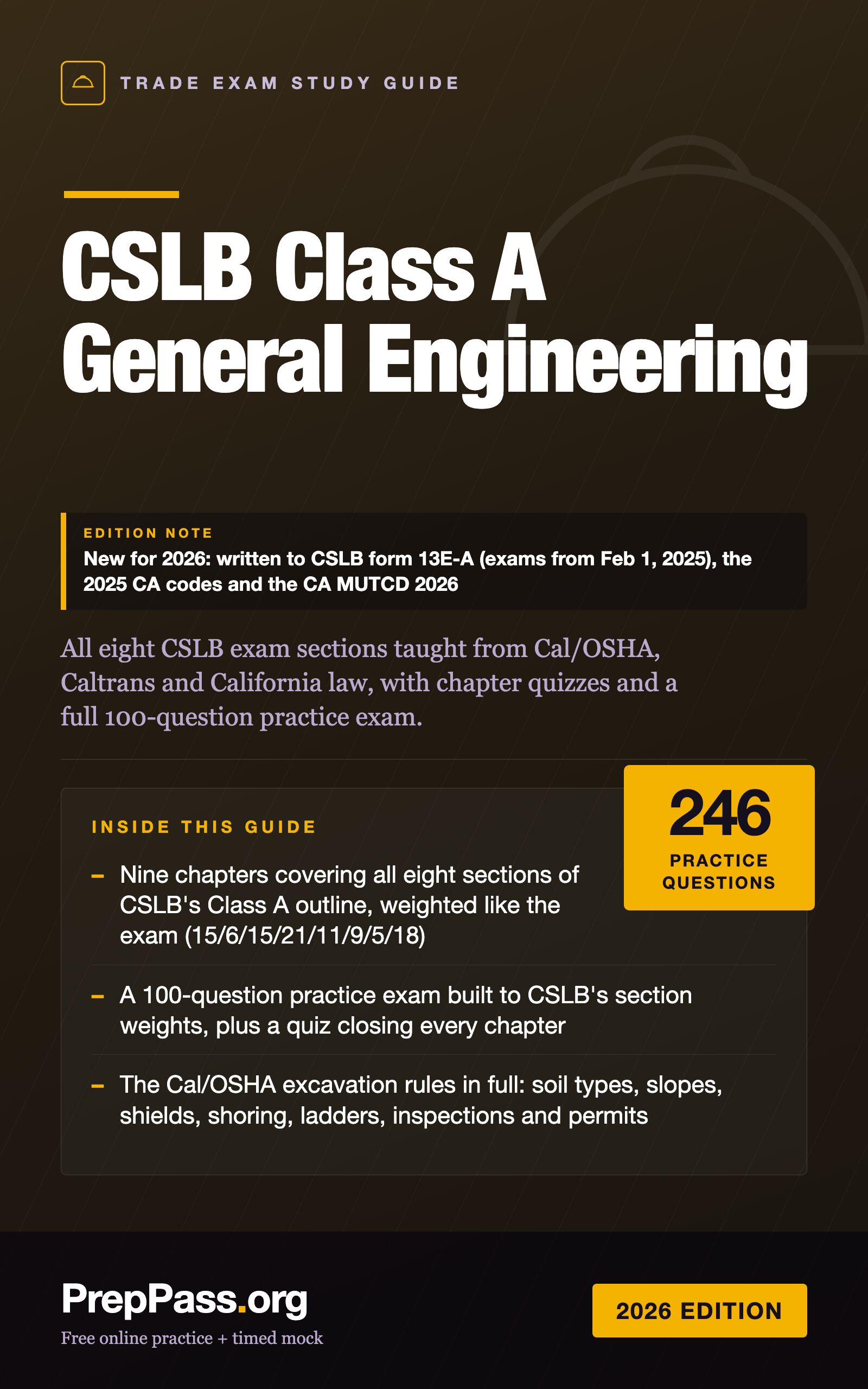
Edition noteNew for 2026: written to CSLB form 13E-A (exams from Feb 1, 2025), the 2025 CA codes and the CA MUTCD 2026
All eight CSLB exam sections taught from Cal/OSHA, Caltrans and California law, with chapter quizzes and a full 100-question practice exam.
- 246 original CSLB Class A General Engineering practice questions, each with a worked explanation, in one PDF + EPUB you keep
PDF + EPUB · English · 217 pages · $24.99 one-time
This book is written in English.
Instant download after payment — no account needed, no subscription.
14-day money-back guarantee: not satisfied for any reason? Email support@preppass.org within 14 days of purchase for a full refund. Refund policy
Read a free sample chapter first
Studying more than one? There's a bundle price
- CSLB Law & Business — Complete Study Guide (2026)$24.99
- CSLB Class A General Engineering — Trade Exam Study Guide (2026)$24.99
- CSLB Law & Business — Cram Sheet (2026)$9.99
Buy all 3: $30.99 — save $28.98 vs buying separately
Separately $59.97 · 48% off · One checkout, all 3 items.
Already bought CSLB Law & Business? Don't buy the bundle — it includes that book and you'd pay for it twice. Get CSLB Class A — General Engineering (Trade Exam) on its own for $24.99. CSLB Class A — General Engineering (Trade Exam) · What's in the bundle →
Try 10 questions first — free
Answer all 10, then see every answer explained — with the section of this guide that teaches it. About 5 minutes, no sign-up.
Start 10 free questionsLook inside the book
Three real pages, rendered straight from the PDF you download — a reference page, a teaching page, and a worked question, always in that order. Nothing here was redrawn to look better.
- Quick referenceChapter 9 — Safety · PDF page 149
A page you can turn back to: the numbers, deadlines or terms gathered in one place.
- How it's taughtChapter 2 — Structural Principles · PDF page 47
An explanation page: the material taught in prose, in the order the exam tests it.
- A question, workedChapter 2 — Structural Principles · PDF page 46
A practice question with its answer and the reasoning behind it — not just a key.
About the exam itself
| Administering body | Contractors State License Board (CSLB), California Department of Consumer Affairs — exam delivered by PSI Services LLC |
|---|---|
| Questions | Not published by CSLB What we read and found nothing in: CSLB — Step 7: Studying for the Examination |
| Time limit | 210 minutes |
| Passing score | Not published by CSLB What we read and found nothing in: CSLB — Step 7: Studying for the Examination |
| Fees |
Source: CSLB — List of All CSLB Fees |
| Languages offered | English |
Questions buyers ask
- What has changed on the CSLB Class A — General Engineering (Trade Exam)?
- New for 2026: written to CSLB form 13E-A (exams from Feb 1, 2025), the 2025 CA codes and the CA MUTCD 2026.
- Is a study guide enough for the CSLB Class A — General Engineering (Trade Exam), or do I need a course?
- A book is exam review: it does not replace any education, training or experience Contractors State License Board (CSLB), California Department of Consumer Affairs requires before you may sit the exam, so check those requirements first. For the exam content itself, this 217-page guide teaches the material chapter by chapter with 246 practice questions and explanations inside, and 100 more practice questions are free on PrepPass. A prep course adds live instruction and a set schedule; whether you need one beyond any required education is your call.
- What is the cheapest way to prepare for the CSLB Class A — General Engineering (Trade Exam)?
- Start with what costs nothing: 100 practice questions on PrepPass, with explanations and no signup. If you want it taught in one file you keep, the full study guide is $24.99 once. No subscription on any of them.
- Who administers the CSLB General Engineering (A) Trade Examination?
- Contractors State License Board (CSLB), California Department of Consumer Affairs — exam delivered by PSI Services LLC. CSLB's legal existence is set by Business and Professions Code § 7000.5. CSLB states it has contracted with PSI to administer its examinations.
- How many questions are on the CSLB General Engineering (A) Trade Examination?
- Not published by CSLB. CSLB says only that “All trade examinations consist of multiple-choice questions.” No count appears in the study guide, the Examinations FAQ, or PSI's candidate bulletin.
- How long is the CSLB General Engineering (A) Trade Examination?
- 210 minutes. CSLB: “You will be given 3-1/2 hours to complete each examination.” It is per examination, not per sitting — a candidate taking Law and Business plus a trade exam gets 3-1/2 hours for each.
- What is the passing score for the CSLB General Engineering (A) Trade Examination?
- Not published by CSLB. CSLB: “You will be informed at the test site about the percentage of correct answers needed to pass each examination,” and, in Get Licensed to Build Q14, that the percentage “varies for each exam”. Passing candidates are never shown their own score. PrepPass states no passing score for this exam.
- How much does the CSLB General Engineering (A) Trade Examination cost?
- $450 — Original application (exam or waiver, one classification) (CSLB, one-time); $51.43 — Examination registration (each registration, first attempt or retake) (PSI Services LLC, per attempt); $200 — Initial license fee (sole owner) (CSLB, one-time); $350 — Initial license fee (non-sole owner: partnership, corporation, LLC, joint venture) (CSLB, one-time). Two payees: application and license fees go to CSLB, the per-exam registration fee to PSI. CSLB's 2023 “Get Licensed to Build” PDF still names a $100 rescheduling fee; it appears neither on CSLB's current fee list nor in Business and Professions Code § 7137 as amended effective 1 January 2026, so it is not stated here. The application fee is charged once per original license application and covers both required exams.
- What languages is the CSLB General Engineering (A) Trade Examination offered in?
- English. CSLB names ten exams that have Spanish versions and A is not one of them, so the A exam is English only. For trade exams without a Spanish version, CSLB says accommodations may be made for a candidate to be joined by an approved translator.
- Does the CSLB Class A — General Engineering (Trade Exam) study guide come as a PDF?
- Yes — CSLB Class A General Engineering — Trade Exam Study Guide (2026) downloads as PDF and EPUB, 217 pages. The download link is emailed the moment payment clears and does not expire.
- How much does the CSLB Class A — General Engineering (Trade Exam) study guide cost?
- $24.99, once. There is no subscription and no account to create; the PDF and EPUB files are yours to keep.
- Are there free CSLB Class A — General Engineering (Trade Exam) practice questions?
- Yes — 100 of them, free to use with no signup and an explanation on every one. They are separate from this study guide, which is what you are buying here.
- Can I read part of the CSLB Class A — General Engineering (Trade Exam) study guide before buying?
- Yes. A full chapter is free to read on this page — not a summary of one, the chapter itself.
- Is there a cheaper way to buy the CSLB Class A — General Engineering (Trade Exam) study guide with anything else?
- Yes. CSLB Law & Business + CSLB Class A General Engineering is $30.99 for 3 files in one checkout — 48% less than the $59.97 those items cost bought separately today. It adds CSLB Law & Business — Complete Study Guide (2026), CSLB Law & Business — Cram Sheet (2026). The saving is measured against the items' real current prices; there is no struck-through "original" price on this site.
- Is this the official CSLB Class A — General Engineering (Trade Exam) study guide?
- No. This is an independent study guide and is not affiliated with or endorsed by the exam's awarding body. It is written from CSLB Class A study guide 13E-A (03-2026), Cal/OSHA Title 8, Caltrans Standard Specifications 2025 and the CA MUTCD 2026, read September 2026. Always confirm current requirements with the body that issues your licence.
Free CSLB Class A — General Engineering (Trade Exam) practice questions and study chapters →
What's included — and what isn't
Included
- Nine chapters covering all eight sections of CSLB's Class A outline, weighted like the exam (15/6/15/21/11/9/5/18)
- A 100-question practice exam built to CSLB's section weights, plus a quiz closing every chapter
- The Cal/OSHA excavation rules in full: soil types, slopes, shields, shoring, ladders, inspections and permits
- California's 811 law as amended January 1, 2025, and CA MUTCD 2026 traffic control
- Thirty worked calculation drills and a formula, conversion and trigger-number reference
- 246 original questions, each with a worked explanation citing its source
- PDF + EPUB you keep
Not included
- No printed copy is shipped — this is a file you download and can print yourself
- No video course, instructor or tutoring comes with the book — the free videos on the site are separate
- Not your exam registration or the testing centre's fee, which you still pay to the official body
Contents
See 22 sections and the page each one starts on
- Chapter 1 — Planning and Estimatingp. 11
- Chapter 2 — Structural Principlesp. 35
- Chapter 3 — Earthwork and Surveyingp. 49
- Chapter 4 — Excavation Support, Erosion Control and Tunnelingp. 69
- Chapter 5 — Pipelines: Installing, Connecting, Testing and Dry Utilitiesp. 87
- Chapter 6 — Foundation and Concrete Constructionp. 103
- Chapter 7 — Buildings, Structures and Related Workp. 118
- Chapter 8 — Roadwork and Pavingp. 131
- Chapter 9 — Safetyp. 142
- Section 1 — Planning and Estimating (15 questions)p. 162
- Section 2 — Structural Principles (6 questions)p. 165
- Section 3 — Earthwork and Surveying (15 questions)p. 167
- Section 4 — Subsurface, Surface, and Elevated Piping Work (21 questions)p. 170
- Section 5 — Foundation and Concrete Construction (11 questions)p. 175
- Section 6 — Buildings, Structures, and Related Work (9 questions)p. 177
- Section 7 — Roadwork and Paving (5 questions)p. 179
- Section 8 — Safety (18 questions)p. 180
- Practice exam answer key and explanationsp. 185
- Appendix A — Exam-day referencep. 198
- Appendix B — Terms to know preciselyp. 200
- Appendix D — Calculation drillsp. 207
- Appendix E — Pairs the exam likes to confusep. 210
Taken from the PDF you download, with the page each one starts on — not typed here.
Read a chapter free, in full
One complete chapter, exactly as it ships in the eBook. Scroll the window to read it right here; no download, no email.
Read chapter 4 here, without leaving the page
We didn't give you the easy intro — the free chapter opens on one of the hardest-working parts of the book, so you can judge the teaching where the exam gets difficult.
Section 4 of the outline, Subsurface, Surface, and Elevated Piping Work, is the largest on the exam at 21%. CSLB lists six topics: shoring and sloping excavations; preventing erosion; tunneling, drilling and boring; installing pipelines; connecting and testing systems; and connecting dry utilities.[1] Because it is more than a fifth of the exam, this book splits it in two. This chapter covers the ground work — keeping the trench open safely, keeping the soil on site, and going under things instead of through them. Chapter 5 covers the pipe itself.
Expect several questions built on the numbers in Cal/OSHA's excavation article (Title 8, Article 6).
4.1 Shoring and sloping excavations
Definitions that decide questions
- A trench is "a narrow excavation (in relation to its length) made below the surface of the ground. In general, the depth is greater than the width, but the width of a trench (measured at the bottom) is not greater than 15 feet."[2]
- A protective system protects workers from cave-ins; the options are "support systems, sloping and benching systems, shield systems, and other systems that provide the necessary protection."[2]
- A shield (trench box) is "a structure that is able to withstand the forces imposed on it by a cave-in and thereby protect employees within the structure."[2] A shield does not hold the walls up; it protects the people inside when the walls come down.
- A competent person is "capable of identifying existing and predictable hazards ... and who has authorization to take prompt corrective measures to eliminate them."[3] Both halves matter: knowledge and authority. A foreman who can see the problem but is not allowed to stop the work is not a competent person.
When protection is required
Every employee in an excavation must be protected from cave-ins by an adequate protective system, with two exceptions: excavations made entirely in stable rock[4], and excavations "less than 5 feet in depth and examination of the ground by a competent person provides no indication of a potential cave-in."[4] Note what the second exception does not say: a 4-foot trench in running sand with water seeping in is not automatically exempt. The 5-foot line is where protection becomes mandatory regardless; below it, the competent person decides.
Five feet is also where the Cal/OSHA permit starts (Chapter 1): trenches 5 feet or deeper that someone must enter.[5]
Classifying the soil
Cal/OSHA's system, in Appendix A to section 1541.1, ranks deposits "in a hierarchy of Stable Rock, Type A, Type B, and Type C, in decreasing order of stability."[6] A competent person classifies each deposit from at least one visual and one manual analysis.[6]
- Type A — cohesive soil with an unconfined compressive strength of 1.5 tsf or more.[6] But "no soil is Type A if" it is fissured, subject to vibration from heavy traffic or pile driving, or previously disturbed.[6] In practice, very little soil next to a street is Type A.
- Type B — cohesive soil between 0.5 and 1.5 tsf, and certain granular soils such as angular gravel and silt, and most previously disturbed soils.[6]
- Type C — cohesive soil of 0.5 tsf or less; granular soils including gravel, sand and loamy sand; submerged soil or soil from which water is freely seeping.[6]
In a layered system, classify by the weakest layer.[6] And classification is not a one-time act: if conditions change — rain, seepage, new vibration — the competent person re-evaluates and reclassifies.[6]
Sloping and benching
Appendix B gives the maximum allowable slopes, written as horizontal to vertical, for excavations less than 20 feet deep[7]:
| Soil or rock type | Maximum slope (H:V) | Angle from horizontal |
|---|---|---|
| Stable rock | Vertical | 90° |
| Type A | ¾:1 | 53° |
| Type B | 1:1 | 45° |
| Type C | 1½:1 | 34° |
Other rules around the table:
- If you do not classify the soil at all, the default (Option 1) is to slope "not steeper than one and one-half horizontal to one vertical" — the Type C slope.[4]
- Type A excavations open 24 hours or less and 12 feet or less deep may use a short-term slope of ½:1.[7]
- In Type A, an excavation 8 feet deep or less may have an unsupported vertical lower portion no taller than 3½ feet.[7] In Type C, any vertical lower portion must be shielded or supported to at least 18 inches above the top of the vertical side.[7]
- Signs of distress — cracks, bulging, spalling, raveling — require cutting the slope back at least ½H:1V flatter than the maximum.[7] Surcharge loads from spoil, equipment or traffic require the competent person to flatten the slope further.[7]
- Sloping or benching deeper than 20 feet must be designed by a registered professional engineer.[7]
Worked example: how wide is a sloped trench at the top?
A trench for a sewer is 10 feet deep and 4 feet wide at the bottom, in Type B soil, sloped on both sides. How wide is it at the top?
Type B is 1:1, so each side lays back 10 × 1 = 10 feet. Top width = 4 + 10 + 10 = 24 feet. In Type C (1½:1) each side lays back 15 feet and the top is 34 feet wide; in Type A (¾:1) each side lays back 7.5 feet and the top is 19 feet wide.
The mistakes the exam plants: using one side only (14 feet in Type B), and reading 1½:1 as vertical-to-horizontal, which gives a slope steeper than Type A. The first number is always horizontal.
That width is why shoring or shields are often cheaper than sloping in streets: 34 feet of open cut through Type C soil next to traffic and utilities is usually impossible.
Support systems and shields
The alternatives to sloping are support systems (timber, hydraulic or pneumatic shoring) and shields. Designs come from one of four routes: Cal/OSHA's own appendices, the manufacturer's tabulated data, other tabulated data approved by a registered engineer, or a registered engineer's design.[2] Whatever the route, "at least one copy of the design shall be maintained at the jobsite during construction of the protective system."[4]
Timber shoring (Appendix C) applies to trenches not exceeding 20 feet in depth.[8] Its members are the crossbraces, the uprights and, where required, the wales.[8] The tables use actual, not nominal, timber dimensions[8], and they are not adequate where adjacent loads exceed a two-foot soil surcharge.[8] Uprights extend to the top of the trench with the lower end no more than 2 feet from the bottom.[4]
Installation and removal rules that the exam likes:
- Excavating up to 2 feet below the bottom of a support system is allowed only if it is designed for the full trench depth and there is no sign of soil loss behind or below it.[4]
- Removal starts at the bottom and progresses upward.[4] Backfill goes in as the supports come out.[4]
- Damaged shoring or shield components are examined by a competent person before further use.[4]
Shields:
- No one may be inside a shield while it is being installed, removed or moved vertically.[4]
- In a trench with sloped upper walls above a vertical lower portion, the shield must extend at least 18 inches above the vertical walls.[4]
- Workers must be protected while entering and leaving the shield — a ladder inside the box, not a climb down the open wall.
Everything else in Article 6 that protects the crew
These rules from section 1541 appear on the exam as often as the slopes do:
- Ladders. Trenches 4 feet or deeper need a stairway, ladder, ramp or other safe means of egress so that no employee travels more than 25 feet laterally to reach it.[9]
- Spoil. Keep excavated material and equipment at least 2 feet from the edge, or use retaining devices.[9]
- Atmosphere. Where oxygen deficiency (less than 19.5% oxygen) or a hazardous atmosphere could exist — landfills, near stored hazardous substances — test before entry into excavations more than 4 feet deep.[9] Prevent exposure to flammable gas above 20% of the lower flammable limit.[9]
- Water. No work in excavations with accumulated or accumulating water unless adequate precautions are taken.[9]
- Inspections. A competent person inspects daily, before the start of work and as needed during the shift, and after every rainstorm or other hazard-increasing occurrence.[9] If there is evidence of a possible cave-in, exposed employees are removed until precautions are taken.[9]
- Crossings. Where employees or equipment cross excavations over 6 feet deep and wider than 30 inches, provide walkways or bridges with standard guardrails.[9]
- Loads and equipment. No one under loads handled by lifting or digging equipment[9]; a warning system (barricades, signals, stop logs) where mobile equipment approaches an edge the operator cannot see.[9]
- Adjacent structures. Do not undermine sidewalks or pavement without support[9]; do not excavate below adjacent footings without underpinning, stable rock or an engineer's approval.[9]
- Utilities. Determine the approximate location of subsurface installations before opening an excavation, and protect, support or remove them while it is open.[9]
4.2 Preventing erosion
The permit and the plan
A site disturbing one acre or more needs coverage under the State Water Board's Construction Stormwater General Permit, currently Order 2022-0057-DWQ, effective September 1, 2023.[10] Coverage brings a Stormwater Pollution Prevention Plan (SWPPP) prepared and implemented by qualified people — the Caltrans specifications use the abbreviation QSP for a "qualified SWPPP practitioner."[11] On Caltrans work, the contractor's water pollution control program includes "developing and implementing the WPCP, providing a WPC manager, conducting WPC training, and monitoring, inspecting and correcting WPC practices."[11]
Erosion control versus sediment control
These are different jobs, and the exam checks that you know which is which:
- Erosion control keeps soil where it is: temporary soil stabilization such as hydroseed, mulch, tackifiers, erosion control blankets and covers on stockpiles. It is the first line of defense because soil that never moves never needs catching.
- Sediment control catches soil that has already moved: fiber rolls, silt fences, check dams, sediment traps and drain inlet protection.
Caltrans treats them in separate sections — temporary soil stabilization and temporary sediment control[11] — and they are maintained differently. Remove sediment from the surface of an erosion control blanket when it exceeds 1 inch deep[11], and from a Type 2 inlet sediment trap when its volume is reduced by about half.[11] Where a check dam and a blanket share an area, install the blanket first.[11] Fiber rolls are staked so that the stake notch is even with the top of the roll.[11]
Site housekeeping that keeps sediment off the street
- Stockpiles. Cover active and inactive soil stockpiles with stabilization material or a temporary cover and surround them with a linear sediment barrier[11]; active stockpiles get this before a forecasted storm.[11]
- Tracking. Sediment tracked onto pavement must not reach storm drains, and Caltrans requires tracked material removed within 6 hours.[11] Stabilized construction entrances and street sweeping are the tools.
- Concrete washout. Washout water is highly alkaline and may not go to a drain. Caltrans allows a temporary washout facility, a portable washout or a washout bin.[11] Rinse water from cleaning sediment control devices may not enter an inlet or waterway either.[11]
- Natural drainage. Where excavation interrupts natural drainage, use diversion ditches, dikes or similar means to keep surface water out of the excavation.[9]
4.3 Tunneling, drilling and boring
When the Tunnel Safety Orders apply
Cal/OSHA's Tunnel Safety Orders cover tunnels, shafts and underground chambers, and specifically "boring and pipejacking operations 30 inches in diameter or greater in size"[12] and "all shaft excavations intended to exceed 20 feet in depth where employees may enter the shaft."[12] A jack-and-bore crossing with a 36-inch casing is therefore tunnel work, with its own rules — even though it looks like pipeline work from the street.
Gas classification
Before bidding, and in all cases before underground construction, the owner obtains a gas classification from the Division.[13] Tunnels are classified as nongassy, potentially gassy, gassy or extrahazardous.[13] A tunnel is gassy where gas is likely or where flammable gas above 5% of the lower explosive limit has been detected 12 inches or more from any surface under normal ventilation[13]; 20% of the LEL at that distance is one of the triggers for extrahazardous.[13] The classification is posted at the site and every worker is told[13]; if readings exceed the limits, "no underground works shall advance until reclassification has been made."[13]
Trenchless methods
- Horizontal directional drilling (HDD). A steerable drill head bores a pilot hole along a planned path, which is reamed and the pipe pulled back. Caltrans requires the bore equipment to have "directional control of the boring tool and ... an electronic boring tool location detection system"[11], the boring tool to be "only as large as necessary to install the conduit"[11], and any drilling fluid — "mineral slurry or wetting solution" to lubricate the tool and stabilize the hole — to be water based.[11]
- Jack and bore (auger boring) and jack and drill. A steel casing is jacked from a pit while an auger or drill removes spoil inside it. Caltrans places jacking or drilling pits no closer than 2 feet to the pavement edge whenever possible[11] and prohibits "excessive water that will soften the subgrade or undermine the pavement."[11]
- Pipe jacking and microtunneling push the product pipe itself behind a boring machine; at 30 inches and above they fall under the Tunnel Safety Orders.[12]
Every trenchless method is still an excavation under the 811 law, which names "drilling, augering, tunneling ... cable or pipe plowing and driving."[14] The bore path must be located and potholed where it crosses marked facilities (Chapter 5).
Sources cited in this excerpt
- License Examination Study Guide: General Engineering (A), form 13E-A (03-2026). Contractors State License Board, 2026-03 (for examinations scheduled on or after February 1, 2025); read 2026-09-24. https://www.cslb.ca.gov/Resources/StudyGuides/AStudyGuide.pdf
- Cal. Code Regs. tit. 8, section 1540. Excavations. California Department of Industrial Relations (Title 8 text), accessed 2026-09-24. https://www.dir.ca.gov/title8/1540.html
- Cal. Code Regs. tit. 8, section 1504. Definitions. California Department of Industrial Relations (Title 8 text), accessed 2026-09-24. https://www.dir.ca.gov/title8/1504.html
- Cal. Code Regs. tit. 8, section 1541.1. Requirements for Protective Systems. California Department of Industrial Relations (Title 8 text), accessed 2026-09-24. https://www.dir.ca.gov/title8/1541_1.html
- Cal. Code Regs. tit. 8, section 341. Permit Requirements. California Department of Industrial Relations (Title 8 text), accessed 2026-09-24. https://www.dir.ca.gov/title8/341.html
- Cal. Code Regs. tit. 8, section 1541.1a. California Department of Industrial Relations (Title 8 text), accessed 2026-09-24. https://www.dir.ca.gov/title8/1541_1a.html
- Cal. Code Regs. tit. 8, section 1541.1b. California Department of Industrial Relations (Title 8 text), accessed 2026-09-24. https://www.dir.ca.gov/title8/1541_1b.html
- Cal. Code Regs. tit. 8, section 1541.1c. California Department of Industrial Relations (Title 8 text), accessed 2026-09-24. https://www.dir.ca.gov/title8/1541_1c.html
- Cal. Code Regs. tit. 8, section 1541. General Requirements. California Department of Industrial Relations (Title 8 text), accessed 2026-09-24. https://www.dir.ca.gov/title8/1541.html
- Construction Stormwater Program. California State Water Resources Control Board, accessed 2026-09-24. https://www.waterboards.ca.gov/water_issues/programs/stormwater/construction.html
- Standard Specifications, 2025 Edition. California Department of Transportation, 2025. https://dot.ca.gov/-/media/dot-media/programs/design/documents/2025_stdspecs.pdf
- Cal. Code Regs. tit. 8, section 8403. Scope and Application. California Department of Industrial Relations (Title 8 text), accessed 2026-09-24. https://www.dir.ca.gov/title8/8403.html
- Cal. Code Regs. tit. 8, section 8422. Tunnel Classifications. California Department of Industrial Relations (Title 8 text), accessed 2026-09-24. https://www.dir.ca.gov/title8/8422.html
- California Government Code section 4216. California Legislative Information, accessed 2026-09-24. https://leginfo.legislature.ca.gov/faces/codes_displaySection.xhtml?lawCode=GOV§ionNum=4216
Before you buy
- How do I get it?
- Pay, and the download appears on this page straight away. The links are also emailed to you. No account is required.
- What if it isn't for me?
- Email us within 14 days for a full refund, no questions asked.
- Is the free practice going away?
- No. Every practice question, the timed mock and the free chapters on this site stay free. This book is the studying half, not a gate around the free half.
- Can I read it on my phone?
- Yes — the EPUB is for phones and e-readers, the PDF is for printing and tabbing. You get both.
The details
All eight CSLB exam sections taught from Cal/OSHA, Caltrans and California law, with chapter quizzes and a full 100-question practice exam.
- Format: PDF + EPUB download · 217 pages
- 246 practice questions in the book, with a full answer key
- 100 free practice questions for this exam on PrepPass, included at no cost
- $24.99 one-time — no subscription
- 14-day money-back guarantee · refund policy
- Cross-referenced against: CSLB Class A study guide 13E-A (03-2026), Cal/OSHA Title 8, Caltrans Standard Specifications 2025 and the CA MUTCD 2026, read September 2026
- Verified from the official source(CSLB Class A study guide 13E-A (03-2026), Cal/OSHA Title 8, Caltrans Standard Specifications 2025 and the CA MUTCD 2026, read September 2026)
- 100 free practice questions
- Instant download, yours for life
A CSLB exam prep course runs $200–$800. This book teaches the same exam — same rules, verified to current standards — for a one-time $24.99 you keep for life.
Why buy the book when the practice is free?
Our practice questions and timed mock stay free — nothing on the site moves behind this book. The $24.99 book is the studying half: the material itself, taught in order, in a file you own.
- Systematic teaching — every exam section explained chapter by chapter, start to finish, not just questions
- Print it & tab it — a paper-ready PDF you can highlight, mark up, and bring to your study table
- Study anywhere, offline — EPUB on your phone or e-reader; no wifi, no browser tabs
- Everything in one place — the chapters and the practice questions in one file
- Yours for life — one-time $24.99, instant download, no subscription
And it's risk-free: 14-day money-back guarantee — not satisfied? Email us for a full refund, no questions asked. See the refund policy.
14-day money-back guarantee · full refund, no questions asked.
One-time purchase, lifetime access to the download. The eBook is the full CSLB Class A — General Engineering (Trade Exam) study guide in PDF and EPUB. Educational summary, not professional or legal advice — always confirm the current rules with the official source.