HESI A2 Practice Test
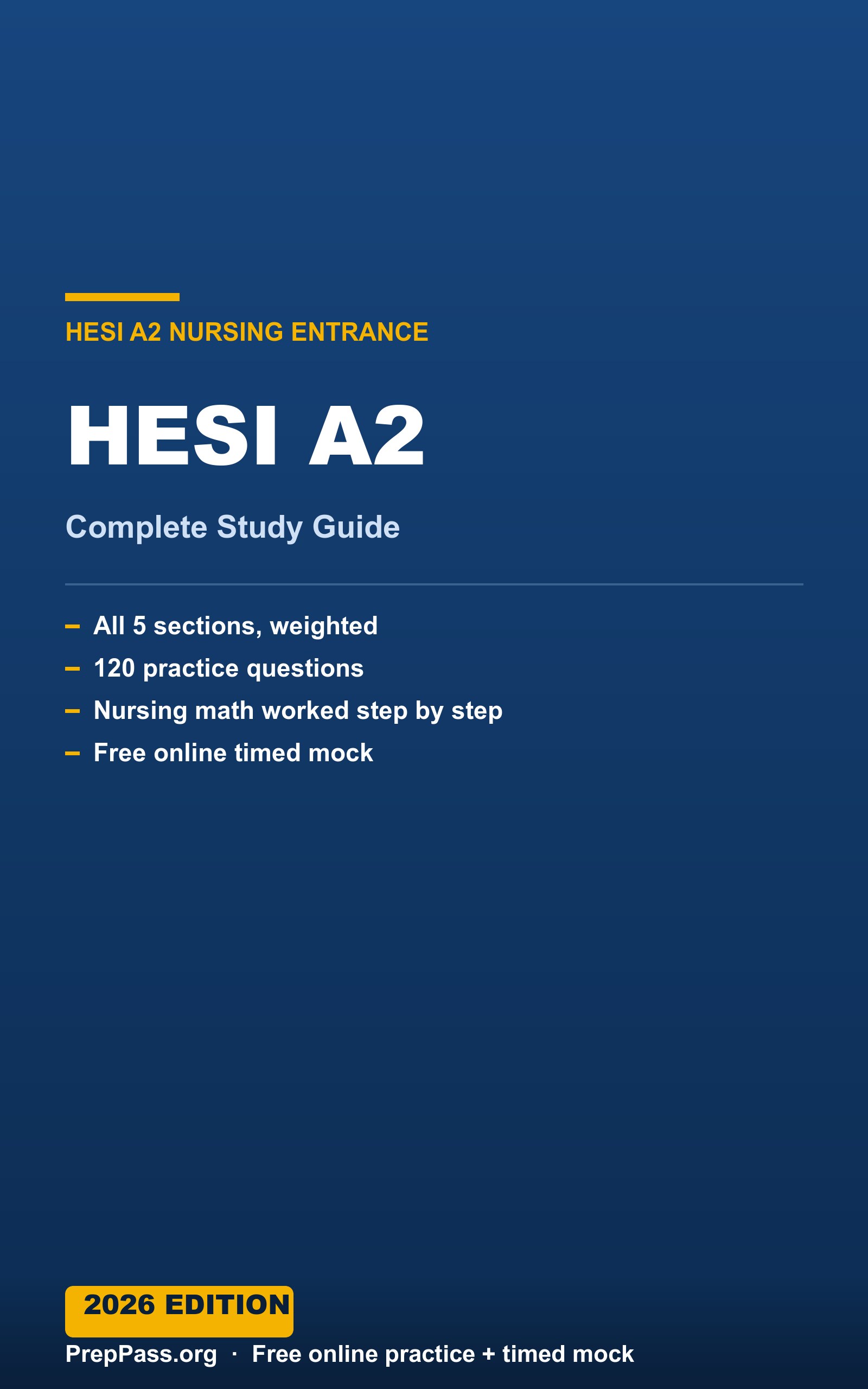
En la guía de HESI A2 Admission Assessment: Una lista de trampas frecuentes del examen y una autoevaluación al cierre de cada una de las 7 materias. La práctica aquí sigue siendo gratis.
Preguntas frecuentes
¿Cuántas preguntas de práctica de HESI A2 hay aquí?+
Un banco completo de preguntas originales de HESI A2 en las áreas oficiales, con el peso del examen real y explicaciones. Gratis, sin registro.
¿Cómo es el examen HESI A2?+
Unas 120 preguntas. Practica por tema aquí y luego haz el simulacro cronometrado para medir tu preparación.
¿Estas son las preguntas reales del examen?+
No. Cada pregunta es 100% original, escrita de fuentes públicas con explicaciones. Nunca copiamos preguntas reales ni material de preparación pagado.
¿Puedo estudiar en chino o español?+
La práctica de PrepPass está en inglés, 中文 y español. El examen oficial es en inglés — cambia el idioma de las preguntas a inglés para ensayar la terminología del día del examen.
¿Hay una guía de estudio para HESI A2?+
Sí: PrepPass vende HESI A2 Exam — Complete Study Guide (2026), en descarga PDF + EPUB, $29.99 pago único; la práctica de esta página sigue siendo gratis sin ella. Ver la guía de estudio →
Preguntas de práctica de ejemplo
Algunas preguntas reales de este banco gratuito, con explicaciones completas. Usa la herramienta de arriba para el banco completo.
- 1. Mathematics
What is 3/4 + 1/6?
- a.7/12
- b.11/12
- c.1/2
- d.4/10
Respuesta: b
Explicación: Find a common denominator of 12: 3/4 = 9/12 and 1/6 = 2/12. Adding gives 9/12 + 2/12 = 11/12, which cannot be reduced.
- 2. Reading Comprehension
Read the passage: 'Water covers about seventy percent of Earth's surface, yet most of it is salt water unsuitable for drinking.' What is the topic?
- a.Ocean animals
- b.Drinking habits
- c.Earth's water
- d.Weather patterns
Respuesta: c
Explicación: The topic is the general subject the passage discusses. This passage focuses on how much of Earth is water and how much of it can be used for drinking.
- 3. Grammar
Choose the correct sentence.
- a.The nurse and the doctor is both present.
- b.The nurse and the doctor were both present.
- c.The nurse and the doctor be both present.
- d.The nurse and the doctor was both present.
Respuesta: b
Explicación: A compound subject joined by 'and' is plural and takes a plural verb. 'The nurse and the doctor' requires 'were,' not 'was.'
- 4. Science
Which chamber of the heart pumps oxygen-rich blood out into the aorta?
- a.Right ventricle
- b.Left atrium
- c.Left ventricle
- d.Right atrium
Respuesta: c
Explicación: The left ventricle has the thickest wall because it must drive blood through the entire systemic circuit by way of the aorta. The right ventricle pumps only as far as the lungs through the pulmonary trunk, and both atria are receiving chambers that move blood a few centimetres into the ventricle below them.
- 5. Science
Which part of a neuron receives incoming signals from other neurons?
- a.The axon
- b.The axon terminal
- c.The dendrites
- d.The myelin sheath
Respuesta: c
Explicación: Dendrites are the branching extensions that collect input and carry it toward the cell body. The axon conducts the impulse away, the axon terminal releases neurotransmitter onto the next cell, and the myelin sheath is insulation rather than a receiving structure.
- 6. Mathematics
Which of these fractions has the greatest value?
- a.2/3
- b.5/8
- c.3/5
- d.7/12
Respuesta: a
Explicación: Rewrite all four over 120: 2/3 = 80/120, 5/8 = 75/120, 3/5 = 72/120 and 7/12 = 70/120. Comparing numerators shows 80/120 is the largest, so 2/3 wins; the other three fall just below it in the order listed.
- 7. Mathematics
A child is to receive 2 teaspoons of syrup. How many milliliters is that? (1 tsp = 5 mL)
- a.10 mL
- b.2.5 mL
- c.15 mL
- d.30 mL
Respuesta: a
Explicación: Multiply the number of teaspoons by 5, so 2 x 5 = 10 mL. Dividing instead of multiplying gives 2.5 mL, 15 mL is one tablespoon, and 30 mL is a full fluid ounce.
- 8. Reading Comprehension
Read the passage: 'The recipe calls for a scant cup of flour. Use slightly less than a full measure, or the dough will turn out tough.' In this passage, 'scant' most nearly means:
- a.heaping
- b.exactly level
- c.barely enough
- d.doubled
Respuesta: c
Explicación: The second sentence defines the word by telling the cook to use slightly less than a full cup. Heaping and doubled both mean more rather than less, and exactly level would be a full measure, which is what the passage warns against.
- 9. Vocabulary
The chart described the patient's blood pressure as labile. This means it:
- a.stays within the normal range
- b.is dangerously low at all times
- c.changes often and unpredictably
- d.has not been measured recently
Respuesta: c
Explicación: Labile means unstable or liable to shift, so a labile pressure swings from reading to reading. A steady reading would be stable, a persistently low one would be described as hypotensive, and an unmeasured value would simply be missing.
- 10. Vocabulary
The instructions were ambiguous, so two nurses read them differently. Ambiguous means:
- a.open to more than one meaning
- b.written in very small print
- c.much too long to read
- d.printed in another language
Respuesta: a
Explicación: Ambiguous wording can be understood in more than one way, which is why the two readings differed. Small print, excessive length and a foreign language all make text hard to read without making its meaning double.