学习指南 · 2026 版
SIE — Securities Industry Essentials Study Guide (2026)
Twenty-seven chapters written to FINRA's SIE content outline, with the working shown on every calculation and a practice question bank behind them.
- 篇幅
- 845 页(讲解 358 页 + 题库)
- 书内练习题
- 1,149
- PrepPass 在线计时模考
- 75 题 · 105 分钟
- 考试事实核对与文件更新
- 2026年10月
- 交付
- PDF + EPUB · 英文 · 即时下载
关于本书
SIE 考试费:每次 $100,缴给 FINRA。补考要再交一次。本指南:$24.99,一次买断。
考试事实、适合谁与变化
关于这场考试本身
| 主管机构 | Financial Industry Regulatory Authority (FINRA) —— 考试由 Prometric 承办 |
|---|---|
| 题目数量 | 80 道题 (75 道计分,5 道不计分预试题) 来源: FINRA — Securities Industry Essentials (SIE) Examination Content Outline (PDF, © 2025 FINRA) |
| 考试时限 | 105 分钟 来源: FINRA — Securities Industry Essentials (SIE) Examination Content Outline (PDF, © 2025 FINRA) |
| 及格标准 | 标准分 70(量表范围 0–100) 来源: FINRA — SIE Exam and Exam Restructuring Frequently Asked Questions (FAQ) |
| 费用 |
|
| 考试语言 | FINRA 未公布 我们查阅但未找到该数据的来源: FINRA — Securities Industry Essentials Exam (SIE) |
翻开这本书看看
三页真实内页,直接从你将下载的 PDF 渲染而来 —— 依次是一页速查、一页讲解、一道带解析的例题。没有任何一页是为了好看而重画的。
- 速查页Chapter 7 — Bonds: Pricing, Yields, Corporates, Treasuries and Municipals · PDF 第 137 页
一页可以随时翻回来的内容:把数字、期限或术语集中在一处。
- 怎么讲Section 32 Criminal: entities Fine up to $25 million · PDF 第 327 页
讲解页:用文字把知识讲清楚,顺序与考试考查的顺序一致。
- 一道题的完整解析Chapter 5 — Rights, Warrants, ADRs and Convertible Securities · PDF 第 90 页
一道练习题,连同答案和背后的推理 —— 不只是一个答案键。
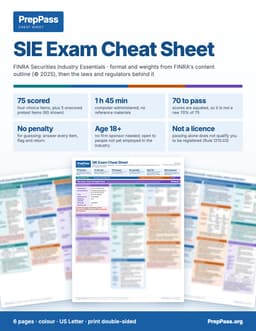
两周内就要考试?
这本指南是系统讲解,要花几周读。如果两周内就考,可打印的彩色速查表是另一款产品:考试涉及的关键数字,按章节排好。
6 页 · US Letter · 可打印 PDF · 永久保存
包含什么,不包含什么
包含
- Twenty-seven chapters in the teaching order of FINRA's SIE content outline: regulators, capital markets, products and their risks, trading and customer accounts, conduct and registration
- Every chapter closes with a key-facts box and a named exam-traps list
不包含
- 不寄送纸质书 —— 这是一份你下载后可自行打印的文件
- 购书不含视频课程、讲师或一对一辅导 —— 站上的免费视频是另一回事
完整的包含项与不包含项
包含
- Worked examples with the working shown where the exam asks for arithmetic: bond pricing and yield, accrued interest, options breakeven, margin, settlement dates
- A chapter on taking the exam: format, retake waiting periods, a study plan and the ten most common confusions
- Dated rule changes called out, including the end of the pattern-day-trader rule and T+1 settlement
- 358 pages of teaching, then a question bank of 1149 practice questions, grouped by topic, with answers and explanations
- PDF (print & tab it) + EPUB (phone / e-reader)
不包含
- 不含考试报名费与考点费用,这些仍需向官方机构缴纳
目录
查看 32 个部分及各部分起始页
- Chapter 1 — Who Regulates the Markets and Who Works in Them第 9 页
- Chapter 2 — Capital Markets, Offerings and Registration第 24 页
- Chapter 3 — The Economy, the Federal Reserve and Company Financials第 47 页
- Chapter 4 — Common and Preferred Stock第 66 页
- Chapter 5 — Rights, Warrants, ADRs and Convertible Securities第 88 页
- Chapter 6 — Corporate Actions, Buybacks and Proxies第 98 页
- Chapter 7 — Bonds: Pricing, Yields, Corporates, Treasuries and Municipals第 107 页
- Chapter 8 — Agency and Mortgage Securities, Municipal Variations, Money Market and Ratings第 127 页
- Chapter 9 — Investment Companies: Mutual Funds, ETFs, Closed-End Funds and UITs第 143 页
- Chapter 10 — What Funds, Annuities and Trades Cost第 164 页
- Chapter 11 — Municipal Fund Securities, Partnerships, REITs, Hedge Funds and Exchange-Traded Products第 176 页
- Chapter 12 — Options: Calls, Puts, Strategies, the OCC and Opening an Account第 187 页
- Chapter 13 — Investment Risks and How to Reduce Them第 205 页
- Chapter 14 — Where Securities Trade: Venues, Market Makers, Regulation NMS, Best Execution, Reporting and Halts第 214 页
- Chapter 15 — Orders, Quotes and Positions第 228 页
- Chapter 16 — Clearing, Settlement and Failed Trades第 236 页
- Chapter 17 — Return, Cost Basis, Tax and Benchmarks第 243 页
- Chapter 18 — Margin and Short Sales第 251 页
- Chapter 19 — Knowing the Customer, Recommendations, Regulation Best Interest and Form CRS第 267 页
- Chapter 20 — Account Types, IRAs and Retirement Plans第 284 页
- Chapter 21 — Anti-Money Laundering: FinCEN, OFAC, Structuring and the PATRIOT Act第 293 页
- Chapter 22 — Confirmations, Statements, Customer Mail, Continuity Plans and Safeguarding Customer Assets第 301 页
- Chapter 23 — Market Manipulation, Insider Trading and Fraud第 308 页
- Section 32 Criminal: entities Fine up to $25 million第 314 页
- Chapter 24 — Conduct Rules: Customer Funds, Trading Practices and Cooperation with Regulators第 317 页
- Chapter 25 — Who May Work in the Industry: Qualification, Registration and Disqualification第 331 页
- Chapter 26 — Hiring, Disclosure, Reporting and Municipal Personnel Rules第 340 页
- Chapter 27 — Taking the SIE: Format, Chapter Map, Study Plan and Ten Confusions第 349 页
- Section 1: Capital Markets (16%)第 351 页
- Section 2: Products and Their Risks (44%)第 351 页
- Section 4: Regulatory Framework (9%)第 353 页
- Appendix — Question Bank 1,149 practice questions with answers and explanations第 359 页
取自你将下载的那份 PDF,并标明各章起始页 —— 不是在此手工录入的。
免费读完整一章
完整的一章,与电子书正文一字不差。直接在此窗口滚动阅读;无需下载,无需邮箱。
在本页直接阅读第 17 章
我们没有拿轻松的绪论充数 —— 免费章节直接翻到书里最见功力的部分,让你在考试真正难的地方检验这本书讲得好不好。
Every investment is judged by what it returns and by what is left after tax. This chapter defines total return, shows how cost basis is set and changed, explains the wash-sale rule and the short-term and long-term capital-gains treatment, and closes with the benchmarks and indices used to judge a portfolio. Dividend types and dates are in Chapter 4.
Words you need
- Return. What an investment earned over a period, usually stated as a percentage of what was put in.
- Income. Cash an investment pays out while you hold it: dividends from stock, interest from bonds.
- Capital gain / capital loss. The profit or loss when you sell for more or less than your cost basis. It is "realized" only when you sell; before then it is "unrealised".
- Total return. Income plus change in price, over the period, as a percentage of the starting value.
- Dividend. A distribution of a company's profit to its shareholders, set by the board of directors.
- Cost basis. What you are treated as having paid for a security. Gain or loss is sale proceeds minus basis.
- Holding period. How long you owned the security. It decides whether a gain is short term or long term.
- Wash sale. Selling at a loss and buying the same or a substantially identical security within a 30-day window around the sale.
- Benchmark. A standard, often an index, against which a portfolio's results are compared.
- Index. A published number that tracks the prices of a defined group of securities. You cannot buy an index directly; funds copy it.
Components of return
An investor can earn money from a security in two ways.
- Income. Dividends or interest paid in cash while you hold it.
- Capital appreciation. The price rises, so you could sell for more than you paid.
Total return = (income + change in price) / starting price.
Worked example. You buy 100 shares at $50 ($5,000). Over the year you receive $1.80 per share in dividends and the price rises to $56.
| Piece | Calculation | Amount |
|---|---|---|
| Income | 100 × $1.80 | $180 |
| Capital gain (unrealized until sold) | 100 × ($56 − $50) | $600 |
| Total | $180 + $600 | $780 |
| Total return | $780 / $5,000 | 15.6% |
The two pieces carry different risks. Income from a stable company is steadier; price change is volatile. Growth-oriented investors lean on appreciation, income-oriented investors on cash payments. A bond held to maturity returns income and a return of principal, with any gain or loss depending on purchase price (Chapter 7).
The exam also separates nominal return (before inflation) from real return (after). With a nominal return of 7.4% and inflation of 3.0%, the approximate real return is 7.4% − 3.0% = 4.4%.
Cost basis
Gain or loss on a sale is proceeds minus cost basis. Basis starts as the price you paid plus commissions and fees, and changes with events such as stock dividends, splits and return of capital.
How you acquired the shares changes the basis
| How acquired | Basis |
|---|---|
| Purchase | Cost plus commissions |
| Gift | The donor's basis carries over to you. If you sell at a loss, your loss is measured from the lower of that basis and the market value at the date of the gift (IRC §1015) |
| Inheritance | Fair market value on the date of death (a "step-up" or "step-down"), and the holding period is automatically long term |
| Stock dividend or split | Original basis divided over the larger number of shares |
| Reinvested dividends | Each reinvestment is a new purchase at its own cost |
When you hold several lots
If you bought shares at different prices, you must say which you are selling.
Worked example. You hold three lots of 100 shares: bought at $30, $40 and $50. You sell 100 shares at $55.
| Method | Lot treated as sold | Basis | Gain |
|---|---|---|---|
| FIFO (first in, first out), the default for stock | $30 lot | $3,000 | $2,500 |
| Specific identification (you name the lot before settlement) | $50 lot | $5,000 | $500 |
| Specific identification | $40 lot | $4,000 | $1,500 |
| Average cost (available for mutual fund shares) | all lots | $40 average | $1,500 |
Average basis: (3,000 + 4,000 + 5,000) / 300 = $40. The same sale produces a gain anywhere from $500 to $2,500 depending on the method, which is why the choice matters. Choosing the highest-basis lot defers tax now; it does not remove it.
Broker reporting of basis
Since the Emergency Economic Stabilization Act of 2008, brokers must report cost basis to the investor and the IRS on Form 1099-B for "covered" securities. Covered means acquired on or after 1 January 2011 for stock, 1 January 2012 for mutual fund shares and dividend-reinvestment plan shares, and 1 January 2014 for most bonds and options. For older "non-covered" securities the broker may not report basis, and the investor must keep records. The broker's default method is FIFO for stock and average cost for mutual funds unless the customer chooses another in time.
The wash-sale rule
The tax law does not allow you to sell at a loss and keep the position. If you buy the same or a substantially identical security within 30 days before or after the sale (a 61-day window including the sale day), the loss is disallowed for now. It is added to the basis of the replacement shares, and the holding period carries over.
Worked example. You sold 100 shares for $5,000 that had cost $7,000: a loss of $2,000. Fifteen days later you buy 100 shares at $48 ($4,800). The $2,000 loss is disallowed. New basis = $4,800 + $2,000 = $6,800, or $68 per share. If you later sell at $60, the gain or loss is $6,000 − $6,800 = a $800 loss, which you can use.
Worked example (partial). You sell 300 shares at a $3,000 loss ($10 a share) and buy back 100 shares within 30 days. Only the replaced one-third is disallowed: 100 × $10 = $1,000 disallowed, $2,000 allowed as a loss now.
The rule applies to purchases in an IRA or by a spouse as well. It affects losses only; gains are never "washed".
Capital-gains tax: short term and long term
| Holding period | Class | Tax treatment |
|---|---|---|
| One year or less | Short term | Taxed as ordinary income at the investor's marginal rate |
| More than one year | Long term | Taxed at preferential rates of 0%, 15% or 20% depending on taxable income |
The holding period starts the day after you acquire the security and includes the day you sell. A purchase on 10 March 2025 and a sale on 10 March 2026 is a one-year hold, which is still short term. A sale on 11 March 2026 is long term.
Higher-income investors may also owe the 3.8% net investment income tax on investment income above statutory thresholds of $200,000 (single) and $250,000 (married filing jointly) of modified adjusted gross income. These NIIT thresholds are set by statute (IRC §1411) and are not indexed; the income brackets for the 0/15/20% rates are indexed annually and are not stated here.
Netting. Gains and losses are netted within each class, then across classes. If losses exceed gains, up to $3,000 of the net loss a year can offset ordinary income (and $1,500 if married filing separately); the rest carries forward to later years indefinitely (IRC §1211(b)).
Worked example. A $600 gain on shares held 8 months is short term. At a 24% marginal rate the tax is $600 × 0.24 = $144. The same $600 gain after 14 months, at 15%, is $90. Waiting saved $54.
Municipal bond interest is generally federally tax-exempt, but a capital gain on selling a municipal bond is taxable like any other gain.
Benchmarks and indices
A benchmark answers: "compared with what?" A portfolio return of 6% sounds acceptable. If the right benchmark returned 11%, it is not.
| Index | What it tracks | How it is weighted |
|---|---|---|
| S&P 500 | About 500 large U.S. companies | Market capitalization (price × shares outstanding) |
| Dow Jones Industrial Average | 30 large U.S. companies | Price weighted |
| Nasdaq Composite | Most stocks listed on the Nasdaq exchange | Market-cap weighted |
| Russell 2000 | 2,000 smaller U.S. companies | Market-cap weighted |
| MSCI EAFE | Developed markets outside the U.S. and Canada | Market-cap weighted |
| Bloomberg U.S. Aggregate Bond Index | Investment-grade U.S. bonds | Market-value weighted |
The index must match the portfolio. Comparing a bond fund with the S&P 500, or a small-cap fund with the Dow, tells you nothing.
How weighting changes the answer
Three stocks, A, B and C, with prices $100, $50 and $30. Shares outstanding: A 10 million, B 100 million, C 200 million. Market capitalizations: A $1,000m, B $5,000m, C $6,000m, total $12,000m.
Stock A rises from $100 to $110; the others do not move.
| Weighting | Calculation | Index change |
|---|---|---|
| Price weighted | Sum of prices 180 → 190, so 190/180 − 1 | +5.56% |
| Market-cap weighted | Total cap 12,000 → 12,100, so 12,100/12,000 − 1 | +0.83% |
| Equal weighted | (10% + 0% + 0%) / 3 | +3.33% |
The price-weighted index is moved most by the highest-priced stock, regardless of company size. The cap-weighted index is moved most by the biggest companies. This is why the Dow can be influenced by a high-priced stock that is small in value, a favorite exam point.
Index funds and ETFs try to match an index; active managers try to beat it. A fund's gap from the benchmark is its tracking difference.
Key facts — Return and tax - Total return = income + price change, as a percentage of the starting price. - Gain or loss = proceeds − cost basis. Gift: donor's basis carries over. Inheritance: market value at death and long-term treatment. - Default basis method: FIFO for stock, average cost for mutual funds. Specific identification must be made before settlement. - Wash sale: loss disallowed if the same or substantially identical security is bought within 30 days before or after. Loss is added to the new basis. - Capital gain is short term if held one year or less, long term if more than one year. Capital losses offset gains plus $3,000 of ordinary income; the rest carries forward. - Price-weighted (Dow) versus cap-weighted (S&P 500). Compare a portfolio with a benchmark that matches it.
Exam traps
- "Total return is only the price change." It includes income.
- "A gain on a stock held exactly one year is long term." It must be held more than one year.
- "The wash-sale rule applies to gains." Only to losses, and the disallowed loss is added to the new basis, not lost forever.
- "Inherited stock keeps the decedent's basis." It is stepped to market value at death.
- "The Dow weights companies by size." It weights by share price.
购买者常问的问题
怎么拿到?
付款后下载入口立即出现在本页,链接同时发到你的邮箱。无需注册账号。
不合适怎么办?
14 天内发邮件即可全额退款,无需理由。
免费练习会取消吗?
不会。站上的每一道练习题、计时模考和免费章节都继续免费。这本书是「学」的那一半,不是把免费部分围起来的门。
更多问题 (1)
能在手机上看吗?
可以 —— EPUB 适合手机和电子书阅读器,PDF 适合打印和贴标签,两种都给你。
练习免费,为什么还要买书?
我们的练习题和计时模考一直免费 —— 网站上的东西不会因为这本书而收起来。这本 $24.99 的书是「学」的那一半:知识本身,按顺序讲清楚,存成一份属于你的文件。
- 系统讲解 —— 每个考试部分按章节从头讲到尾,不只是题目
- 可打印可贴标签 —— 一份适合打印的 PDF,能划重点、做批注、带到书桌前
- 随处离线学 —— EPUB 放手机或电子书阅读器;不用 wifi,不用一堆浏览器标签
- 全在一处 —— 章节和练习题都在同一份文件里
- 永久归你 —— 一次 $24.99,即时下载,无订阅
详细信息
- 官方来源核验(FINRA SIE content outline / SEC, FINRA, MSRB and OCC rules)
- 1,149 道免费练习题
FINRA SIE exam prep course 要 $150–$500。这本书讲的是同一门考试 —— 同样的规则、核对到最新标准 —— 只需一次性 $24.99,永久归你。
一次购买,永久下载访问。此电子书是完整的 FINRA SIE (Securities Industry Essentials) 学习指南,含 PDF 与 EPUB。仅为教育性摘要,非专业或法律意见 —— 请始终以官方来源核实当前规定。最后更新:October 2026。