CSLB Class B — General Building (Trade Exam) · 2026 Edition
CSLB Class B General Building — Trade Exam Study Guide (2026)
Edition noteWritten to the 2025 California codes in force since January 1, 2026 — guards are now CRC R321, stairs R318.7.
This independent PrepPass study guide gives you 348 pages of teaching plus 130 practice questions with a full answer key — PDF + EPUB, $29.99 one-time. Inside: 130 practice questions written for the book — none of them in the free bank on this site; key numbers, named traps and takeaways closing each of the 5 chapters.
- All 5 trade-exam sections as one PDF + EPUB you keep
- 130 practice questions written for the book — none of them in the free bank on this site
- Key numbers, named traps and takeaways closing each of the 5 chapters
Examination registration (each registration, first attempt or retake): $51.43 per attempt, paid to PSI Services LLC. A retake pays it again. This guide: $29.99, one time.
$29.99one-time · lifetime download · no subscription
PDF + EPUB · English · 348 pages · $29.99 one-time
This book is written in English.
Instant download after payment — no account needed, no subscription.
14-day money-back guarantee: not satisfied for any reason? Email support@preppass.org within 14 days of purchase for a full refund. It's a download, so there is nothing to ship back. Refund policy
Exam facts last checked against official sources: September 2026.
To prepare for the CSLB Class B — General Building (Trade Exam), start with what the exam body publishes: Class B General Building examination study guide from Contractors State License Board (CSLB) — the board's own study guide for the trade exam, free (PDF download). That is enough if you only need to see what the exam covers; this book is for learning it and practising it. The exam itself (CSLB General Building (B) Trade Examination): questions not published by CSLB, 210 minutes, passing score not published by CSLB. Choose this book if you want the Class B topics taught in one place, with the maths worked step by step and practice questions, as a download you can start today.
Try 10 questions first — free
Answer all 10, then see every answer explained — with the section of this guide that teaches it. About 5 minutes, no sign-up.
You do not need the book to practise: 700 practice questions for this exam are free on PrepPass.
Start 10 free questionsLook inside the book
Three real pages, rendered straight from the PDF you download — a reference page, a teaching page, and a worked question, always in that order. Nothing here was redrawn to look better.
- Quick referencePart I — Enforcement, recordkeeping, and reporting · PDF page 221
A page you can turn back to: the numbers, deadlines or terms gathered in one place.
- How it's taughtPractice Exam — 130 Questions · PDF page 275
An explanation page: the material taught in prose, in the order the exam tests it.
- A question, workedPractice Exam — 130 Questions · PDF page 262
A practice question with its answer and the reasoning behind it — not just a key.
Studying more than one? There's a bundle price
- CSLB Law & Business — Complete Study Guide (2026)$24.99
- CSLB Class B General Building — Trade Exam Study Guide (2026)$29.99
- CSLB Class C-10 Electrical — Trade Exam Study Guide (2026)$14.99
- CSLB C-20 HVAC Trade Exam Study Guide (2026)$14.99
- CSLB C-27 Landscaping Trade Exam Study Guide (2026)$14.99
- CSLB C-33 Painting Trade Exam Study Guide (2026)$14.99
- CSLB Class C-36 Plumbing — Trade Exam Study Guide (2026)$14.99
- CSLB Law & Business — Cheat Sheet (2026)$9.99
Buy all 8: $79.99 — save $59.93 vs buying separately
Separately $139.92 · 42% off · One checkout, all 8 items.
Already bought CSLB Law & Business? Don't buy the bundle — it includes that book and you'd pay for it twice. Get CSLB Class B — General Building (Trade Exam) on its own for $29.99. CSLB Class B — General Building (Trade Exam) · What's in the bundle →
Pairing it with a different trade exam?
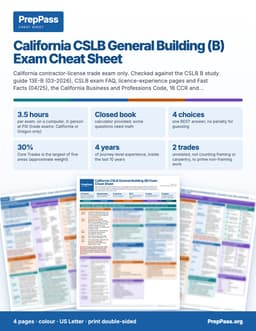
Exam inside two weeks?
This guide is the teaching, read over weeks. If your exam is inside two weeks, the printable colour cheat sheet is the other product: the figures the exam turns on, laid out by section.
See the CSLB Class B — General Building cheat sheet PDF — $9.99 →
4 pages · US Letter · printable PDF · yours to keep
About the exam itself
| Administering body | Contractors State License Board (CSLB), California Department of Consumer Affairs — exam delivered by PSI Services LLC |
|---|---|
| Questions | Not published by CSLB What we read and found nothing in: CSLB — Step 7: Studying for the Examination |
| Time limit | 210 minutes |
| Passing score | Not published by CSLB What we read and found nothing in: CSLB — Step 7: Studying for the Examination |
| Fees |
Source: CSLB — List of All CSLB Fees |
| Languages offered | English · Spanish |
Questions buyers ask
- What has changed on the CSLB Class B — General Building (Trade Exam)?
- Written to the 2025 California codes in force since January 1, 2026 — guards are now CRC R321, stairs R318.7.
- Which CSLB Class B — General Building (Trade Exam) study guide should I use?
- It depends on what you already have. Contractors State License Board (CSLB): Class B General Building examination study guide, free (PDF download) — read it in any case: it is the board's own list of what the exam covers, and it may be all you need if you already know the trade well. Peerless Institute: CSLB General Building (B): Study Guide, $150.00 (study guide only); $250.00 with a trade practice exam — choose Peerless if you want a printed, shipped book, or a bundle that adds an online practice exam. This PrepPass guide: 348 pages, 130 practice questions with explanations, PDF + EPUB, $29.99 one-time — choose this book if you want the Class B topics taught in one place, with the maths worked step by step and practice questions, as a download you can start today. Prices were checked on 2026-09-24; confirm them with each seller.
- Is a study guide enough for the CSLB Class B — General Building (Trade Exam), or do I need a course?
- A book is exam review: it does not replace any education, training or experience Contractors State License Board (CSLB), California Department of Consumer Affairs requires before you may sit the exam, so check those requirements first. For the exam content itself, this 348-page guide teaches the material chapter by chapter with 130 practice questions and explanations inside, and 700 more practice questions are free on PrepPass. A prep course adds live instruction and a set schedule; whether you need one beyond any required education is your call.
- What is the cheapest way to prepare for the CSLB Class B — General Building (Trade Exam)?
- Start with what costs nothing: Class B General Building examination study guide from Contractors State License Board (CSLB) — free (PDF download) and 700 practice questions on PrepPass, with explanations and no signup. If you want it taught in one file you keep, the full study guide is $29.99 once; the printable cheat sheet for the last days is $9.99. No subscription on any of them.
- Who administers the CSLB General Building (B) Trade Examination?
- Contractors State License Board (CSLB), California Department of Consumer Affairs — exam delivered by PSI Services LLC. CSLB's legal existence is set by Business and Professions Code § 7000.5. CSLB states it has contracted with PSI to administer its examinations.
- How many questions are on the CSLB General Building (B) Trade Examination?
- Not published by CSLB. CSLB says only that “All trade examinations consist of multiple-choice questions.” No count appears in the study guide, the Examinations FAQ, or PSI's candidate bulletin.
- How long is the CSLB General Building (B) Trade Examination?
- 210 minutes. CSLB: “You will be given 3-1/2 hours to complete each examination.” It is per examination, not per sitting — a candidate taking Law and Business plus a trade exam gets 3-1/2 hours for each.
- What is the passing score for the CSLB General Building (B) Trade Examination?
- Not published by CSLB. CSLB: “You will be informed at the test site about the percentage of correct answers needed to pass each examination,” and, in Get Licensed to Build Q14, that the percentage “varies for each exam”. Passing candidates are never shown their own score. PrepPass states no passing score for this exam.
- How much does the CSLB General Building (B) Trade Examination cost?
- $450 — Original application (exam or waiver, one classification) (CSLB, one-time); $51.43 — Examination registration (each registration, first attempt or retake) (PSI Services LLC, per attempt); $200 — Initial license fee (sole owner) (CSLB, one-time); $350 — Initial license fee (non-sole owner: partnership, corporation, LLC, joint venture) (CSLB, one-time). Two payees: application and license fees go to CSLB, the per-exam registration fee to PSI. CSLB's 2023 “Get Licensed to Build” PDF still names a $100 rescheduling fee; it appears neither on CSLB's current fee list nor in Business and Professions Code § 7137 as amended effective 1 January 2026, so it is not stated here. The application fee is charged once per original license application and covers both required exams.
- What languages is the CSLB General Building (B) Trade Examination offered in?
- English · Spanish. CSLB publishes Spanish versions of 10 exams and names this one among them. Candidates requesting a translator for those exams are required to take the Spanish version instead.
- Does the CSLB Class B — General Building (Trade Exam) study guide come as a PDF?
- Yes — CSLB Class B General Building — Trade Exam Study Guide (2026) downloads as PDF and EPUB, 348 pages. The download link is emailed the moment payment clears and does not expire.
- How much does the CSLB Class B — General Building (Trade Exam) study guide cost?
- $29.99, once. There is no subscription and no account to create; the PDF and EPUB files are yours to keep.
- Are there free CSLB Class B — General Building (Trade Exam) practice questions?
- Yes — 700 of them, free to use with no signup and an explanation on every one. They are separate from this study guide, which is what you are buying here. The same free, no-account system also has practice modes (adaptive, new questions, spaced review of misses, weak-topic focus, saved, my mistakes); a timed mock exam (100 questions, 210 minutes) with a score report by topic; a 10-question readiness check (about 5 minutes); 5 study chapters; a day-by-day study plan. None of it needs this study guide.
- Can I read part of the CSLB Class B — General Building (Trade Exam) study guide before buying?
- Yes. A full chapter is free to read on this page — not a summary of one, the chapter itself.
- What is the difference between the CSLB Class B — General Building (Trade Exam) study guide and the cheat sheet?
- The study guide ($29.99) teaches the material chapter by chapter and is meant to be read over weeks. The cheat sheet ($9.99, 4 pages) drops the teaching and keeps the figures: every number on the exam grouped by value so the confusable ones sit together, each reference page paired with a recall page that blanks the answers, and four routes by days left — 14, 7, 3, or tonight. They are separate purchases; neither replaces the other.
- Is there a cheaper way to buy the CSLB Class B — General Building (Trade Exam) study guide with anything else?
- Yes. CSLB Law & Business + CSLB Class B is $32.99 for 4 files in one checkout — 55% less than the $74.96 those items cost bought separately today. It adds CSLB Law & Business — Complete Study Guide (2026), CSLB Law & Business — Cheat Sheet (2026), CSLB Class B — General Building — Cheat Sheet (2026). The saving is measured against the items' real current prices; there is no struck-through "original" price on this site.
- Is this the official CSLB Class B — General Building (Trade Exam) study guide?
- No. This is an independent study guide and is not affiliated with or endorsed by the exam's awarding body. It is written from California Building Code (CBC/CRC) / Cal-OSHA Title 8. Always confirm current requirements with the body that issues your licence.
Free CSLB Class B — General Building (Trade Exam) practice questions and study chapters →
How this book compares
CSLB publishes a free Class B study guide that lists what the trade exam covers. This book teaches that material chapter by chapter with worked examples and practice questions; Peerless Institute sells a printed Class B study guide.
| Resource | Price | What you get | Choose it if |
|---|---|---|---|
| This bookCSLB Class B General Building — Trade Exam Study Guide (2026)PrepPass | $29.99 | Downloadable study guide for the Class B trade exam
| Choose this book if you want the Class B topics taught in one place, with the maths worked step by step and practice questions, as a download you can start today. |
| From the exam bodyClass B General Building examination study guide (opens the publisher's page in a new tab)Contractors State License Board (CSLB) | Free (PDF download) | The board's own study guide for the trade exam
| Read it in any case: it is the board's own list of what the exam covers, and it may be all you need if you already know the trade well. |
| AlternativeCSLB General Building (B): Study Guide (opens the publisher's page in a new tab)Peerless Institute | $150.00 (study guide only); $250.00 with a trade practice exam | Printed study guide for the Class B trade exam
| Choose Peerless if you want a printed, shipped book, or a bundle that adds an online practice exam. |
This book
CSLB Class B General Building — Trade Exam Study Guide (2026)
PrepPass
- Price
- $29.99
- What you get
Downloadable study guide for the Class B trade exam
- 130 practice questions, each with a worked explanation
- 348 pages, PDF + EPUB
- Choose it if
- Choose this book if you want the Class B topics taught in one place, with the maths worked step by step and practice questions, as a download you can start today.
From the exam body
Class B General Building examination study guide (opens the publisher's page in a new tab)
Contractors State License Board (CSLB)
- Price
- Free (PDF download)
- What you get
The board's own study guide for the trade exam
- A breakdown of examination topics, sample examination questions, resource information and test strategy
- Choose it if
- Read it in any case: it is the board's own list of what the exam covers, and it may be all you need if you already know the trade well.
Alternative
CSLB General Building (B): Study Guide (opens the publisher's page in a new tab)
Peerless Institute
- Price
- $150.00 (study guide only); $250.00 with a trade practice exam
- What you get
Printed study guide for the Class B trade exam
- Chapters on general building, safety, carpentry, electrical, concrete, plumbing, roofing, a mathematics review, and plans and specifications, among others
- Choose it if
- Choose Peerless if you want a printed, shipped book, or a bundle that adds an online practice exam.
Other resources' prices and contents are as listed on each publisher's or seller's own page, checked September 24, 2026. Prices change; confirm on the linked page before you buy. This book's price and contents come from our own catalog.
Sources (2)
- https://www.cslb.ca.gov/Contractors/Applicants/Examination_Study_Guides/ — read September 24, 2026
- https://www.peerlessinstitute.com/products/peerless-study-guide-general-building-b — read September 24, 2026
What's included — and what isn't
Included
- Every chapter closes the same way: key numbers & facts, the exam traps named one by one, and the takeaways — so the night before is a re-read, not a re-study
- 58 worked examples with every step shown — concrete by the cubic yard, board feet, water-cement ratio, swell, slope factor, labor burden, CPM float
- Planning, plan-reading, takeoffs, and estimating math worked by hand
- Framing & structural: spans, spacing, seismic hardware, load path
- Core & finish trades, envelope, EERO, GFCI/AFCI, fire ratings
- Cal/OSHA safety at the CURRENT limits: lead PEL 10 µg/m³ (not the federal 50), residential framing fall protection at 6 ft, trenching, heat illness, silica
- 130 original practice questions with a worked explanation on every one — and no length tell: taking the longest, second-longest, third or shortest option each pays about 25%, the same as guessing
- Written to the 2025 Title 24 code cycle, with a per-chapter Sources list so you can check any figure at its source
- PDF (print & tab it) + EPUB (phone / e-reader)
Not included
- No printed copy is shipped — this is a file you download and can print yourself
- No video course, instructor or tutoring comes with the book — the free videos on the site are separate
- Not your exam registration or the testing centre's fee, which you still pay to the official body
Contents
See 12 sections and the page each one starts on
- Chapter 1 — Planning & Estimatingp. 11
- Chapter 2 — Framing & Structuralp. 41
- Part I — Siding, stucco, and the water-resistive barrierp. 73
- Chapter 3 — Core Tradesp. 89
- Chapter 4 — Finish Tradesp. 158
- Chapter 5 — Safetyp. 193
- Part I — Enforcement, recordkeeping, and reportingp. 219
- Practice Exam — 130 Questionsp. 233
- Appendix A — Formulas and Conversions Quick Referencep. 285
- Appendix B — Consolidated Key Numbers, with edition flagsp. 292
- Appendix C — Glossary of Trade Termsp. 337
- Appendix D — Exam-Day Strategyp. 344
Taken from the PDF you download, with the page each one starts on — not typed here.
Read a chapter free, in full
One complete chapter, exactly as it ships in the eBook. Scroll the window to read it right here; no download, no email.
Read chapter 3 here, without leaving the page
We didn't give you the easy intro — the free chapter opens on one of the hardest-working parts of the book, so you can judge the teaching where the exam gets difficult.
Introduction
Core Trades is nearly a third of the examination and it is spread across seven subjects: concrete, electrical, plumbing, HVAC, roofing, insulation and weatherproofing, and earthwork. That arithmetic matters for how you study it. Thirty percent divided seven ways is roughly four questions per trade, which tells you the depth the exam is after.
A Class B general building contractor is not being examined as an electrician, a plumber, or a sheet-metal mechanic. You are being examined on whether you can recognize correct and incorrect work, coordinate the trades so they do not collide, sequence them so nothing is covered before inspection, and catch the defects that will fail an inspection or hurt somebody. The exam's own published sample questions sit at the depth of "what is the minimum width of a residential hallway" — recognition, not design.
So this chapter teaches the numbers a general contractor is genuinely expected to know, works the arithmetic that appears on the test, and deliberately stops short of the trade-design material a specialty contractor owns. Where a figure could not be verified against its primary source, it is not in this book. A missing number is a gap; a wrong number in a construction book is a hazard.
Code edition. This chapter is written to the 2025 California Building Standards Code (Title 24), effective January 1, 2026 — the 2025 California Plumbing Code (based on the 2024 UPC), the 2025 California Mechanical Code (2024 UMC), the 2025 California Electrical Code (2023 NEC), the 2025 California Energy Code, the 2025 California Residential and Building Codes, and CALGreen. Concrete provisions reference ACI 318-19, which is the edition the California Building Code adopts in its Chapter 35.
One structural change you must know about. In the 2025 cycle, California Building Code Chapter 7A, California Fire Code Chapter 49, and California Residential Code Section R337 were deleted and consolidated into a new Title 24 Part 7 — the California Wildland-Urban Interface Code (CWUIC), effective January 1, 2026. Every "CBC Chapter 7A" and "CRC R337.x" citation you will see in older study material is now a dead citation. The provisions live in CWUIC Chapter 5.
Learning objectives
After working through this chapter you should be able to:
- Compute a water-cement ratio, find the maximum mixing water for a mix, and calculate what adding water on site does to both the ratio and the strength.
- State the concrete cover requirements and pick the right one for a given exposure.
- Select a concrete exposure class and read its maximum w/c and minimum f'c.
- Compute a rebar takeoff for a slab, in lineal feet and in pounds.
- Apply the curing and 28-day test conventions, and the cold-weather and hot-weather thresholds.
- Recognize correct electrical work: conductor ampacity, GFCI and AFCI locations, receptacle spacing, working space, and the 125%/80% continuous-load rule.
- Compute drainage slope and fall, check a trap arm against its maximum length, and total drainage fixture units.
- Apply the water heater rules — relief valve discharge, seismic strapping, and the statute behind it.
- Size combustion air openings by all three methods and know which figure goes with which.
- Apply duct leakage limits for new and altered systems.
- Give the minimum roof slope for each covering — and explain why the answer changes between the Residential and the Building Code.
- Compute attic and crawl space ventilation net free area under both ratios.
- Distinguish R-value from assembly U-factor and say which one Title 24 actually prescribes.
- Compute cut and fill by the average end area method, and run a differential leveling circuit with its arithmetic check.
Part A — Concrete
What concrete is, and what controls it
Concrete is portland cement, water, fine aggregate (sand), coarse aggregate (rock), and usually admixtures. Cement and water react chemically — hydration — and that reaction, not drying, is what makes concrete hard. Concrete does not dry; it cures. Everything else in this part follows from that one fact.
Compressive strength (f'c) is specified in pounds per square inch and, by long convention, tested at 28 days.
The water-cement ratio
The water-cement ratio is the single most important number in a concrete mix. It is the weight of water divided by the weight of cementitious material:
w/c = weight of water ÷ weight of cement
Lower w/c = stronger and more durable concrete. Higher w/c = weaker, more permeable, more prone to shrinkage cracking and to freeze-thaw damage. That relationship is fundamental, and it is why the codes and standards control the ratio directly rather than the strength alone.
ACI 211.1 publishes the relationship, and it is worth reading in the direction the standard actually runs — from a required strength to a maximum ratio, not the other way:
| Required f'c (psi) | Maximum w/c, non-air-entrained | Maximum w/c, air-entrained |
|---|---|---|
| 6,000 | 0.41 | — |
| 5,000 | 0.48 | 0.40 |
| 4,000 | 0.57 | 0.48 |
| 3,000 | 0.68 | 0.59 |
| 2,000 | 0.82 | 0.74 |
ACI 211.1 is a standard practice, not a code section, and this table assumes 6×12-inch cylinders at 28 days with 3/4-to-1-inch aggregate. Air entrainment costs strength at the same ratio — which is the price of freeze-thaw durability.
Worked example 1 — Maximum mixing water
A mix design calls for 600 pounds of cement per cubic yard and a maximum water-cement ratio of 0.45. What is the maximum water, in pounds and in gallons?
- Maximum water = w/c × cement weight = 0.45 × 600 = 270 pounds
- Water weighs 8.34 pounds per gallon
- Gallons = 270 ÷ 8.34 = 32.4 gallons per cubic yard
That is the entire water budget for a cubic yard — and it includes the free moisture already in the aggregate, which on a wet sand pile can be several gallons per yard. A batch plant corrects for aggregate moisture; a crew mixing on site usually does not, which is one reason site-mixed concrete underperforms.
Worked example 2 — The driver adds water at the site
The same 600-lb, 0.45 mix arrives. The crew says it is too stiff and the driver adds 5 gallons per cubic yard at the chute. What is the new water-cement ratio, and what does it do to the strength?
- Added water = 5 gal × 8.34 = 41.7 pounds
- New total water = 270 + 41.7 = 311.7 pounds
- New w/c = 311.7 ÷ 600 = 0.52
The mix was specified at 0.45 and is now at 0.52. Read that against the ACI 211.1 table: 0.48 corresponds to about 5,000 psi and 0.57 to about 4,000 psi, so 0.52 lands between them — this batch will come in somewhere around the low 4,000s where the specification wanted 5,000-plus. Five gallons of water, poured out of a hose in about forty seconds, has cost roughly a sixth of the concrete's strength, along with more shrinkage cracking, more permeability, and a softer surface.
Adding water on site to improve workability is the classic wrong answer on the exam, and the right answers are the ones that improve workability without adding water:
- A water-reducing admixture or a superplasticizer (high-range water reducer), which increases slump with no added water.
- Ordering the correct slump in the first place.
- Placing the concrete sooner, before it stiffens.
The narrow, controlled exception exists and is worth knowing precisely: where the delivered slump is below the specified slump, a one-time addition of water may be permitted at the site, within the mix's design water allowance, followed by the specified mixing revolutions — the project specification and the mix design govern, and it is never a hose-it-down-until-it-flows decision. If water is added past the design allowance, the load should be rejected.
Slump
Slump measures consistency — how far a cone of fresh concrete settles when the cone is lifted, in inches, tested by ASTM C143. Higher slump means a wetter, more workable, weaker mix.
ACI 211.1's recommended slump ranges, which apply only where slump is not specified:
| Construction | Slump (in) |
|---|---|
| Reinforced foundation walls and footings | 1–3 |
| Plain footings, caissons, substructure walls | 1–3 |
| Beams and reinforced walls | 1–4 |
| Building columns | 1–4 |
| Pavements and slabs | 1–3 |
| Mass concrete | 1–2 |
Add 1 inch where the concrete is not consolidated by vibration. These are recommendations from a standard practice, not code requirements, and this book attaches no code section to them.
Admixtures
| Admixture | What it does | When you use it |
|---|---|---|
| Water reducer | More workability at the same water, or the same workability at less water | To hit slump without raising w/c |
| High-range water reducer (superplasticizer) | A large slump increase with no added water | Congested reinforcement, tight forms |
| Accelerator | Speeds set and early strength | Cold weather, fast turnaround |
| Retarder | Slows set | Hot weather, long hauls, large continuous pours |
| Air-entraining | Creates microscopic air bubbles | Freeze-thaw exposure |
| Corrosion inhibitor | Protects reinforcement | Marine and deicing-salt exposure |
Two exam points. Calcium chloride accelerators corrode reinforcement and are restricted or prohibited where steel is present and in some exposure classes. And air entrainment costs compressive strength — roughly what the ACI 211.1 table's two columns show — which is exactly why it is required only where freeze-thaw demands it.
Exposure classes — ACI 318-19 Table 19.3.2.1
Durability, not strength, drives most concrete requirements. ACI 318 assigns each element an exposure class and sets a maximum w/c and a minimum f'c for each:
| Class | Exposure | Max w/c | Min f'c (psi) |
|---|---|---|---|
| F1 | Freeze-thaw, limited water contact | 0.55 | 3,500 |
| F2 | Freeze-thaw, frequent water contact | 0.45 | 4,500 |
| F3 | Freeze-thaw with deicing chemicals | 0.40 | 5,000 |
| S1 | Moderate sulfate | 0.50 | 4,000 (Type II cement) |
| S2 | Severe sulfate | 0.45 | 4,500 (Type V, no calcium chloride) |
| S3 | Very severe sulfate | 0.45 / 0.40 | 4,500 / 5,000 |
| W2 | In contact with water, low permeability required | 0.50 | 4,000 |
| C2 | Corrosion protection of reinforcement required | 0.40 | 5,000 |
Note the pattern that makes these memorable: the worse the exposure, the lower the allowed ratio and the higher the required strength, and the two move together because they are two views of the same property — permeability.
Separately, and for residential work more often controlling, CRC Table R402.2 sets 2,500 psi for foundations and interior slabs, 3,000 for exterior vertical work in moderate and severe weathering, and 3,000 / 3,500 for porches, carport slabs, exterior steps, and garage floor slabs — with R404 requiring 3,000 psi for foundation walls in Seismic Design Category D0, D1, or D2, which covers most populated California. The CBC §1904.1 defers to ACI 318, with an exception permitting 3,000 psi for Group R-2 and R-3 occupancies of three stories or fewer.
Air content
ACI 318-19 Table 19.3.3.1, total air content by nominal maximum aggregate size:
| Nominal max aggregate | Class F1 | Classes F2 and F3 |
|---|---|---|
| 3/8 in | 6.0% | 7.5% |
| 1/2 in | 5.5% | 7.0% |
| 3/4 in | 5.0% | 6.0% |
| 1 in | 4.5% | 6.0% |
| 1-1/2 in | 4.5% | 5.5% |
| 2 in | 4.0% | 5.0% |
| 3 in | 3.5% | 4.5% |
F2 and F3 share one column. Field tolerance is ±1.5 percent. And note the direction: smaller aggregate needs more air, because air is protecting the paste and a smaller-aggregate mix has more paste.
For comparison, CRC Table R402.2 puts residential air entrainment, where required, at 5 to 7 percent — with a steel-troweled garage floor permitted to drop to 3 percent air if f'c is raised to at least 4,000 psi, because entrained air and steel troweling fight each other and produce surface blistering and delamination.
Reinforcement and cover
Concrete is strong in compression and weak in tension. Steel carries the tension. The bond between them works because steel and concrete have nearly the same coefficient of thermal expansion — they move together.
ASTM A615 bar properties, which the takeoff arithmetic runs on:
| Bar | Nominal diameter | Nominal area | Weight |
|---|---|---|---|
| #3 | 0.375 in | 0.11 in² | 0.376 lb/ft |
| #4 | 0.500 in | 0.20 in² | 0.668 lb/ft |
| #5 | 0.625 in | 0.31 in² | 1.043 lb/ft |
| #6 | 0.750 in | 0.44 in² | 1.502 lb/ft |
The bar number is the diameter in eighths of an inch — a #4 is 4/8 = 1/2 inch, a #6 is 6/8 = 3/4 inch. Use the ASTM nominal areas above rather than computing π d² ÷ 4, which gives slightly different figures (0.196, 0.307, 0.442) and will make your arithmetic disagree with every published table.
Concrete cover — ACI 318-19 Table 20.5.1.3.1. Cover protects the steel from corrosion and fire, and it is the most commonly violated requirement on a residential jobsite:
| Condition | Cover |
|---|---|
| Cast against and permanently in contact with ground | 3 in |
| Exposed to earth or weather, #6 through #18 | 2 in |
| Exposed to earth or weather, #5 and smaller | 1-1/2 in |
| Not exposed — slabs, joists, walls, #14 and #18 | 1-1/2 in |
| Not exposed — slabs, joists, walls, #11 and smaller | 3/4 in |
| Not exposed — beams, columns, pedestals, and ties | 1-1/2 in |
Worked example 3 — Two cover questions
(a) A grade beam is cast directly against earth on its sides and bottom. The crew sets #5 bars on 1-1/2-inch chairs. Correct? (b) A formed foundation wall is exposed to weather and has #5 vertical bars. How much cover?
(a) No. Concrete cast against and permanently in contact with ground requires 3 inches of cover. The 1-1/2-inch figure the crew used is the value for beams and columns not exposed to earth or weather — a real number, applied to the wrong condition. Three inches is required because an earth-formed surface is rough and irregular, and because the steel is in permanent contact with soil moisture. Reinforcement with inadequate cover rusts, and rusting steel expands roughly seven times its own volume, which spalls the concrete off and exposes more steel. The failure is slow, certain, and expensive.
(b) 1-1/2 inches. Exposed to earth or weather, #5 and smaller get 1-1/2 inches; #6 through #18 get 2 inches. The bar size changes the answer, which is exactly what the exam is testing — and it is why "the cover is two inches" is not a complete answer to any cover question.
Worked example 4 — A rebar takeoff
A slab 20 ft × 24 ft is reinforced with #4 bars at 18 inches on center each way. How many lineal feet of steel, and how many pounds?
Run each direction separately, and remember that bars running one way are spaced out along the other dimension.
Bars running the 24-foot direction, laid out across the 20-foot width:
- 20 ft = 240 in; spaces = 240 ÷ 18 = 13.33 → 14 spaces
- Bars = 14 + 1 = 15 bars, each 24 ft = 360 lineal feet
Bars running the 20-foot direction, laid out across the 24-foot width:
- 24 ft = 288 in; spaces = 288 ÷ 18 = 16 spaces
- Bars = 16 + 1 = 17 bars, each 20 ft = 340 lineal feet
Totals:
- Lineal feet = 360 + 340 = 700 lf
- Weight = 700 × 0.668 lb/ft = 467.6 pounds, or about 0.23 ton
Then add for laps and waste, which this calculation deliberately does not include: a 24-foot run has to be spliced from stock lengths, and lap length is set by the structural drawings. The familiar "40 bar diameters" rule of thumb — 40 × 0.5 = 20 inches for a #4 — is worth knowing and worth labeling honestly: it is a field rule of thumb for concrete, and it is not in ACI 318. ACI 318 sets tension lap splices as Class A = 1.0 ℓd or Class B = 1.3 ℓd, with a 12-inch minimum, where the development length ℓd itself varies with concrete strength, bar grade, cover, spacing, and coating. A 40-bar-diameter minimum is real code — for masonry, at IBC §2107.2.1. Take the lap from the structural drawings, not from a rule of thumb.
The traps in this question type: laying out along the wrong dimension (it halves or doubles the count), the fence-post error (13.33 rounds to 14 spaces, which is 15 bars), and rounding the spaces down, which would put the bars further apart than the drawing requires.
Worked example 5 — Bags versus a truck
The nine deck piers from Chapter 1 came to 24.74 cubic feet of concrete. How many bags of premix, and should you bag it?
Manufacturer yields (Quikrete, and they are manufacturer data, not code):
- An 80-lb bag yields about 0.60 cubic foot
- A 60-lb bag yields about 0.45 cubic foot
So:
- 80-lb bags = 24.74 ÷ 0.60 = 41.2 → 42 bags, weighing 42 × 80 = 3,360 pounds
- 60-lb bags = 24.74 ÷ 0.45 = 55 bags
And the conversions worth memorizing: a cubic yard is 27 cubic feet, which is 45 bags of 80-lb mix or 60 bags of 60-lb mix.
Forty-two bags is roughly an hour and a half of mixing for two people, plus the risk of batch-to-batch variation across 42 separate mixes. Against that, 24.74 cubic feet is 0.92 cubic yard, and a ready-mix load at that size carries a short-load charge. The honest answer is that this pour is right at the crossover, and the decision turns on access, on whether the piers must be monolithic, and on whether anyone will actually add the right amount of water to bag number 37.
Normalweight concrete weighs roughly 140 to 150 pounds per cubic foot (NRMCA), so a cubic yard weighs about 4,000 pounds — two tons. That figure decides whether the truck can reach the pour and whether the slab you are demolishing needs a dumpster or three.
Placing, consolidating, curing, and testing
- Do not over-vibrate and do not move concrete with the vibrator. Vibration consolidates and releases entrapped air; too much of it segregates the mix, driving the coarse aggregate down and the paste up. Honeycombing — voids with exposed aggregate at a formed face — is a consolidation failure.
- Cure it. ACI 318-19 §26.5.3.2 requires concrete to be maintained above 50°F and in a moist condition for at least 7 days; high-early-strength concrete for at least 3 days. Note the wording: the 3-day case is "other than high-early-strength" reversed — it is a property of the concrete, not a cement type. ACI 308R gives the curing periods by cement type: Type I 7 days, Type II 10 days, Type III 3 days, Type IV and V 14 days. ACI 301 allows an early end to curing at 70 percent of f'c, which is a specification provision rather than a code one.
- Test it. ACI 318-19 §26.12.1.1(a): a strength test is the average of two 6×12-inch cylinders or three 4×8-inch cylinders, sampled per ASTM C172, cured per ASTM C31, and tested per ASTM C39 at 28 days. One cylinder is not a test.
- Cold weather — ACI 306R-16 §2.2: cold weather exists when the air temperature has fallen to, or is expected to fall below, 40°F during the protection period. Minimum concrete temperature as placed, from ACI 306R: 55°F for sections under 12 inches, 50°F for 12 to 36 inches, 45°F for 36 to 72 inches, and 40°F for over 72 inches — thin sections need to be warmer because they lose heat faster. Protect from freezing; use accelerators, heated water or aggregate, insulating blankets, and enclosures.
- Hot weather — ACI 305R-20 §2.2 sets no numeric threshold. Anyone who tells you "ACI 305 defines hot weather as above 90 degrees" is quoting a citation that does not exist. What is specified: ACI 301 and ACI 305.1 cap concrete discharge temperature at 95°F. Hot-weather practice is retarders, chilled water or ice, shading the aggregate, wetting the subgrade and forms, pouring early or at night, and curing immediately — because in hot, dry, windy conditions the surface can lose water faster than bleed water reaches it, which is what produces plastic shrinkage cracking within the first hours.
Before you buy
- How do I get it?
- Pay, and the download appears on this page straight away. The links are also emailed to you. No account is required.
- What if it isn't for me?
- Email us within 14 days for a full refund, no questions asked.
- Is the free practice going away?
- No. Every practice question, the timed mock and the free chapters on this site stay free. This book is the studying half, not a gate around the free half.
- Can I read it on my phone?
- Yes — the EPUB is for phones and e-readers, the PDF is for printing and tabbing. You get both.
The details
The trade/craft half of the B license — planning & estimating, framing & structural, core & finish trades, and Cal/OSHA safety. Pairs with the Law & Business book.
- Format: PDF + EPUB download · 348 pages
- 130 practice questions in the book, with a full answer key
- 700 free practice questions for this exam on PrepPass, included at no cost
- $29.99 one-time — no subscription
- 14-day money-back guarantee · refund policy
- Cross-referenced against: California Building Code (CBC/CRC) / Cal-OSHA Title 8
- Last updated: September 2026
- Verified from the official source(California Building Code (CBC/CRC) / Cal-OSHA Title 8)
- 700 free practice questions
- Instant download, yours for life
“The book helped me figure out what I actually needed to memorize and the practice questions showed me where I was weak.”
Individual results, shared with permission. Not a pass-rate claim.
A CSLB exam prep course runs $200–$800. This book teaches the same exam — same rules, verified to current standards — for a one-time $29.99 you keep for life.
Why buy the book when the practice is free?
Our practice questions and timed mock stay free — nothing on the site moves behind this book. The $29.99 book is the studying half: the material itself, taught in order, in a file you own.
- Systematic teaching — every exam section explained chapter by chapter, start to finish, not just questions
- Print it & tab it — a paper-ready PDF you can highlight, mark up, and bring to your study table
- Study anywhere, offline — EPUB on your phone or e-reader; no wifi, no browser tabs
- Everything in one place — the chapters and the practice questions in one file
- Yours for life — one-time $29.99, instant download, no subscription
And it's risk-free: 14-day money-back guarantee — not satisfied? Email us for a full refund, no questions asked. See the refund policy.
Also free on PrepPass for CSLB Class B — General Building (Trade Exam)
Beside this guide, PrepPass has a free study system for the same exam. It needs no account, and buying the guide does not unlock or change it: 700 practice questions with explanations; practice modes (adaptive, new questions, spaced review of misses, weak-topic focus, saved, my mistakes); a timed mock exam (100 questions, 210 minutes) with a score report by topic; a 10-question readiness check (about 5 minutes); 5 study chapters; a day-by-day study plan.
Progress is saved in your browser; a free account keeps it across devices. The readiness gauge reflects your own practice, not a prediction of the real exam result. How the practice works
14-day money-back guarantee · full refund, no questions asked.
One-time purchase, lifetime access to the download. The eBook is the full CSLB Class B — General Building (Trade Exam) study guide in PDF and EPUB. Educational summary, not professional or legal advice — always confirm the current rules with the official source. Last updated: September 2026.