Study guide · 2026 Edition
CSLB B-2 Residential Remodeling Study Guide — 2026 Edition
PrepPass's independent 2026 study guide for the CSLB B-2 Residential Remodeling exam is 232 pages including 323 practice questions with a full answer key, PDF + EPUB, $24.99 one-time; it is not affiliated with the exam provider. The book does not include PrepPass's separate online timed mock for this exam (100 questions, 210 minutes). The book also prints its own practice exam, which is separate.
Edition: Written to CSLB study guide 13E-B2 (03-2026) and the 2025 California codes
- Length
- 232 pages
- Practice questions in the book
- 323
- PrepPass online timed mock
- 100 questions · 210 min
- Exam facts checked, file updated
- November 2026
- Delivery
- PDF + EPUB · English · instant download
What is in the CSLB B-2 Residential Remodeling study guide?
The real exam: CSLB Residential Remodeling (B-2) Trade Examination — Questions: Not published by CSLB · 210 minutes · Passing score: Not published by CSLB.
Trade exam prep from CSLB's March 2026 outline, with the 2025 California codes
Examination registration (each registration, first attempt or retake): $51.43 per attempt, paid to PSI Services LLC. A retake pays it again. This guide: $24.99, one time.
Exam facts, who it suits and what changed
About the exam itself
| Administering body | Contractors State License Board (CSLB), California Department of Consumer Affairs — exam delivered by PSI Services LLC |
|---|---|
| Questions | Not published by CSLB What we read and found nothing in: CSLB — Step 7: Studying for the Examination |
| Time limit | 210 minutes |
| Passing score | Not published by CSLB What we read and found nothing in: CSLB — Step 7: Studying for the Examination |
| Fees |
Source: CSLB — List of All CSLB Fees |
| Languages offered | English |
Look inside the book
Three real pages, rendered straight from the PDF you download — a reference page, a teaching page, and a worked question, always in that order. Nothing here was redrawn to look better.
- Quick referenceChapter 1 — Planning and Estimating (15%) · PDF page 19
A page you can turn back to: the numbers, deadlines or terms gathered in one place.
- How it's taughtChapter 3 — Core Trades Remodeling (25%) · PDF page 64
An explanation page: the material taught in prose, in the order the exam tests it.
- A question, workedChapter 4 — Finish Trades Remodeling (18%) · PDF page 96
A practice question with its answer and the reasoning behind it — not just a key.
Exam inside two weeks?
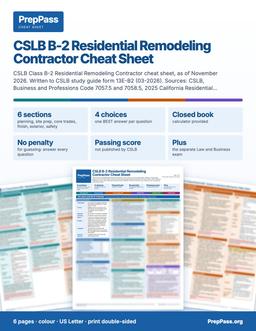
This guide is the teaching, read over weeks. If your exam is inside two weeks, the printable colour cheat sheet is the other product: the figures the exam turns on, laid out by section.
See the CSLB B-2 Residential Remodeling cheat sheet PDF — $9.99 →
6 pages · US Letter · printable PDF · yours to keep
What's included — and what isn't
Included
- Six chapters, one for each CSLB exam section, weighted as CSLB publishes (15/13/25/18/13/16 percent)
- All 25 CSLB outline bullets taught as numbered units, each with rules and a worked example
Not included
- No printed copy is shipped — this is a file you download and can print yourself
- No video course, instructor or tutoring comes with the book — the free videos on the site are separate
Everything included, and everything that isn't
Included
- Estimating math step by step: waste, labor, equipment, markup versus margin, roof squares
- 2025 California Residential Code figures for halls, stairs, escape openings, glazing, roofs and fireplaces
- Cal/OSHA and federal lead-safe rules for demolition, ladders, falls, heat, asbestos, lead and silica
- 323 original practice questions: 71 chapter-quiz, a 100-question practice exam and 152 extra practice, with every option explained
Not included
- Not your exam registration or the testing centre's fee, which you still pay to the official body
Contents
See 19 sections and the page each one starts on
- Chapter 1 — Planning and Estimating (15%)p. 14
- Chapter 2 — Job Site Preparation (13%)p. 37
- Chapter 3 — Core Trades Remodeling (25%)p. 54
- Chapter 4 — Finish Trades Remodeling (18%)p. 79
- Chapter 5 — Exterior Remodeling (13%)p. 99
- Chapter 6 — Safety (16%)p. 115
- Practice exam — 100 questionsp. 134
- Section 1 — Planning and Estimating (15 questions)p. 134
- Section 2 — Job Site Preparation (13 questions)p. 137
- Section 3 — Core Trades Remodeling (25 questions)p. 140
- Section 4 — Finish Trades Remodeling (18 questions)p. 145
- Section 5 — Exterior Remodeling (13 questions)p. 149
- Section 6 — Safety (16 questions)p. 151
- Practice exam answer key and explanationsp. 155
- Appendix A — The exam at a glance, in one tablep. 167
- Appendix B — Terms the exam expects you to use preciselyp. 169
- Appendix C — Formulas and key numbers Formulasp. 171
- Appendix D — Pairs the exam likes to confusep. 176
- Appendix E — Extra practice setsp. 181
Taken from the PDF you download, with the page each one starts on — not typed here.
Read a chapter free, in full
One complete chapter, exactly as it ships in the eBook. Scroll the window to read it right here; no download, no email.
Read chapter 1 here, without leaving the page
The Board gives Planning and Estimating about 15% of the B-2 examination and lists six knowledge statements under it: scope of work and code compliance; design and construction error identification; shop drawings, plans and specifications; field inspection performance; project coordination; and cost estimation for materials, equipment and labor.[1] This is the section where the exam's arithmetic lives, and the study guide says some questions require mathematical computation and that a calculator will be provided.[1] It is also the section that decides whether a job can be taken at all, because a B-2 contractor's license is narrower than it sounds.
1.1 Scope of work and code compliance
What a B-2 contractor may and may not contract for
The classification is defined in Business and Professions Code section 7057.5. A residential remodeling contractor is "a contractor whose principal contracting business is in connection with any project to make improvements to, on, or in an existing residential wood frame structure," and the project "requires the use of at least three unrelated building trades or crafts for a single contract."[2] The statute then adds a rule that the exam loves: a residential remodeling contractor "shall not take a contract unless the contract includes three or more unrelated trades or crafts."[2] A one-trade job, such as painting alone, is outside the B-2 license no matter how small it is.
The statute lists trades a B-2 contractor may take on a prime contract, "which may include, but is not limited to," drywall, finish carpentry, flooring, insulation, painting, plastering, roof repair, siding and tiling, plus installing, repairing or replacing electrical fixtures (dimmers, fans, lights, outlets and switches), plumbing fixtures (faucets, sinks, toilets and tubs) and mechanical fixtures (air filters, air delivery and return grills and preassembled exhaust fans).[2] The contractor may self-perform the work or subcontract any of the trades to an appropriately licensed subcontractor.[2]
The limits
Three restrictions in subdivision (c) of the same section define the edges of the license:
- Trades that always need the right license. A B-2 contractor shall not contract for a project that includes C-16 Fire Protection, C-22 Asbestos Abatement or C-57 Well Drilling work unless the contractor holds that classification or subcontracts with an appropriately licensed contractor.[2]
- No structural changes. A B-2 contractor "shall not contract to make structural changes to load bearing portions of an existing structure, including, but not limited to, footings, foundations, load bearing walls, partitions, and roof structures."[2] This is why Section 2 of the exam teaches removing non-load-bearing walls only.
- Systems versus fixtures. A B-2 contractor shall not contract "to install, replace, substantially alter, or extend electrical, mechanical, or plumbing systems or their component parts" unless it holds the proper classification or subcontracts with a properly licensed contractor; it may contract "to make minor alterations to existing electrical, mechanical, or plumbing systems to effectuate the purpose of installing, repairing, or replacing" fixtures, provided the contract uses at least three unrelated trades.[2]
Read the system rule like a plumber would. Replacing a kitchen faucet is a fixture. Relocating a sink across the room so that new supply and drain lines run through the wall is a change to the plumbing system, and the work goes to a licensed plumber (a C-36 contractor) or a subcontractor holding that license. The same split applies to moving a switch box versus replacing a switch, or replacing a bathroom fan with a preassembled unit versus running new ductwork.
Asbestos sits at the edge
Business and Professions Code section 7058.5 says a contractor shall not engage in asbestos-related work involving 100 square feet or more of surface area of asbestos-containing materials unless it holds a C-22 license or the qualifier has passed the Board's asbestos certification examination.[3] Every applicant for an initial license completes the Board's open-book asbestos examination before the license is issued.[3] For a remodeler the practical rule is simpler: if a survey says the material contains asbestos, the job is no longer a routine demolition (Chapter 6).
Code compliance: which book answers which question
The Board's reference list names the California Building, Electrical, Plumbing and Residential Codes and the Title 8 safety orders.[1] For a one- or two-family dwelling the 2025 California Residential Code (CRC) is the building code, and it sends you to other codes for other systems: the CRC says bathroom fans follow the California Mechanical Code and the California Green Building Standards Code, and that fixtures are "spaced in accordance with the California Plumbing Code."[4] The 2025 California codes took effect January 1, 2026 (Cal. Code Regs., tit. 24)[5], and a California building department's current handouts say they are written to the 2025 CRC, CMC, CEC, CPC, Energy Code and CALGreen.[6]
Permits: when work needs one
Under CRC Section R105.1, any owner or authorized agent who intends to "construct, enlarge, alter, repair, move, demolish or change the occupancy of a building or structure," or to install, alter, remove or replace regulated electrical, gas, mechanical or plumbing systems, must first apply to the building official and obtain the permit.[7] Section R105.2 lists work exempt from a permit, which includes "painting, papering, tiling, carpeting, cabinets, counter tops and similar finish work."[7] The same section says an exemption does not authorize work in violation of the code.[7]
Ordinary repairs need no application, but the exemption "shall not include the cutting away of any wall, partition or portion thereof, the removal or cutting of any structural beam or load-bearing support," or relocating water, drain, gas, waste, vent piping or electric wiring.[7] So a bathroom remodel that removes the wallboard is permitted work even though painting is not. One city's handout puts the same idea in plain terms: a permit is required for a bathroom remodel that includes removal and replacement or relocation of vanity cabinets, toilets, sinks, tubs or showers, alteration of electrical work, or removal and replacement of wallboard, while towel bars, mirrors, paint and floor covers are maintenance items.[6] The same department says a kitchen countertop replacement or refacing of existing cabinets needs no permit, but moving cabinets, sink, dishwasher or the exhaust hood does.[8]
A permit also expires. Under CRC Section R105.5.1 a permit becomes invalid unless work on the site commences within 12 months of issue or is suspended or abandoned for 12 months, and the building official may grant written extensions.[7]
Rules
- A B-2 contract must include three or more unrelated trades; one-trade work is not B-2 work.[2]
- No structural changes to load-bearing walls, partitions, footings, foundations or roof structures.[2]
- Fixtures are in; systems are out. Install, repair or replace fixtures; make only minor alterations to the systems behind them; sub out anything larger.[2]
- C-16, C-22 and C-57 work always goes to the properly licensed contractor.[2]
- A permit is required for the work in CRC R105.1 unless R105.2 exempts it, and an exemption never excuses a code violation.[7]
- Removing wall surfaces, cutting a wall or moving piping or wiring takes the job out of the "ordinary repairs" exemption.[7]
Worked example 1.1 — Is this a B-2 job?
A homeowner asks for: new paint in three rooms, a replacement toilet and vanity faucet in the hall bath, and new hallway flooring. Count the unrelated trades: painting, plumbing fixtures, flooring. Three trades, all on the statute's list, all fixtures or finishes. The B-2 contractor may take the prime contract and may sub any trade. If the owner then adds "move the toilet 4 feet and add a second sink on a new drain line," that is a change to the plumbing system; the contractor must subcontract it to a C-36 licensee or decline it. If the owner adds "remove the wall between the hall and the den," the answer depends on the wall: a bearing wall is structural and outside the license; a non-bearing wall is within it once the framing has been identified (Chapter 2).
Named traps — scope and code compliance
- Two trades are not enough. The statute says three or more unrelated trades, so count trades, not rooms or tasks.
- "Minor alterations" is not a license to relocate. The minor-alterations clause serves fixtures; it does not cover extending systems.
- A permit exemption is not a code exemption. Tile, paint and cabinets need no permit, but fixture clearances, glazing rules and VOC limits still apply.[7]
1.2 Design and construction error identification
Plan review and field checks on a remodel are the same activity at different times: compare what is drawn or built with what the code requires, and catch the mismatch while it is cheap. The most useful habit is a short list of dimensions that remodels violate over and over. The following are all 2025 CRC figures.
The dimension checklist
| Item | Requirement | Where |
|---|---|---|
| Hallway width | not less than 3 feet | R318.6[4] |
| Habitable room area | not less than 70 square feet (kitchens excepted); not less than 7 feet in any horizontal dimension (kitchens excepted) | R312.1, R312.2[4] |
| Ceiling height | habitable space and hallways not less than 7 feet; bathrooms, toilet rooms and laundry rooms not less than 6 feet 8 inches; 6 feet 8 inches over a 30 by 30 inch area at a showerhead | R313.1[4] |
| Egress door | 32 inches clear width, 78 inches clear height | R318.2[4] |
| Stairs | riser not more than 7-3/4 inches; tread not less than 10 inches; width 36 inches; headroom 6 feet 8 inches | R318.7[4] |
| Handrail height | 34 to 38 inches | R320.2[4] |
| Guards | where drop is more than 30 inches; 42 inches high; no opening passing a 4-inch sphere | R321.1[4] |
| Emergency escape and rescue opening | 5.7 sq ft net clear (5 sq ft at grade floor); 24 inches high; 20 inches wide; sill not over 44 inches | R319.2[4] |
| Glazing | natural light 8% of floor area; ventilation 4% of floor area | R325.1[4] |
Two things to notice. First, some figures are exceptions-based: in an existing building, a habitable attic or basement space created in the remodel needs 6 feet 8 inches of ceiling height rather than 7 feet, and alterations to existing stairs "shall not be required to comply with the requirements of this code where the existing space and construction does not allow a reduction in pitch or slope."[4] Second, replacement windows in a required escape opening are exempt from the size rule only if they are "the manufacturer's largest standard size window that will fit within the existing frame or existing rough opening."[4]
Life-safety items that follow the permit
Where alterations, repairs or additions requiring a permit occur, the dwelling unit must be equipped with smoke alarms located as required for new dwellings.[4] Carbon monoxide alarms follow a different trigger: they are required where an addition is made, or where a fuel-burning heater, appliance or fireplace is added to a dwelling not previously required to have them, with exceptions for exterior work such as roofing, siding, windows and doors, for plumbing and for mechanical work that is not fuel fired.[4] Detail is in Chapter 3.
Rules
- Check the dimension checklist before anything is framed: hall width, room size, ceiling height, egress door, stairs, escape openings.[4]
- In a bedroom, basement or habitable attic, always verify the escape opening.[4]
- Verify guards wherever a walking surface is more than 30 inches above the floor or grade below.[4]
- Existing stairs altered in place do not have to be rebuilt to current pitch if the space will not allow it.[4]
- A permit for alterations triggers smoke alarms; carbon monoxide alarms follow their own trigger.[4]
Worked example 1.2 — Finding the error in a bedroom plan
A plan for a new bedroom in an existing house shows a casement window whose net clear opening, as the window actually operates, is 18 inches high by 30 inches wide, with the bottom of the opening 50 inches above the floor. Test each rule. Net clear area is 18 × 30 = 540 square inches; divided by 144 that is 3.75 square feet, below the 5.7 square feet required (the 5-square-foot reduction applies only to grade-floor openings).[4] The clear height of 18 inches is less than the required 24 inches, and the sill at 50 inches is above the 44-inch limit (the 30-inch width does pass the 20-inch minimum).[4] The window fails the area, height and sill tests and must be replaced with a larger one set lower. Whether a sleeping room needs the opening at all is settled by R319.1.[4]
Named traps — error identification
- Clear opening is not frame size. The exam measures the net clear opening produced by normal operation of the window.[4]
- 7 feet is not the only ceiling height. Bathrooms, toilet rooms and laundry rooms use 6 feet 8 inches.[4]
- Hallway width is 3 feet. Do not carry a figure over from a commercial or accessible corridor.[4]
Sources cited in this excerpt
- CSLB License Examination Study Guide: Residential Remodeling (B-2), form 13E-B2 (03-2026), for examinations scheduled on or after August 4, 2021. Contractors State License Board (CSLB), 2026-03; read 2026-11-08. https://www.cslb.ca.gov/Resources/StudyGuides/B02StudyGuide.pdf
- B-2 - Residential Remodeling Contractor (Business and Professions Code section 7057.5), CSLB web page. Contractors State License Board (CSLB), read 2026-11-08. https://www.cslb.ca.gov/About_Us/Library/Licensing_Classifications/Licensing_Classifications_Detail.aspx?Class=B-2
- California Contractors License Law and Reference Book, 2026 edition: Business and Professions Code sections 7055 through 7058.5 (excerpt). Contractors State License Board (CSLB), 2026 edition; read 2026-11-08. https://www.cslb.ca.gov/Resources/GuidesAndPublications/2026/2026_CSLB_Law_Book.pdf
- 2025 California Residential Code (Cal. Code Regs., tit. 24, part 2.5), Chapter 3 Building Planning. California Building Standards Commission (code text via UpCodes), 2025 edition, effective 2026-01-01; read 2026-11-08. https://up.codes/viewer/california/ca-residential-code-2025/chapter/3/building-planning
- 2025 California Plumbing Code (Cal. Code Regs., tit. 24, part 5), section 507.2 Seismic Provisions. California Building Standards Commission (code text via GoCodebook), 2025 edition, effective 2026-01-01; read 2026-11-08. https://gocodebook.com/library/us/ca/ca-plumbing-code/chapter-5-water-heaters/507.2-seismic-provisions
- Residential Bathroom Remodel, handout BSF-0031 revision D (2025 CRC, CMC, CEC, CPC, CEnC and CALGreen requirements), City of Rancho Cucamonga Building and Safety. City of Rancho Cucamonga, Building and Safety Services (a California building department), 2026-02-11; read 2026-11-08. https://www.cityofrc.us/sites/default/files/2026-02/BSF-0031-Bathroom%20Remodel-D.pdf
- 2025 California Residential Code (Cal. Code Regs., tit. 24, part 2.5), Chapter 1 Administration. California Building Standards Commission (code text via UpCodes), 2025 edition, effective 2026-01-01; read 2026-11-08. https://up.codes/viewer/california/ca-residential-code-2025/chapter/1/administration
- Residential Kitchen Remodel, handout BSF-0030 revision B (2025 CRC, CMC, CEC, CEnC and CALGreen requirements), City of Rancho Cucamonga Building and Safety. City of Rancho Cucamonga, Building and Safety Services (a California building department), 2026-02-12; read 2026-11-08. https://www.cityofrc.us/sites/default/files/2026-02/BSF-0030-Residental%20Kitchen%20Remodel-C.pdf
Questions buyers ask
How do I get it?
Pay, and the download appears on this page straight away. The links are also emailed to you. No account is required.
What if it isn't for me?
Email us within 14 days for a full refund, no questions asked.
Is the free practice going away?
No. Every practice question, the timed mock and the free chapters on this site stay free. This book is the studying half, not a gate around the free half.
More questions (17)
Can I read it on my phone?
Yes — the EPUB is for phones and e-readers, the PDF is for printing and tabbing. You get both.
What has changed on the CSLB B-2 Residential Remodeling exam?
Written to CSLB study guide 13E-B2 (03-2026) and the 2025 California codes.
Is a study guide enough for the CSLB B-2 Residential Remodeling exam, or do I need a course?
A book is exam review: it does not replace any education, training or experience Contractors State License Board (CSLB), California Department of Consumer Affairs requires before you may sit the exam, so check those requirements first. For the exam content itself, this 232-page guide teaches the material chapter by chapter with 323 practice questions and explanations inside, and 252 more practice questions are free on PrepPass. A prep course adds live instruction and a set schedule; whether you need one beyond any required education is your call.
What is the cheapest way to prepare for the CSLB B-2 Residential Remodeling exam?
Start with what costs nothing: 252 practice questions on PrepPass, with explanations and no signup. If you want it taught in one file you keep, the full study guide is $24.99 once; the printable cheat sheet for the last days is $9.99. No subscription on any of them.
Who administers the CSLB Residential Remodeling (B-2) Trade Examination?
Contractors State License Board (CSLB), California Department of Consumer Affairs — exam delivered by PSI Services LLC. CSLB's legal existence is set by Business and Professions Code § 7000.5. CSLB states it has contracted with PSI to administer its examinations.
How many questions are on the CSLB Residential Remodeling (B-2) Trade Examination?
Not published by CSLB. CSLB says only that “All trade examinations consist of multiple-choice questions.” No count appears in the study guide, the Examinations FAQ, or PSI's candidate bulletin.
How long is the CSLB Residential Remodeling (B-2) Trade Examination?
210 minutes. CSLB: “You will be given 3-1/2 hours to complete each examination.” It is per examination, not per sitting — a candidate taking Law and Business plus a trade exam gets 3-1/2 hours for each.
What is the passing score for the CSLB Residential Remodeling (B-2) Trade Examination?
Not published by CSLB. CSLB: “You will be informed at the test site about the percentage of correct answers needed to pass each examination,” and, in Get Licensed to Build Q14, that the percentage “varies for each exam”. Passing candidates are never shown their own score. PrepPass states no passing score for this exam.
How much does the CSLB Residential Remodeling (B-2) Trade Examination cost?
$450 — Original application (exam or waiver, one classification) (CSLB, one-time); $51.43 — Examination registration (each registration, first attempt or retake) (PSI Services LLC, per attempt); $200 — Initial license fee (sole owner) (CSLB, one-time); $350 — Initial license fee (non-sole owner: partnership, corporation, LLC, joint venture) (CSLB, one-time). Two payees: application and license fees go to CSLB, the per-exam registration fee to PSI. CSLB's 2023 “Get Licensed to Build” PDF still names a $100 rescheduling fee; it appears neither on CSLB's current fee list nor in Business and Professions Code § 7137 as amended effective 1 January 2026, so it is not stated here. The application fee is charged once per original license application and covers both required exams.
What languages is the CSLB Residential Remodeling (B-2) Trade Examination offered in?
English. CSLB names ten exams that have Spanish versions and B-2 is not one of them, so the B-2 exam is English only. For trade exams without a Spanish version, CSLB says accommodations may be made for a candidate to be joined by an approved translator.
Does the CSLB B-2 Residential Remodeling study guide come as a PDF?
Yes — CSLB B-2 Residential Remodeling Study Guide — 2026 Edition downloads as PDF and EPUB, 232 pages. The download link is emailed the moment payment clears and does not expire.
How much does the CSLB B-2 Residential Remodeling study guide cost?
$24.99, once. There is no subscription and no account to create; the PDF and EPUB files are yours to keep.
Are there free CSLB B-2 Residential Remodeling practice questions?
Yes — 252 of them, free to use with no signup and an explanation on every one. They are separate from this study guide, which is what you are buying here. The same free, no-account system also has practice modes (adaptive, new questions, spaced review of misses, weak-topic focus, saved, my mistakes); a timed mock exam (100 questions, 210 minutes) with a score report by topic; a 10-question readiness check (about 5 minutes); 6 study chapters. None of it needs this study guide.
Can I read part of the CSLB B-2 Residential Remodeling study guide before buying?
Yes. A full chapter is free to read on this page — not a summary of one, the chapter itself.
What is the difference between the CSLB B-2 Residential Remodeling study guide and the cheat sheet?
The study guide ($24.99) teaches the material chapter by chapter and is meant to be read over weeks. The cheat sheet ($9.99, 6 pages) drops the teaching and keeps the figures: every number on the exam grouped by value so the confusable ones sit together, each reference page paired with a recall page that blanks the answers, and four routes by days left — 14, 7, 3, or tonight. They are separate purchases; neither replaces the other.
Is there a cheaper way to buy the CSLB B-2 Residential Remodeling study guide with anything else?
Yes. CSLB Law & Business + CSLB B-2 Residential Remodeling is $30.99 for 4 files in one checkout — 57% less than the $72.96 those items cost bought separately today. It adds CSLB Law & Business — Complete Study Guide (2026), CSLB Law & Business — Cheat Sheet (2026), CSLB B-2 Residential Remodeling — Cheat Sheet (2026). The saving is measured against the items' real current prices; there is no struck-through "original" price on this site.
Is this the official CSLB B-2 Residential Remodeling study guide?
No. This is an independent study guide and is not affiliated with or endorsed by the exam's awarding body. It is written from CSLB B-2 study guide 13E-B2 (03-2026) and the CSLB Examination FAQ, with the primary sources listed in the book's Sources chapter, read November 2026. Always confirm current requirements with the body that issues your licence.
Why buy the book when the practice is free?
Our practice questions and timed mock stay free — nothing on the site moves behind this book. The $24.99 book is the studying half: the material itself, taught in order, in a file you own.
- Systematic teaching — every exam section explained chapter by chapter, start to finish, not just questions
- Print it & tab it — a paper-ready PDF you can highlight, mark up, and bring to your study table
- Study anywhere, offline — EPUB on your phone or e-reader; no wifi, no browser tabs
- Everything in one place — the chapters and the practice questions in one file
- Yours for life — one-time $24.99, instant download, no subscription
The details
- Verified from the official source(CSLB B-2 study guide 13E-B2 (03-2026) and the CSLB Examination FAQ, with the primary sources listed in the book's Sources chapter, read November 2026)
- 252 free practice questions
A CSLB exam prep course runs $200–$800. This book teaches the same exam — same rules, verified to current standards — for a one-time $24.99 you keep for life.
Also free on PrepPass for CSLB B-2 Residential Remodeling
Beside this guide, PrepPass has a free study system for the same exam. It needs no account, and buying the guide does not unlock or change it: 252 practice questions with explanations; practice modes (adaptive, new questions, spaced review of misses, weak-topic focus, saved, my mistakes); a timed mock exam (100 questions, 210 minutes) with a score report by topic; a 10-question readiness check (about 5 minutes); 6 study chapters.
Progress is saved in your browser; a free account keeps it across devices. The readiness gauge reflects your own practice, not a prediction of the real exam result. How the practice works
One-time purchase, lifetime access to the download. The eBook is the full CSLB B-2 Residential Remodeling study guide in PDF and EPUB. Educational summary, not professional or legal advice — always confirm the current rules with the official source. Last updated: November 2026.