Study guide · 2026 Edition
CSLB C-17 Glazing Contractor Study Guide 2026
PrepPass's independent 2026 study guide for the CSLB C-17 Glazing exam is 260 pages including 411 practice questions with a full answer key, PDF + EPUB, $24.99 one-time; it is not affiliated with the exam provider. The book does not include PrepPass's separate online timed mock for this exam (100 questions, 210 minutes).
Edition: Written to CSLB form 13E-17 (03-2026) and the 2025 California codes
- Length
- 260 pages
- Practice questions in the book
- 411
- PrepPass online timed mock
- 100 questions · 210 min
- Exam facts checked, file updated
- November 2026
- Delivery
- PDF + EPUB · English · instant download
What is in the CSLB C-17 Glazing study guide?
The real exam: CSLB Glazing (C-17) Trade Examination — Questions: Not published by CSLB · 210 minutes · Passing score: Not published by CSLB.
Written to CSLB's March 2026 outline, with worked estimating math, the 2025 California glazing code rules and Cal/OSHA safety
Examination registration (each registration, first attempt or retake): $51.43 per attempt, paid to PSI Services LLC. A retake pays it again. This guide: $24.99, one time.
Exam facts, who it suits and what changed
About the exam itself
| Administering body | Contractors State License Board (CSLB), California Department of Consumer Affairs — exam delivered by PSI Services LLC |
|---|---|
| Questions | Not published by CSLB What we read and found nothing in: CSLB — Step 7: Studying for the Examination |
| Time limit | 210 minutes |
| Passing score | Not published by CSLB What we read and found nothing in: CSLB — Step 7: Studying for the Examination |
| Fees |
Source: CSLB — List of All CSLB Fees |
| Languages offered | English |
Look inside the book
Three real pages, rendered straight from the PDF you download — a reference page, a teaching page, and a worked question, always in that order. Nothing here was redrawn to look better.
- Quick referenceAppendix E — Practice sets by exam section · PDF page 258
A page you can turn back to: the numbers, deadlines or terms gathered in one place.
- How it's taughtChapter 3 — Fabrication and Installation of Glazing Materials (18%) · PDF page 82
An explanation page: the material taught in prose, in the order the exam tests it.
- A question, workedChapter 1 — Planning and Estimating (27%) · PDF page 35
A practice question with its answer and the reasoning behind it — not just a key.
Exam inside two weeks?
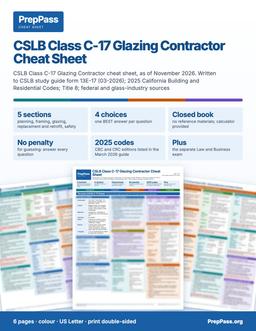
This guide is the teaching, read over weeks. If your exam is inside two weeks, the printable colour cheat sheet is the other product: the figures the exam turns on, laid out by section.
See the CSLB C-17 Glazing cheat sheet PDF — $9.99 →
6 pages · US Letter · printable PDF · yours to keep
What's included — and what isn't
Included
- Five chapters, one for each CSLB section, weighted 27%, 21%, 18%, 15% and 19% as CSLB publishes them
- 59 worked examples: reading a glazing schedule, area and perimeter, setting blocks, glass weight, sealant quantities, markup versus margin
Not included
- No printed copy is shipped — this is a file you download and can print yourself
- No video course, instructor or tutoring comes with the book — the free videos on the site are separate
Everything included, and everything that isn't
Included
- Hazardous-location safety glazing in the 2025 California Building Code and Residential Code, side by side
- Frame measuring, shimming and anchoring, and glass setting rules from glass-maker guidelines and federal guide specifications
- Cal/OSHA fall protection, opening, ladder, scaffold and heat rules with the numbers to memorize
- 411 original practice questions, with an explanation for every answer choice
Not included
- Not your exam registration or the testing centre's fee, which you still pay to the official body
Contents
See 13 sections and the page each one starts on
- Chapter 1 — Planning and Estimating (27%)p. 14
- Chapter 2 — Fabrication and Installation of Framing Systems (21%)p. 38
- Chapter 3 — Fabrication and Installation of Glazing Materials (18%)p. 61
- Chapter 4 — Glazing Replacement and Retrofit Projects (15%)p. 93
- Chapter 5 — Safety (19%)p. 112
- Practice exam — 100 questionsp. 136
- Practice exam — Section 3: Fabrication and Installation of Glazing Materials (18 questions)p. 146
- Practice exam answer key and explanationsp. 157
- Appendix A — The exam at a glance, in one tablep. 168
- Appendix B — Terms the exam expects you to use preciselyp. 169
- Appendix C — Formulas and key numbers Formulasp. 171
- Appendix D — Pairs the exam likes to confuse Pair The differencep. 175
- Appendix E — Practice sets by exam sectionp. 176
Taken from the PDF you download, with the page each one starts on — not typed here.
Read a chapter free, in full
One complete chapter, exactly as it ships in the eBook. Scroll the window to read it right here; no download, no email.
Read chapter 1 here, without leaving the page
The Board gives Planning and Estimating about 27% of the C-17 examination, the largest share of any section, and lists two knowledge statements under it: evaluating plans and specifications, and performing job-related calculations.[1] This is the section where careful reading and careful arithmetic earn the most marks, and it is the section that most often decides a bid. A glazing contractor who reads the glass type wrong orders the wrong glass; one who divides square inches by 144 only once instead of treating both dimensions the same way prices a job at a fraction of its cost. The Board also says that some questions require mathematical computation and that a calculator will be provided.[1] Expect numbers.
1.1 Evaluating plans and specifications
What a C-17 contractor is licensed to do
Scope questions are planning questions, so start with the license itself. The Board's classification text says a glazing contractor "selects, cuts, assembles and/or installs all makes and kinds of glass, glass work, mirrored glass, and glass substitute materials for glazing; executes the fabrication and glazing of frames, panels, sashes and doors; and/or installs these items in any structure."[2] Read it phrase by phrase:
- Selects, cuts, assembles and installs. The license covers the whole chain from choosing the glass to setting it, including the shop work of cutting and assembling.
- All makes and kinds of glass, glass work, mirrored glass. Float glass, tempered, laminated, insulating units, mirrors and decorative glass are all inside the license.
- Glass substitute materials for glazing. Rigid plastic glazing sheets are named, because they are installed like glass.
- Fabrication and glazing of frames, panels, sashes and doors. The contractor may build the frame as well as set the glass in it. This is why the exam has a whole section on framing systems (Chapter 2).
- In any structure. There is no building-type limit in the definition. A glazier may work on a house, a storefront or a high-rise.
What the sentence does not say matters too. It does not mention structural steel, masonry, roofing, general carpentry or electrical work. When a project needs the structure altered to receive a larger opening, or power run to an automatic door operator, that work belongs to another license class. Planning means knowing where your scope stops so the bid does not quietly include someone else's work.
The documents and what each one tells you
A glazing job is described by several documents, and the exam expects you to know which one answers which question.
- Plans (floor plans). Show where openings are, which way doors swing and what is on each side of the glass. You find hazardous locations here: a sidelite beside a door, a window at a stair landing, a shower enclosure.
- Elevations. Show each opening as seen from outside or inside, with the frame divisions and a mark for each lite or opening type. Count lites and frame bays here.
- Sections and details. Cut through the frame and the wall to show the glass pocket, the stops or beads, the sealant joints and the flashing. This is where bite, clearances, weeps and sealant joint sizes are drawn.
- Schedules. Tables listing each opening type: size, frame, glass type, hardware and notes. The glazing schedule lists each glass type by mark (for example G-1, G-2) with the makeup, coating, tint and the standard it must meet.
- Specifications. The written requirements: products, performance, standards, installation methods, testing, warranty and cleaning. Where drawing and specification disagree, the contract documents say which governs; read that clause and, when still unclear, ask in writing before pricing.
- Addenda. Changes issued during bidding. A bid that ignores an addendum prices the wrong job.
- Shop drawings, product data and samples (submittals). Prepared by the glazing contractor or the frame manufacturer for review before fabrication. They show actual lite sizes, glass makeup, anchor locations and joint details.
A request for information (RFI) is the proper way to resolve a conflict. Never resolve a conflict by guessing and never by quietly choosing the cheaper reading.
Reading a glazing schedule
A glazing schedule row packs a lot into a few marks, so learn to unpack it. Take this row:
| Mark | Location | Type | Makeup | Notes |
|---|---|---|---|---|
| G-2 | Storefront sidelites | Insulating, low-e | 1/4 in fully tempered, 1/2 in air space, 1/4 in fully tempered, coating on surface 2 | Safety glazing, hazardous location |
- Insulating means an insulating glass unit (IGU): two or more lites separated by a sealed space. The Energy Commission's manual defines an IG unit as including "the glazing, coatings, tinting, spacer(s), films (if any), gas infills, and edge caulking."[3]
- Makeup lists the outboard lite first, then the air space, then the inboard lite. Glass surfaces are numbered counting from the exterior (surface 1) to the interior.[4] In a double-glazed unit surface 1 is the outside face of the outer lite, surface 2 is the inside face of the outer lite, surface 3 is the inside face of the inner lite, and surface 4 is the room-side face of the inner lite.
- Coating on surface 2 tells you a low-emissivity coating sits on the inboard face of the outer lite. The Energy Commission says low-e coatings are "applied to the second, third, or fourth surfaces in double- or triple-glazed windows or skylights."[3] A coated lite installed backward still looks like glass and performs the wrong way, so the surface number is an instruction to the installer, not decoration.
- Fully tempered on both lites is what the safety-glazing note demands in a hazardous location; Chapter 3 covers which locations those are.
- Overall thickness of this unit is 1/4 + 1/2 + 1/4 = 1 inch. That is the number that must fit the glazing pocket.
Glass terms you must read at a glance
- Annealed glass is glass cooled slowly so residual stress is low; it can be cut and fabricated. The federal glazing standard says annealed glass "has been subjected to a slow, controlled cooling process during manufacture to control residual stresses so that it can be cut or subjected to other fabrication."[5]
- Heat-strengthened (HS) and fully tempered (FT) glass are both heat-treated by heating and rapid cooling; "the rate of cooling that determines whether the final product is heat-strengthened or fully tempered."[6] Rules of thumb in the industry: HS is about twice as strong as annealed of the same thickness and FT about four times.[6] Heat-strengthened glass "is not a safety glazing material" unless laminated.[6]
- Laminated glass is "two or more pieces of glass" bonded to an interlayer of resilient plastic.[5]
- Insulating glass unit (IGU) is a factory-sealed unit of two or more lites; the Guardian technical brochure describes one or more "hermetically sealed cavities, filled with either air or inert gas."[4]
- Spandrel glass covers the zone between floors where the building does not want to be seen through. Tempered spandrel glass is the one case where the code lets the identification be a removable paper marking.[7]
- Lite (light) is one piece of glass in an opening. The Energy Commission uses it for "a layer of glazing material, especially in a multilayered IG unit". Do not confuse a lite with a pane in an IGU count: the code says two panes laminated together are not double-pane glazing.[3]
- Daylight opening (DLO) is the visible glass area inside the stops. Glass size (cut size) is larger than the DLO because the glass edge sits inside the frame.
- Sightline is the visible line of the frame or glazing seal as seen from the room or outside.
Performance the documents may demand
Specifications name performance, and each item has a figure or a test behind it.
- Wind and seismic. The code requires vertical glass to resist the design wind load, and glass in curtain walls, storefronts and glazed partitions to meet the seismic requirements of ASCE 7.[7] The load resistance of glass under uniform load is determined by the ASTM E1300 practice.[7] The glazing contractor's job is to install the glass thickness and type the engineered design calls for. Never swap thickness or type without a written change.
- Thermal performance. Three numbers appear on a fenestration label: U-factor, solar heat gain coefficient (SHGC) and visible transmittance (VT). The Energy Commission puts it plainly: "The lower the U-factor, the more energy efficient the product is."[3] "A low SHGC number (closer to 0) means that the fenestration product keeps out most solar heat."[3] And visible transmittance "is the ratio of visible light transmitted through the fenestration."[3] The U-factor is for the whole product, not the center of the glass: for metal-framed products "the frame losses can be significant."[3]
- Safety. Glass in hazardous locations must pass the federal impact test or its ANSI equivalent, as Chapter 3 explains.[7]
- Fire rating. Glass in a rated opening carries a rating label; Chapter 3.
- Acoustic, security, impact and blast performance appear in some specifications as test-based claims. The contractor installs the tested assembly. Changing a lite, a bead, a gasket or a sealant can void a test.
Field dimensions come before shop dimensions
Specifications routinely say "field verify" for a reason. The federal guide specification tells the glazier to "Determine the sizes to provide the required edge clearances by measuring the actual opening to receive the glass."[8] The storefront specification adds "Field-verify dimensions before fabricating components."[9] Frames and openings are never exactly the drawn size. Glass ordered from the drawing and found too tight in the field has to be scrapped, because heat-treated glass and sealed units cannot be cut down.[6, 10]
Identification, submittals and the inspector
Every pane must be identifiable. The Building Code requires that "Each pane shall bear the manufacturer's mark designating the type and thickness of the glass or glazing material." The identification may be omitted only when approved and "an affidavit is furnished by the glazing contractor certifying that each light is glazed in accordance with approved construction documents."[7] That affidavit is a contractor's own legal statement. Do not sign one for glass you did not check. Leave the labels on until the work is accepted; the federal guide specification says "Leave labels in place until the installation is approved", with exceptions for heat-absorbing glass and insulating units (see Chapter 3).[8]
Worked example 1.1 — Reading a scale
An elevation is drawn at 1/4 inch = 1 foot. A storefront bay measures 3-1/2 inches wide on the drawing. How wide is it in real life?
- At 1/4 inch to the foot, one drawing inch is 4 feet.
- The bay is 3.5 × 4 = 14 feet wide.
A section is drawn at 1-1/2 inches = 1 foot, and the glass pocket measures 3/4 inch on the drawing. One drawing inch is 12 ÷ 1.5 = 8 real inches, so the pocket is 0.75 × 8 = 6 inches deep in real life. Check the answer against the product: a 6-inch pocket is far too deep for a lite, so a pocket that scales to 6 inches means the detail is not at the scale you assumed, or the callout is for a wall element. Always read the scale printed under each view, because one sheet can carry several scales, and sanity-check any scaled dimension against what the product can physically be.
Worked example 1.2 — Unpacking a glazing schedule row
A schedule says: "G-5, borrowed lites at corridor, 3/8 in laminated, 1/8 in PVB, fully tempered both plies, 45-minute fire-protection rated, 2 ft 6 in × 5 ft 0 in each, qty 6." List what you must verify before ordering.
- The row asks for a fire-rated assembly. The glass alone is not the rating: the frame, stops, gasket or glazing compound and anchorage are part of the labeled assembly, and the label on the glass must show the rating. Chapter 3 teaches the marking.
- "Borrowed lite" and "corridor" mean a wall that is required to be rated. Check the rated wall type on the plans, because the code limits the area of fire-protection-rated glazing in a wall.[11]
- The size is the glass or the opening? Ask. Check whether the listed assembly was tested up to that size.
- A rated laminated lite is a listed, labeled product, not a field lamination, so confirm that the makeup in the schedule matches a listed assembly before ordering.
- Six lites at 2.5 × 5 ft each is 12.5 sq ft per lite and 75 sq ft in all. The area per lite exceeds 9 square feet, which also puts the Category II impact class in play if the lite is in a hazardous location.[5]
Worked example 1.3 — Specification versus code
A specification calls for 1/4 inch annealed glass in a 3 ft × 5 ft window whose bottom edge is 12 inches above the floor, 24 inches from a walkway, in a commercial building. Is this a conflict?
- Exposed area: 3 × 5 = 15 square feet, which is more than 9 square feet.[7]
- Bottom edge 12 inches above the floor is less than 18 inches.[7]
- Top edge is 12 + 60 = 72 inches, which is more than 36 inches.[7]
- A walking surface is within 36 inches horizontally of the glass.[7]
All four conditions are met, so this is a hazardous location and the glass must be safety glazing (Category II because the lite is over 9 square feet). The specification as written conflicts with the code. The correct step is a written RFI. The correct bid is the compliant glass, or a clearly stated exclusion approved in writing. Never install the annealed glass because "the spec says so": the code is the minimum and the contractor who installs glass that violates it owns the problem.[7]
Rules for evaluating plans and specifications
- Read the scope sentence of your license and your contract; price only what both cover.
- Read the specification section and the drawings together; note every glass mark and every detail callout.
- Check each glass mark against the hazardous-location rules before pricing.
- Write an RFI for every conflict, in writing, before you bid or order.
- Field-verify openings before fabrication; heat-treated and sealed glass cannot be recut.
- Confirm the standard each product must meet and the label that proves it.
- Do not substitute thickness, type, coating or accessories without written approval.
- Check addenda before you sign a bid.
Named traps — plans and specifications
- The surface-number trap. Coating "on surface 2" means the inboard face of the outer lite, counting from outside. Counting from the room is wrong.
- The nominal-size trap. A schedule's opening size is not the cut size of the glass.
- The code-minimum trap. A specification that is silent about safety glazing does not excuse the glazier.
- The "or equal" trap. An equal product still has to be submitted and accepted before it is installed.
- The scale-mix trap. One sheet can carry several scales. Read the one printed under each view.
- The rated-glass trap. The rating belongs to the labeled assembly, not to the glass alone.
Sources cited in this excerpt
- CSLB License Examination Study Guide: Glazing (C-17), form 13E-17 (03-2026), for examinations scheduled on or after April 1, 2023. Contractors State License Board (CSLB), 2026-03; read 2026-11-08. https://www.cslb.ca.gov/Resources/StudyGuides/C17StudyGuide.pdf
- C-17 - Glazing Contractor (Title 16 CCR Division 8, Article 3, Classifications), CSLB web page. Contractors State License Board (CSLB), read 2026-11-08. https://www.cslb.ca.gov/About_Us/Library/Licensing_Classifications/Licensing_Classifications_Detail.aspx?Class=C-17
- 2025 Building Energy Efficiency Standards, 2025 Single-Family Residential Compliance Manual, Chapter 3 (fenestration and envelope), file 8635. California Energy Commission, 2025 standards; read 2026-11-08. https://www.energy.ca.gov/filebrowser/download/8635?fid=8635
- Expert Series: Insulating Glass - The History, Evolution and Mechanics of the IGU (2020) (manufacturer data). Guardian Glass (manufacturer), 2020; read 2026-11-08. https://www.guardianglass.com/content/dam/guardianindustriesholdings/collateral/usca/brochure_expert_series_EN_doc3_igu_2020.pdf
- 16 CFR Part 1201 Safety Standard for Architectural Glazing Materials (eCFR, current). U.S. Consumer Product Safety Commission, via eCFR, read 2026-11-08. https://www.ecfr.gov/current/title-16/part-1201
- Recommended Applications for Heat-Treated Glass, Glass Technical Paper FB45-14 (2019). Glass Association of North America / National Glass Association, 2019; read 2026-11-08. https://glass.org/sites/default/files/2021-08/FB45-14_2019_Recommended_Applications_for_Heat-Treated_Glass_0521_0.pdf
- 2025 California Building Code (Cal. Code Regs., tit. 24, part 2), Chapter 24 Glass and Glazing. California Building Standards Commission (code text via UpCodes), 2025 edition, effective 2026-01-01; read 2026-11-08. https://up.codes/viewer/california/ca-building-code-2025/chapter/24/glass-and-glazing
- UFGS 08 81 00 Glazing (May 2019). U.S. Department of Defense (USACE / NAVFAC / AFCEC), Unified Facilities Guide Specifications, via WBDG, 2019-05; read 2026-11-08. https://www.wbdg.org/FFC/DOD/UFGS/UFGS%2008%2081%2000.pdf
- UFGS 08 41 13 Aluminum-Framed Entrances and Storefronts (November 2016, Change 1 08/18). U.S. Department of Defense (USACE / NAVFAC / AFCEC), Unified Facilities Guide Specifications, via WBDG, 2016-11 chg 1 2018-08; read 2026-11-08. https://www.wbdg.org/FFC/DOD/UFGS/UFGS%2008%2041%2013.pdf
- General glazing guidelines, Technical Information ATS-192 (2013-01-02) (manufacturer data). Pilkington North America, Inc. (manufacturer), 2013-01-02; read 2026-11-08. https://www.pilkington.com/-/media/pilkington/site-content/usa/window-manufacturers/technical-bulletins/ats192generalglazingguidelines2013102.pdf
- 2025 California Building Code (Cal. Code Regs., tit. 24, part 2), Chapter 7 Fire and Smoke Protection Features (Section 716 Opening Protectives). California Building Standards Commission (code text via UpCodes), 2025 edition, effective 2026-01-01; read 2026-11-08. https://up.codes/viewer/california/ca-building-code-2025/chapter/7/fire-and-smoke-protection-features
Questions buyers ask
How do I get it?
Pay, and the download appears on this page straight away. The links are also emailed to you. No account is required.
What if it isn't for me?
Email us within 14 days for a full refund, no questions asked.
Is the free practice going away?
No. Every practice question, the timed mock and the free chapters on this site stay free. This book is the studying half, not a gate around the free half.
More questions (17)
Can I read it on my phone?
Yes — the EPUB is for phones and e-readers, the PDF is for printing and tabbing. You get both.
What has changed on the CSLB C-17 Glazing exam?
Written to CSLB form 13E-17 (03-2026) and the 2025 California codes.
Is a study guide enough for the CSLB C-17 Glazing exam, or do I need a course?
A book is exam review: it does not replace any education, training or experience Contractors State License Board (CSLB), California Department of Consumer Affairs requires before you may sit the exam, so check those requirements first. For the exam content itself, this 260-page guide teaches the material chapter by chapter with 411 practice questions and explanations inside, and 260 more practice questions are free on PrepPass. A prep course adds live instruction and a set schedule; whether you need one beyond any required education is your call.
What is the cheapest way to prepare for the CSLB C-17 Glazing exam?
Start with what costs nothing: 260 practice questions on PrepPass, with explanations and no signup. If you want it taught in one file you keep, the full study guide is $24.99 once; the printable cheat sheet for the last days is $9.99. No subscription on any of them.
Who administers the CSLB Glazing (C-17) Trade Examination?
Contractors State License Board (CSLB), California Department of Consumer Affairs — exam delivered by PSI Services LLC. CSLB's legal existence is set by Business and Professions Code § 7000.5. CSLB states it has contracted with PSI to administer its examinations.
How many questions are on the CSLB Glazing (C-17) Trade Examination?
Not published by CSLB. CSLB says only that “All trade examinations consist of multiple-choice questions.” No count appears in the study guide, the Examinations FAQ, or PSI's candidate bulletin.
How long is the CSLB Glazing (C-17) Trade Examination?
210 minutes. CSLB: “You will be given 3-1/2 hours to complete each examination.” It is per examination, not per sitting — a candidate taking Law and Business plus a trade exam gets 3-1/2 hours for each.
What is the passing score for the CSLB Glazing (C-17) Trade Examination?
Not published by CSLB. CSLB: “You will be informed at the test site about the percentage of correct answers needed to pass each examination,” and, in Get Licensed to Build Q14, that the percentage “varies for each exam”. Passing candidates are never shown their own score. PrepPass states no passing score for this exam.
How much does the CSLB Glazing (C-17) Trade Examination cost?
$450 — Original application (exam or waiver, one classification) (CSLB, one-time); $51.43 — Examination registration (each registration, first attempt or retake) (PSI Services LLC, per attempt); $200 — Initial license fee (sole owner) (CSLB, one-time); $350 — Initial license fee (non-sole owner: partnership, corporation, LLC, joint venture) (CSLB, one-time). Two payees: application and license fees go to CSLB, the per-exam registration fee to PSI. CSLB's 2023 “Get Licensed to Build” PDF still names a $100 rescheduling fee; it appears neither on CSLB's current fee list nor in Business and Professions Code § 7137 as amended effective 1 January 2026, so it is not stated here. The application fee is charged once per original license application and covers both required exams.
What languages is the CSLB Glazing (C-17) Trade Examination offered in?
English. CSLB names ten exams that have Spanish versions and C-17 is not one of them, so the C-17 exam is English only. For trade exams without a Spanish version, CSLB says accommodations may be made for a candidate to be joined by an approved translator.
Does the CSLB C-17 Glazing study guide come as a PDF?
Yes — CSLB C-17 Glazing Contractor Study Guide 2026 downloads as PDF and EPUB, 260 pages. The download link is emailed the moment payment clears and does not expire.
How much does the CSLB C-17 Glazing study guide cost?
$24.99, once. There is no subscription and no account to create; the PDF and EPUB files are yours to keep.
Are there free CSLB C-17 Glazing practice questions?
Yes — 260 of them, free to use with no signup and an explanation on every one. They are separate from this study guide, which is what you are buying here. The same free, no-account system also has practice modes (adaptive, new questions, spaced review of misses, weak-topic focus, saved, my mistakes); a timed mock exam (100 questions, 210 minutes) with a score report by topic; a 10-question readiness check (about 5 minutes); 5 study chapters. None of it needs this study guide.
Can I read part of the CSLB C-17 Glazing study guide before buying?
Yes. A full chapter is free to read on this page — not a summary of one, the chapter itself.
What is the difference between the CSLB C-17 Glazing study guide and the cheat sheet?
The study guide ($24.99) teaches the material chapter by chapter and is meant to be read over weeks. The cheat sheet ($9.99, 6 pages) drops the teaching and keeps the figures: every number on the exam grouped by value so the confusable ones sit together, each reference page paired with a recall page that blanks the answers, and four routes by days left — 14, 7, 3, or tonight. They are separate purchases; neither replaces the other.
Is there a cheaper way to buy the CSLB C-17 Glazing study guide with anything else?
Yes. CSLB Law & Business + CSLB C-17 Glazing is $30.99 for 4 files in one checkout — 57% less than the $72.96 those items cost bought separately today. It adds CSLB Law & Business — Complete Study Guide (2026), CSLB Law & Business — Cheat Sheet (2026), CSLB C-17 Glazing — Cheat Sheet (2026). The saving is measured against the items' real current prices; there is no struck-through "original" price on this site.
Is this the official CSLB C-17 Glazing study guide?
No. This is an independent study guide and is not affiliated with or endorsed by the exam's awarding body. It is written from CSLB C-17 study guide 13E-17 (03-2026) and the CSLB Examination FAQ, with the primary sources listed in the book's Sources chapter, read November 2026. Always confirm current requirements with the body that issues your licence.
Why buy the book when the practice is free?
Our practice questions and timed mock stay free — nothing on the site moves behind this book. The $24.99 book is the studying half: the material itself, taught in order, in a file you own.
- Systematic teaching — every exam section explained chapter by chapter, start to finish, not just questions
- Print it & tab it — a paper-ready PDF you can highlight, mark up, and bring to your study table
- Study anywhere, offline — EPUB on your phone or e-reader; no wifi, no browser tabs
- Everything in one place — the chapters and the practice questions in one file
- Yours for life — one-time $24.99, instant download, no subscription
The details
- Verified from the official source(CSLB C-17 study guide 13E-17 (03-2026) and the CSLB Examination FAQ, with the primary sources listed in the book's Sources chapter, read November 2026)
- 260 free practice questions
A CSLB exam prep course runs $200–$800. This book teaches the same exam — same rules, verified to current standards — for a one-time $24.99 you keep for life.
Also free on PrepPass for CSLB C-17 Glazing
Beside this guide, PrepPass has a free study system for the same exam. It needs no account, and buying the guide does not unlock or change it: 260 practice questions with explanations; practice modes (adaptive, new questions, spaced review of misses, weak-topic focus, saved, my mistakes); a timed mock exam (100 questions, 210 minutes) with a score report by topic; a 10-question readiness check (about 5 minutes); 5 study chapters.
Progress is saved in your browser; a free account keeps it across devices. The readiness gauge reflects your own practice, not a prediction of the real exam result. How the practice works
One-time purchase, lifetime access to the download. The eBook is the full CSLB C-17 Glazing study guide in PDF and EPUB. Educational summary, not professional or legal advice — always confirm the current rules with the official source. Last updated: November 2026.