Study guide · 2026 Edition
CSLB C-53 Swimming Pool Study Guide — 2026 Edition
PrepPass's independent 2026 study guide for the CSLB C-53 Swimming Pool exam is 218 pages including 216 practice questions with a full answer key, PDF + EPUB, $24.99 one-time; it is not affiliated with the exam provider. The book does not include PrepPass's separate online timed mock for this exam (100 questions, 210 minutes). The book also prints its own practice exam, which is separate.
Edition: Follows CSLB guide 13E-53 (03-2026) and 2025 CA codes, with the Safety Act's 2025 changes
- Length
- 218 pages
- Practice questions in the book
- 216
- PrepPass online timed mock
- 100 questions · 210 min
- Exam facts checked, file updated
- November 2026
- Delivery
- PDF + EPUB · English · instant download
What is in the CSLB C-53 Swimming Pool study guide?
The real exam: CSLB Swimming Pool (C-53) Trade Examination — Questions: Not published by CSLB · 210 minutes · Passing score: Not published by CSLB.
Seven sections, 26 knowledge statements, 216 explained questions
Examination registration (each registration, first attempt or retake): $51.43 per attempt, paid to PSI Services LLC. A retake pays it again. This guide: $24.99, one time.
Exam facts, who it suits and what changed
About the exam itself
| Administering body | Contractors State License Board (CSLB), California Department of Consumer Affairs — exam delivered by PSI Services LLC |
|---|---|
| Questions | Not published by CSLB What we read and found nothing in: CSLB — Step 7: Studying for the Examination |
| Time limit | 210 minutes |
| Passing score | Not published by CSLB What we read and found nothing in: CSLB — Step 7: Studying for the Examination |
| Fees |
Source: CSLB — List of All CSLB Fees |
| Languages offered | English |
Look inside the book
Three real pages, rendered straight from the PDF you download — a reference page, a teaching page, and a worked question, always in that order. Nothing here was redrawn to look better.
- Quick referenceAppendix I — Field notes by chapter · PDF page 208
A page you can turn back to: the numbers, deadlines or terms gathered in one place.
- How it's taughtChapter 2 — Swimming Pool/Spa Shell Construction (32%) · PDF page 48
An explanation page: the material taught in prose, in the order the exam tests it.
- A question, workedChapter 4 — Pool/Spa Deck and Shell Finish (9%) · PDF page 88
A practice question with its answer and the reasoning behind it — not just a key.
Exam inside two weeks?
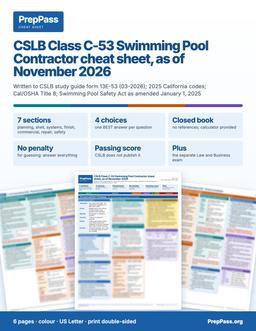
This guide is the teaching, read over weeks. If your exam is inside two weeks, the printable colour cheat sheet is the other product: the figures the exam turns on, laid out by section.
See the CSLB C-53 Swimming Pool cheat sheet PDF — $9.99 →
6 pages · US Letter · printable PDF · yours to keep
What's included — and what isn't
Included
- Seven chapters that follow CSLB's seven sections and all 26 knowledge statements, weighted like the outline
- Worked calculations: gallons, flow rate, filter area, concrete yards, deck volume, downpayment cap
Not included
- No printed copy is shipped — this is a file you download and can print yourself
- No video course, instructor or tutoring comes with the book — the free videos on the site are separate
Everything included, and everything that isn't
Included
- 2025 California codes and the Swimming Pool Safety Act with its January 2025 changes, residential and public rules kept apart
- 216 original questions: 60 chapter-quiz questions, a 100-question practice exam and 56 practice-set questions, each explaining every option
- Appendices: formula sheet, glossary, exam-day strategy, and a table of numbers with the code edition each comes from
- Four worked case problems and a four-week study plan
Not included
- Not your exam registration or the testing centre's fee, which you still pay to the official body
Contents
See 28 sections and the page each one starts on
- Chapter 1 — Planning and Estimating (21%)p. 11
- Chapter 2 — Swimming Pool/Spa Shell Construction (32%)p. 30
- Chapter 3 — Pool/Spa Systems Installation (11%)p. 55
- Chapter 4 — Pool/Spa Deck and Shell Finish (9%)p. 77
- Chapter 5 — Commercial Swimming Pools/Spas (3%)p. 90
- Chapter 11B of the Building Code governs accessibility in publicp. 96
- Chapter 6 — Pool/Spa Repair, Renovation, Removal, and Maintenance (6%)p. 104
- Chapter 7 — Safety (18%)p. 117
- Practice Exam — Swimming Pool (C-53) Full-Length Practicep. 134
- Section 1 — Planning and Estimating (21 questions)p. 134
- Section 2 — Swimming Pool/Spa Shell Construction (32 questions)p. 138
- Section 3 — Pool/Spa Systems Installation (11 questions)p. 145
- Section 4 — Pool/Spa Deck and Shell Finish (9 questions)p. 148
- Section 5 — Commercial Swimming Pools/Spas (3 questions)p. 150
- Section 6 — Pool/Spa Repair, Renovation, Removal, and Maintenance (6 questions)p. 150
- Section 7 — Safety (18 questions)p. 152
- Practice exam answer key and explanationsp. 156
- Appendix A — Formulas and quick referencep. 169
- Appendix B — Terms the exam expects you to use preciselyp. 172
- Appendix C — Exam-day strategyp. 175
- Appendix D — Numbers with the edition or source each comes fromp. 176
- Appendix E — Chapter practice setsp. 181
- Answer key & explanationsp. 183
- Appendix F — Worked case problemsp. 198
- Appendix G — The twenty numbers to know coldp. 203
- Appendix H — Common mistakes, chapter by chapterp. 204
- Appendix I — Field notes by chapterp. 205
- Appendix J — Four-week study plan and frequently asked questionsp. 212
Taken from the PDF you download, with the page each one starts on — not typed here.
Read a chapter free, in full
One complete chapter, exactly as it ships in the eBook. Scroll the window to read it right here; no download, no email.
Read chapter 1 here, without leaving the page
Planning and Estimating is the second-largest block on the exam after shell construction. The Board weights it at about 21% and lists four knowledge statements: review plans and specifications, evaluate job sites, obtain permits, and estimate equipment and material costs.[1] The Board also says some questions "require mathematical computation" and that a calculator will be provided, so expect a few volume, flow-rate and quantity problems.[1]
Think of this chapter as the work you do before a shovel touches the ground. A pool built on a misread plan, on an unlocated gas line, without a permit or at a price that forgot the deck is a loss that no amount of good gunite work can repair. The exam rewards the candidate who knows what the plan must show, what the site must be checked for, which approvals come first and how to turn dimensions into gallons, cubic yards and dollars.
1.1 Review plans and specifications
What a pool plan set has to tell you
A residential pool is built from engineered plans. One city's builder guide asks for two stamped and signed engineered pool construction plans, highlighted for soil conditions and applicable construction details, plus site plans drawn to scale.[2] The site plan in that guide shows every structure on the property, the pool or spa location, the equipment location (including sub-panels and heaters), the pool fence location, type and height, all distances from property lines, structures and any sewage system, and the size, location and material of the gas line and the electrical conduit.[2] Another county requires pool plans, specifications and design calculations prepared by a licensed civil or structural engineer.[3]
When the work is a home improvement contract, the contract itself must carry a description of the project and, for swimming pools, "a plan and scale drawing showing the shape, size, dimensions, and the construction and equipment specifications."[4] That is the contractor's own obligation under the Business and Professions Code, separate from the engineer's structural plans. A contractor who cannot hand the owner a dimensioned drawing with the equipment listed has not yet got a compliant contract.
A public pool adds a plan-review step. The Building Code's public-pool chapter requires plans and specifications detailing compliance to be submitted to the enforcing agent "for review and written approval prior to commencing construction."[5] Those plans are drawn to a scale of 1/4 inch equals 1 foot, except that spa plans are drawn at 1 inch equals 1 foot, and the approved plans are valid for two years from the date of approval unless the enforcing agent extends them.[5]
Reading a plan: the sheets and what each one is for
- Site plan — where the pool sits on the lot: setbacks, easements, fences, gates, gas and electrical routes, equipment pad, drainage.
- Pool plan view — the outline, with dimensions, steps, benches, light niches, skimmers and returns, main drains and the bond beam line.
- Sections and profiles — a slice through the shell showing depths, the slope of the floor, wall thickness, bond beam, coping and deck. This is the sheet that tells you excavation depth.
- Structural details and the steel schedule — bar size, spacing, laps, cover, and where the bars go. Section 2.3 teaches how this is checked in the field.
- Equipment and plumbing layout — pump, filter, heater, valves, line sizes and flow direction.
- Electrical and bonding notes — service size, sub-panel, disconnects, the bonding scheme and light niches.
- Specifications — the written part: shell finish, tile, coping, deck, equipment makes and models, and any special conditions.
Scale and dimension arithmetic
Plans are drawn to scale, so every measurement on paper converts to a real dimension. The conversion is a ratio, and the quickest way to avoid mistakes is to write it down. At 1/4 inch = 1 foot, each inch on paper is 4 feet, so a pool drawn 5 inches long is 20 feet. At 1/8 inch = 1 foot, each inch is 8 feet. At 1 inch = 1 foot (spa details), the paper length equals the real length.
Plan features that are tested because they are easy to get wrong
- Elevations. The bond beam, coping and deck elevations decide where water sits, how the deck drains and how high the shell stands above grade. The deck must fall away from the pool, so the beam elevation is never chosen from the pool's own dimensions alone; the deck drainage and the coping thickness are part of the decision.
- Slopes near the pool. The Building Code sets the setback between a pool and a slope at one-half the building footing setback, and the part of the pool wall within 7 feet horizontally of the top of the slope has to be able to support the water in the pool without soil support.[6] A plan that puts a pool at the crest of a slope without that engineering is a plan to question.
- Floor slope. For a public pool, any part of the pool 4-1/2 feet deep or less has a uniform slope not exceeding 1 foot of vertical in 10 feet of horizontal.[5] The same chapter allows a construction tolerance of up to 2 inches on the dimensions in its figures, except that the water-level tolerance of a pool with a nonadjustable overflow system is 1/8 inch.[5]
- Safety features shown on the plan. The enclosure, gates, alarms, covers and anti-entrapment drains are part of the permit review. Chapter 7 covers them in detail.
Key numbers and facts for 1.1
| Item | Value | Where it comes from |
|---|---|---|
| Contract drawing for a pool | Plan and scale drawing with shape, size, dimensions, construction and equipment specifications | Business and Professions Code §7159(d)(7)[4] |
| Public pool plan scale | 1/4 in. = 1 ft; spa 1 in. = 1 ft | Building Code §3103B.2[5] |
| Public pool plans valid | Two years from approval | Building Code §3103B.4[5] |
| Pool wall near a slope | Within 7 ft of the top of slope, must hold the water without soil support | Building Code §1808.7.3[6] |
| Floor slope, 4-1/2 ft or less (public) | No steeper than 1 in 10 | Building Code §3109B.3[5] |
Rules
- The engineer's stamped plans, the permit set and the contract drawing must agree; when they do not, stop and resolve it before excavation.
- Equipment, gas, electrical conduit, fencing and distances to property lines belong on the site plan before a permit is issued.[2]
- A swimming pool contract must include a scale drawing, a project description and the significant equipment to be installed.[4]
- For a public pool, nothing is built until the enforcing agent has approved the plans in writing.[5]
- Convert every dimension through the plan scale before you order, excavate or form.
- A pool near a slope needs the engineer's confirmation that the wall can support the water without soil support within 7 feet of the slope's top.[6]
Worked example 1.1 — Reading a dimension off a plan
A section drawn at 1/4 inch = 1 foot shows the pool's deep end as 1-3/4 inches from the bond beam line to the floor line. How deep is that?
- Each inch on paper is 4 feet at this scale.
- 1-3/4 inches = 1.75 inches.
- 1.75 × 4 = 7 feet.
The deep end is 7 feet below the bond beam line. If the same drawing were mistakenly read at 1/8 inch = 1 foot, the answer would be 14 feet, a shell no residential engineer designed.
Named traps for 1.1
- The scale you assume is not the scale on the sheet. Different sheets in one set can carry different scales. Read the scale note of the sheet in front of you.
- Public-pool rules read as residential rules. The 1/4-inch plan scale and the agency approval are in Chapter 31B for public pools; they are not a rule for a backyard pool.
- A plan is not a permit. The plan shows what will be built; the permit allows it. Section 1.3 covers the permit.
1.2 Evaluate job sites
The walk before the bid
Evaluating a site means answering a short list of questions before price and schedule are set. The answers decide excavation method, shell design, cost and whether the job can be built at all.
- Access. Can the excavator, the shotcrete truck or pump line, the concrete truck and the deliveries get to the yard? A narrow side yard may mean hand digging, a smaller machine or a conveyor, and each of those is money.
- Soil. Expansive clay moves, rock slows digging, fill and loose soil may need an engineer's attention. One county tells builders to assume the soils are expansive unless the owner shows otherwise by actual tests from a recognized soil testing laboratory.[3]
- Groundwater. A high water table can float an empty shell. For public pools the Building Code calls for a hydrostatic relief device in areas with a high groundwater table, or as required by local plumbing codes.[5] Dewatering during excavation is a cost to price.
- Slopes and setbacks. The setback from a slope (Section 1.1) and the lot's property-line setbacks, which the planning division enforces, decide where the pool can sit.
- Underground utilities. Gas, water, sewer, electric and communication lines must be located before digging. The excavator must determine the approximate location of subsurface installations "prior to opening an excavation," and excavation may not start until the area has been marked as Government Code §4216.2 requires.[7] Regional notification centers and known owners must be told at least 2 working days before digging starts.[7]
- Overhead lines. Any overhead conductor is treated as energized unless its owner verifies otherwise and the line is visibly grounded at the work site.[8] Operating or handling materials over energized high-voltage lines is prohibited, and so is storing equipment or material under or near them.[8] Chapter 7 gives the clearance figures.
- Drainage. Where does water go during a storm with an open hole in the yard, and where will deck and yard drainage go afterward?
- Neighboring structures and fences. Shoring, vibration and a temporary construction fence need a plan. One building department requires a temporary fence and gate in place when construction starts if the yard fence or wall is open.[2]
- Staging and sanitation. Portable toilets used during construction may not sit in the public right-of-way; they stay within the private property lines.[2]
- Existing structure. For a remodel, the existing shell, drains and equipment are part of the site.
Key numbers and facts for 1.2
| Item | Value | Source |
|---|---|---|
| Notify notification centers and owners before digging | At least 2 working days | Title 8 §1541(b)(2)[7] |
| Overhead high-voltage lines | Treat as energized until the owner verifies and the line is visibly grounded | Title 8 §2946[8] |
| Pool near a slope | Setback is half the building footing setback | Building Code §1808.7.3[6] |
| Assume expansive soils (one county) | Unless lab tests show otherwise | Sonoma CNI-044[3] |
Rules
- Locate and mark underground installations before opening any excavation.[7]
- Give the required notice at least 2 working days before digging.[7]
- Treat every overhead line as live until its owner says otherwise and the line is visibly grounded.[8]
- Do not assume soil is stable; get the engineer's soils information, and where the building department assumes expansive soil, design and bid for it.[3]
- Price groundwater control before the hole is open, not after water arrives.
- Plan access, staging, fencing and toilets during the site walk.
Worked example 1.2 — Scheduling the dig around the utility notice
A homeowner signs on Monday morning and wants the excavator on site Wednesday. When can digging legally begin?
- The notice must go to the regional notification center and known owners at least 2 working days before any digging or excavation work begins.[7]
- If the notice goes out Monday, two working days later is Wednesday; the excavator's legal start depends on the marking and positive responses as well, because excavation may not commence until the area is marked and positive responses from known owners are received.[7]
- A response that is late or missing delays the start, whatever the schedule says.
Named traps for 1.2
- The "call before you dig" call is not the whole job. The excavator must also mark the area and have positive responses before digging begins.[7]
- Pool excavation is exempt from the trench permit but not from the trench rules. Section 1.3 and Chapter 7 return to this.
- Overhead lines are not insulated. Do not assume the covering on a line makes it safe.
Sources cited in this excerpt
- CSLB License Examination Study Guide: Swimming Pool (C-53), form 13E-53 (03-2026), for examinations scheduled on or after June 1, 2023. Contractors State License Board (CSLB), 2026-03; read 2026-11-08. https://www.cslb.ca.gov/Resources/StudyGuides/C53StudyGuide.pdf
- Guide for Pool and Spa Construction, City of Menifee Building and Safety (rev. 1/23). City of Menifee, Building and Safety, read 2026-11-08. https://www.menifee.ca.gov/DocumentCenter/View/13207/Homeowner-guide-for-pool-and-spa-construction
- CNI-044 Swimming Pool Safety Regulations (updated 09/26/2018, reviewed 01/2020), County of Sonoma Permit Sonoma. County of Sonoma, Permit Sonoma, read 2026-11-08. https://sonomacounty.ca.gov/PRMD/Instructions-and-Forms/CNI-044-Swimming-Pool-Safety-Regulations
- 2026 CSLB Law Book: 16 CCR section 832.53 and Business and Professions Code sections 7159, 7159.5, 7165 to 7168 (extracts). Contractors State License Board (CSLB), 2026; read 2026-11-08. https://www.cslb.ca.gov/Resources/GuidesAndPublications/2026/2026_CSLB_Law_Book.pdf
- 2025 California Building Code (Cal. Code Regs., tit. 24, part 2), Chapter 31B Public Pools. California Building Standards Commission (code text via UpCodes), 2025 edition, effective 2026-01-01; read 2026-11-08. https://up.codes/viewer/california/ca-building-code-2025/chapter/31B/public-swimming-pools
- 2025 California Building Code (Cal. Code Regs., tit. 24, part 2), Chapter 18 Soils and Foundations. California Building Standards Commission (code text via UpCodes), 2025 edition, effective 2026-01-01; read 2026-11-08. https://up.codes/viewer/california/ca-building-code-2025/chapter/18/soils-and-foundations
- California Code of Regulations, Title 8, Section 1541. General Requirements (excavations). California Department of Industrial Relations (Cal/OSHA), read 2026-11-08. https://www.dir.ca.gov/title8/1541.html
- California Code of Regulations, Title 8, Section 2946. Provisions for Preventing Accidents Due to Proximity to Overhead Lines. California Department of Industrial Relations (Cal/OSHA), read 2026-11-08. https://www.dir.ca.gov/title8/2946.html
Questions buyers ask
How do I get it?
Pay, and the download appears on this page straight away. The links are also emailed to you. No account is required.
What if it isn't for me?
Email us within 14 days for a full refund, no questions asked.
Is the free practice going away?
No. Every practice question, the timed mock and the free chapters on this site stay free. This book is the studying half, not a gate around the free half.
More questions (17)
Can I read it on my phone?
Yes — the EPUB is for phones and e-readers, the PDF is for printing and tabbing. You get both.
What has changed on the CSLB C-53 Swimming Pool exam?
Follows CSLB guide 13E-53 (03-2026) and 2025 CA codes, with the Safety Act's 2025 changes.
Is a study guide enough for the CSLB C-53 Swimming Pool exam, or do I need a course?
A book is exam review: it does not replace any education, training or experience Contractors State License Board (CSLB), California Department of Consumer Affairs requires before you may sit the exam, so check those requirements first. For the exam content itself, this 218-page guide teaches the material chapter by chapter with 216 practice questions and explanations inside, and 340 more practice questions are free on PrepPass. A prep course adds live instruction and a set schedule; whether you need one beyond any required education is your call.
What is the cheapest way to prepare for the CSLB C-53 Swimming Pool exam?
Start with what costs nothing: 340 practice questions on PrepPass, with explanations and no signup. If you want it taught in one file you keep, the full study guide is $24.99 once; the printable cheat sheet for the last days is $9.99. No subscription on any of them.
Who administers the CSLB Swimming Pool (C-53) Trade Examination?
Contractors State License Board (CSLB), California Department of Consumer Affairs — exam delivered by PSI Services LLC. CSLB's legal existence is set by Business and Professions Code § 7000.5. CSLB states it has contracted with PSI to administer its examinations.
How many questions are on the CSLB Swimming Pool (C-53) Trade Examination?
Not published by CSLB. CSLB says only that “All trade examinations consist of multiple-choice questions.” No count appears in the study guide, the Examinations FAQ, or PSI's candidate bulletin.
How long is the CSLB Swimming Pool (C-53) Trade Examination?
210 minutes. CSLB: “You will be given 3-1/2 hours to complete each examination.” It is per examination, not per sitting — a candidate taking Law and Business plus a trade exam gets 3-1/2 hours for each.
What is the passing score for the CSLB Swimming Pool (C-53) Trade Examination?
Not published by CSLB. CSLB: “You will be informed at the test site about the percentage of correct answers needed to pass each examination,” and, in Get Licensed to Build Q14, that the percentage “varies for each exam”. Passing candidates are never shown their own score. PrepPass states no passing score for this exam.
How much does the CSLB Swimming Pool (C-53) Trade Examination cost?
$450 — Original application (exam or waiver, one classification) (CSLB, one-time); $51.43 — Examination registration (each registration, first attempt or retake) (PSI Services LLC, per attempt); $200 — Initial license fee (sole owner) (CSLB, one-time); $350 — Initial license fee (non-sole owner: partnership, corporation, LLC, joint venture) (CSLB, one-time). Two payees: application and license fees go to CSLB, the per-exam registration fee to PSI. CSLB's 2023 “Get Licensed to Build” PDF still names a $100 rescheduling fee; it appears neither on CSLB's current fee list nor in Business and Professions Code § 7137 as amended effective 1 January 2026, so it is not stated here. The application fee is charged once per original license application and covers both required exams.
What languages is the CSLB Swimming Pool (C-53) Trade Examination offered in?
English. CSLB names ten exams that have Spanish versions and C-53 is not one of them, so the C-53 exam is English only. For trade exams without a Spanish version, CSLB says accommodations may be made for a candidate to be joined by an approved translator.
Does the CSLB C-53 Swimming Pool study guide come as a PDF?
Yes — CSLB C-53 Swimming Pool Study Guide — 2026 Edition downloads as PDF and EPUB, 218 pages. The download link is emailed the moment payment clears and does not expire.
How much does the CSLB C-53 Swimming Pool study guide cost?
$24.99, once. There is no subscription and no account to create; the PDF and EPUB files are yours to keep.
Are there free CSLB C-53 Swimming Pool practice questions?
Yes — 340 of them, free to use with no signup and an explanation on every one. They are separate from this study guide, which is what you are buying here. The same free, no-account system also has practice modes (adaptive, new questions, spaced review of misses, weak-topic focus, saved, my mistakes); a timed mock exam (100 questions, 210 minutes) with a score report by topic; a 10-question readiness check (about 5 minutes); 7 study chapters. None of it needs this study guide.
Can I read part of the CSLB C-53 Swimming Pool study guide before buying?
Yes. A full chapter is free to read on this page — not a summary of one, the chapter itself.
What is the difference between the CSLB C-53 Swimming Pool study guide and the cheat sheet?
The study guide ($24.99) teaches the material chapter by chapter and is meant to be read over weeks. The cheat sheet ($9.99, 6 pages) drops the teaching and keeps the figures: every number on the exam grouped by value so the confusable ones sit together, each reference page paired with a recall page that blanks the answers, and four routes by days left — 14, 7, 3, or tonight. They are separate purchases; neither replaces the other.
Is there a cheaper way to buy the CSLB C-53 Swimming Pool study guide with anything else?
Yes. CSLB Law & Business + CSLB C-53 Swimming Pool is $30.99 for 4 files in one checkout — 57% less than the $72.96 those items cost bought separately today. It adds CSLB Law & Business — Complete Study Guide (2026), CSLB Law & Business — Cheat Sheet (2026), CSLB C-53 Swimming Pool — Cheat Sheet (2026). The saving is measured against the items' real current prices; there is no struck-through "original" price on this site.
Is this the official CSLB C-53 Swimming Pool study guide?
No. This is an independent study guide and is not affiliated with or endorsed by the exam's awarding body. It is written from CSLB C-53 study guide 13E-53 (03-2026) and the CSLB Examination FAQ, with the primary sources listed in the book's Sources chapter, read November 2026. Always confirm current requirements with the body that issues your licence.
Why buy the book when the practice is free?
Our practice questions and timed mock stay free — nothing on the site moves behind this book. The $24.99 book is the studying half: the material itself, taught in order, in a file you own.
- Systematic teaching — every exam section explained chapter by chapter, start to finish, not just questions
- Print it & tab it — a paper-ready PDF you can highlight, mark up, and bring to your study table
- Study anywhere, offline — EPUB on your phone or e-reader; no wifi, no browser tabs
- Everything in one place — the chapters and the practice questions in one file
- Yours for life — one-time $24.99, instant download, no subscription
The details
- Verified from the official source(CSLB C-53 study guide 13E-53 (03-2026) and the CSLB Examination FAQ, with the primary sources listed in the book's Sources chapter, read November 2026)
- 340 free practice questions
A CSLB exam prep course runs $200–$800. This book teaches the same exam — same rules, verified to current standards — for a one-time $24.99 you keep for life.
Also free on PrepPass for CSLB C-53 Swimming Pool
Beside this guide, PrepPass has a free study system for the same exam. It needs no account, and buying the guide does not unlock or change it: 340 practice questions with explanations; practice modes (adaptive, new questions, spaced review of misses, weak-topic focus, saved, my mistakes); a timed mock exam (100 questions, 210 minutes) with a score report by topic; a 10-question readiness check (about 5 minutes); 7 study chapters.
Progress is saved in your browser; a free account keeps it across devices. The readiness gauge reflects your own practice, not a prediction of the real exam result. How the practice works
One-time purchase, lifetime access to the download. The eBook is the full CSLB C-53 Swimming Pool study guide in PDF and EPUB. Educational summary, not professional or legal advice — always confirm the current rules with the official source. Last updated: November 2026.