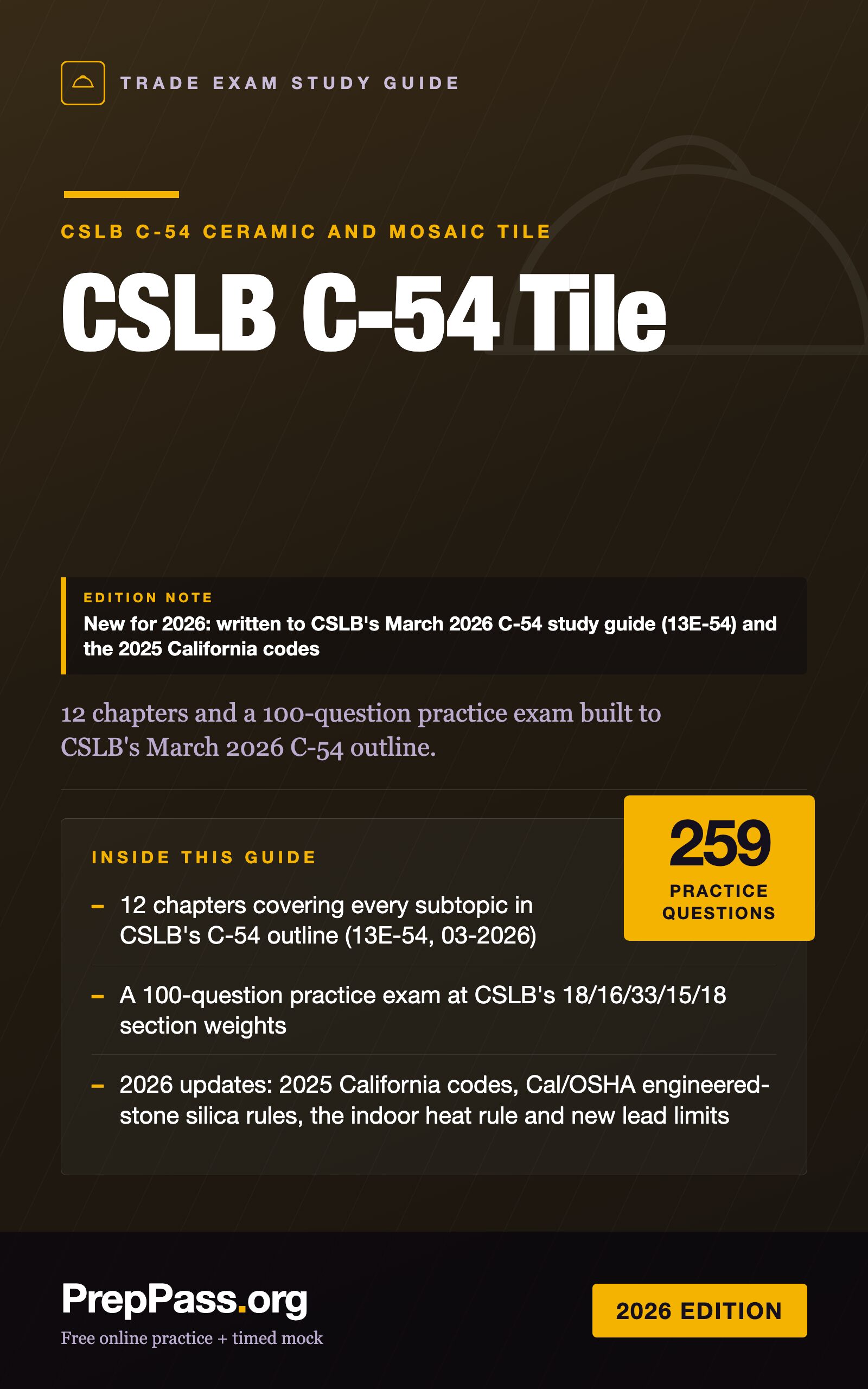
CSLB C-54 Ceramic and Mosaic Tile · 2026 Edition
CSLB C-54 Tile Trade Exam Study Guide (2026)
Edition noteNew for 2026: written to CSLB's March 2026 C-54 study guide (13E-54) and the 2025 California codes
12 chapters and a 100-question practice exam built to CSLB's March 2026 C-54 outline.
- 259 original CSLB tile trade-exam practice questions, each with a worked explanation, in one PDF + EPUB you keep
PDF + EPUB · English · 235 pages · $24.99 one-time
This book is written in English.
Instant download after payment — no account needed, no subscription.
14-day money-back guarantee: not satisfied for any reason? Email support@preppass.org within 14 days of purchase for a full refund. Refund policy
Read a free sample chapter first
Studying more than one? There's a bundle price
- CSLB Law & Business — Complete Study Guide (2026)$24.99
- CSLB C-54 Tile Trade Exam Study Guide (2026)$24.99
- CSLB Law & Business — Cram Sheet (2026)$9.99
Buy all 3: $30.99 — save $28.98 vs buying separately
Separately $59.97 · 48% off · One checkout, all 3 items.
Already bought CSLB Law & Business? Don't buy the bundle — it includes that book and you'd pay for it twice. Get CSLB C-54 Ceramic and Mosaic Tile on its own for $24.99. CSLB C-54 Ceramic and Mosaic Tile · What's in the bundle →
Try 10 questions first — free
Answer all 10, then see every answer explained — with the section of this guide that teaches it. About 5 minutes, no sign-up.
Start 10 free questionsLook inside the book
Three real pages, rendered straight from the PDF you download — a reference page, a teaching page, and a worked question, always in that order. Nothing here was redrawn to look better.
- Quick referenceChapter 1 — Plans, Specifications and Selecting Materials · PDF page 22
A page you can turn back to: the numbers, deadlines or terms gathered in one place.
- How it's taughtChapter 1 — Plans, Specifications and Selecting Materials · PDF page 26
An explanation page: the material taught in prose, in the order the exam tests it.
- A question, workedChapter 1 — Plans, Specifications and Selecting Materials · PDF page 25
A practice question with its answer and the reasoning behind it — not just a key.
About the exam itself
| Administering body | Contractors State License Board (CSLB), California Department of Consumer Affairs — exam delivered by PSI Services LLC |
|---|---|
| Questions | Not published by CSLB What we read and found nothing in: CSLB — Step 7: Studying for the Examination |
| Time limit | 210 minutes |
| Passing score | Not published by CSLB What we read and found nothing in: CSLB — Step 7: Studying for the Examination |
| Fees |
Source: CSLB — List of All CSLB Fees |
| Languages offered | English · Spanish |
Questions buyers ask
- What has changed on the CSLB C-54 Ceramic and Mosaic Tile exam?
- New for 2026: written to CSLB's March 2026 C-54 study guide (13E-54) and the 2025 California codes.
- Is a study guide enough for the CSLB C-54 Ceramic and Mosaic Tile exam, or do I need a course?
- A book is exam review: it does not replace any education, training or experience Contractors State License Board (CSLB), California Department of Consumer Affairs requires before you may sit the exam, so check those requirements first. For the exam content itself, this 235-page guide teaches the material chapter by chapter with 259 practice questions and explanations inside, and 100 more practice questions are free on PrepPass. A prep course adds live instruction and a set schedule; whether you need one beyond any required education is your call.
- What is the cheapest way to prepare for the CSLB C-54 Ceramic and Mosaic Tile exam?
- Start with what costs nothing: 100 practice questions on PrepPass, with explanations and no signup. If you want it taught in one file you keep, the full study guide is $24.99 once. No subscription on any of them.
- Who administers the CSLB Ceramic and Mosaic Tile (C-54) Trade Examination?
- Contractors State License Board (CSLB), California Department of Consumer Affairs — exam delivered by PSI Services LLC. CSLB's legal existence is set by Business and Professions Code § 7000.5. CSLB states it has contracted with PSI to administer its examinations.
- How many questions are on the CSLB Ceramic and Mosaic Tile (C-54) Trade Examination?
- Not published by CSLB. CSLB says only that “All trade examinations consist of multiple-choice questions.” No count appears in the study guide, the Examinations FAQ, or PSI's candidate bulletin.
- How long is the CSLB Ceramic and Mosaic Tile (C-54) Trade Examination?
- 210 minutes. CSLB: “You will be given 3-1/2 hours to complete each examination.” It is per examination, not per sitting — a candidate taking Law and Business plus a trade exam gets 3-1/2 hours for each.
- What is the passing score for the CSLB Ceramic and Mosaic Tile (C-54) Trade Examination?
- Not published by CSLB. CSLB: “You will be informed at the test site about the percentage of correct answers needed to pass each examination,” and, in Get Licensed to Build Q14, that the percentage “varies for each exam”. Passing candidates are never shown their own score. PrepPass states no passing score for this exam.
- How much does the CSLB Ceramic and Mosaic Tile (C-54) Trade Examination cost?
- $450 — Original application (exam or waiver, one classification) (CSLB, one-time); $51.43 — Examination registration (each registration, first attempt or retake) (PSI Services LLC, per attempt); $200 — Initial license fee (sole owner) (CSLB, one-time); $350 — Initial license fee (non-sole owner: partnership, corporation, LLC, joint venture) (CSLB, one-time). Two payees: application and license fees go to CSLB, the per-exam registration fee to PSI. CSLB's 2023 “Get Licensed to Build” PDF still names a $100 rescheduling fee; it appears neither on CSLB's current fee list nor in Business and Professions Code § 7137 as amended effective 1 January 2026, so it is not stated here. The application fee is charged once per original license application and covers both required exams.
- What languages is the CSLB Ceramic and Mosaic Tile (C-54) Trade Examination offered in?
- English · Spanish. CSLB publishes Spanish versions of 10 exams and names this one among them. Candidates requesting a translator for those exams are required to take the Spanish version instead.
- Does the CSLB C-54 Ceramic and Mosaic Tile study guide come as a PDF?
- Yes — CSLB C-54 Tile Trade Exam Study Guide (2026) downloads as PDF and EPUB, 235 pages. The download link is emailed the moment payment clears and does not expire.
- How much does the CSLB C-54 Ceramic and Mosaic Tile study guide cost?
- $24.99, once. There is no subscription and no account to create; the PDF and EPUB files are yours to keep.
- Are there free CSLB C-54 Ceramic and Mosaic Tile practice questions?
- Yes — 100 of them, free to use with no signup and an explanation on every one. They are separate from this study guide, which is what you are buying here.
- Can I read part of the CSLB C-54 Ceramic and Mosaic Tile study guide before buying?
- Yes. A full chapter is free to read on this page — not a summary of one, the chapter itself.
- Is there a cheaper way to buy the CSLB C-54 Ceramic and Mosaic Tile study guide with anything else?
- Yes. CSLB Law & Business + CSLB C-54 Tile is $30.99 for 3 files in one checkout — 48% less than the $59.97 those items cost bought separately today. It adds CSLB Law & Business — Complete Study Guide (2026), CSLB Law & Business — Cram Sheet (2026). The saving is measured against the items' real current prices; there is no struck-through "original" price on this site.
- Is this the official CSLB C-54 Ceramic and Mosaic Tile study guide?
- No. This is an independent study guide and is not affiliated with or endorsed by the exam's awarding body. It is written from CSLB C-54 study guide 13E-54 (03-2026) and Examination FAQ, the 2026 CSLB Law Book, Cal/OSHA Title 8 and 40 CFR 745, read September 2026. Always confirm current requirements with the body that issues your licence.
Free CSLB C-54 Ceramic and Mosaic Tile practice questions and study chapters →
What's included — and what isn't
Included
- 12 chapters covering every subtopic in CSLB's C-54 outline (13E-54, 03-2026)
- A 100-question practice exam at CSLB's 18/16/33/15/18 section weights
- 2026 updates: 2025 California codes, Cal/OSHA engineered-stone silica rules, the indoor heat rule and new lead limits
- Estimating drills: area, scale, tile counts, waste and attic stock, mortar volume, slope, markup vs margin
- Shower and steam-room requirements from 2025 California code handouts, and TCNA/ANSI installation numbers as quoted by CTEF and federal specifications
- 259 original questions, each with a worked explanation citing its source
- PDF + EPUB you keep
Not included
- No printed copy is shipped — this is a file you download and can print yourself
- No video course, instructor or tutoring comes with the book — the free videos on the site are separate
- Not your exam registration or the testing centre's fee, which you still pay to the official body
Contents
See 24 sections and the page each one starts on
- Chapter 1 — Plans, Specifications and Selecting Materialsp. 12
- Chapter 2 — Estimating Quantities and Costsp. 28
- Chapter 3 — Demolition, Disposal and Job-Site Preparationp. 40
- Chapter 4 — Substrates, Membranes and Barriersp. 54
- Chapter 5 — Setting Tile and Stonep. 69
- Chapter 6 — Grout, Movement Joints and Sealantsp. 85
- Answer key & explanationsp. 97
- Chapter 7 — Showers and Steam Roomsp. 100
- Chapter 8 — Repairs and Restorationp. 114
- Chapter 9 — Specialty Tile and Accessoriesp. 126
- Chapter 10 — Stone Slabs and Countertopsp. 139
- Chapter 11 — Personnel Safetyp. 152
- Chapter 12 — Job-Site Safetyp. 166
- Section 1 — Planning and Estimating (18 questions)p. 178
- Section 2 — Preparation for Tile and Stone Installation (16 questions)p. 182
- Section 3 — Installation and Repairs (33 questions)p. 186
- Section 4 — Specialty Installations (15 questions)p. 193
- Section 5 — Safety (18 questions)p. 196
- Practice exam answer key and explanationsp. 200
- Appendix A — Numbers to know coldp. 213
- Appendix B — Terms to use precisely Term Meaningp. 217
- Appendix C — Pairs the exam likes to confusep. 218
- Appendix D — How the C-54 exam asks, and how to answerp. 221
- Appendix F — Where each safety rule livesp. 225
Taken from the PDF you download, with the page each one starts on — not typed here.
Read a chapter free, in full
One complete chapter, exactly as it ships in the eBook. Scroll the window to read it right here; no download, no email.
Read chapter 7 here, without leaving the page
We didn't give you the easy intro — the free chapter opens on one of the hardest-working parts of the book, so you can judge the teaching where the exam gets difficult.
Outline section 3, Installation and Repairs (33%): "Showers and steam rooms".[1]
A shower is the hardest environment a tile contractor builds. The industry puts it in numbers: "A daily 15-minute shower represents 30 gallons of water per day or the equivalent of 3" of rainfall per day, which translates to 1100" of rainfall per year."[2] A steam room adds heat and vapor pressure to that water. The exam tests two bodies of rules here: the plumbing and residential code requirements that a building inspector enforces (size, doors, liners, slope, tests, valves), and the tile-industry methods that make the assembly last (pre-slope, waterproofing, coverage, sloped horizontal surfaces, steam-room ceilings).
A caution about section numbers: California city handouts written to the 2025 codes cite the same shower requirements under different California Plumbing Code section numbers. This chapter teaches the requirement and names the code; learn the numbers, not the section labels.
7.1 Wet areas defined
The ANSI standard's introduction defines wet areas as "Tile surfaces that are either soaked, saturated, or subjected to moisture or liquids (usually water) such as in gang showers, tub enclosures, showers, floors adjacent to curbless showers, laundries, saunas, steam rooms, swimming pools, or exterior areas."[3] Everything in this chapter is a wet area, so the 95 percent coverage minimum of Chapter 5 applies.[4]
7.2 What the code requires of a shower
These are the requirements city building departments list for residential shower work under the 2025 California codes.[5]
Size. "Shower compartments, regardless of shape, shall have a minimum finished interior of 1024 square inches and shall also be capable of encompassing a 30-inch circle." A receptor at least 30 by 60 inches is exempt.[6] "The curb may encroach on these size requirements."[7] The area and dimensions are maintained "to a point of not less than 70 inches above the shower drain inlet".[8]
Door. "Any door shall have a clear opening not less than 22 inches".[6]
Finish surfaces. Shower floors and walls "must be finished with a nonabsorbent surface. For walls, this must extend to a height at least 6 feet above the floor."[6] Another handout puts it as waterproof "up to 72 inches above the drain inlet".[7]
Liner. "Shower receptors must be constructed and lined with watertight materials". "Linings shall have no nails or perforations to a height at least 1 inch above the finished dam or threshold. Ensure that the subdrain weep holes are protected from clogging."[6]
Test. "Shower receptors shall be tested for watertightness by filling with water to the level of the rough threshold. The test plug shall be so placed that both upper and under sides of the sub-pan shall be subjected to the test at the point where it is clamped to the drain."[6] One department states the practice as "2-inches of water sitting for at least 24 hours".[5]
Drain. "Showers require a minimum 2-inch drain and trap". When a tub is replaced with a shower, "the waste outlet and fixture tailpiece must be increased to at least 2″ in diameter if smaller than this".[6, 7]
Valves and temperature. Valves must be "pressure balance, thermostatic, or combination pressure balance/thermostatic mixing valve type that provide scald and thermal shock protection", installed at the point of use.[6] "The maximum water temperature to a shower or tub/shower combination is 120°F. The water heater thermostat cannot be used as the control for this temperature."[7] Valves and showerhead are arranged so "the bather can adjust the valves before stepping into the shower spray".[6]
Glass. "Safety glass (tempered or laminated) is required for all glass shower doors and partitions".[7]
Backer. No water-resistant gypsum board behind tile in the shower; use cement board, fiber-cement or glass-mat gypsum (Chapter 4).[5]
7.3 The traditional mortar-bed shower floor
This is the assembly the exam most often describes, from the subfloor up:
- Pre-slope (sloped fill). "This slope, according to the TCNA Handbook is called “sloped fill” or commonly known as the pre-slope. This sloped material is installed under the pan liner". Every Handbook shower detail that uses a clamping ring drain "requires sloped fill (pre-slope) under the shower pan membrane."[3] It exists so water that gets through the tile and mortar bed runs to the drain's weep holes instead of pooling on the liner.
- Pan liner (the shower pan membrane) over the pre-slope, clamped at the drain, turned up the walls and over the curb, with no nails in the zone just above the threshold.[6]
- Flood test of the liner before anything covers it.[6]
- Wall backer lapped over the turned-up liner, fastened only in the top inch of the turn-up.[9]
- Mortar bed on the liner, of uniform thickness: "The mortar bed on top of the membrane is exactly the same thickness along the walls as it is at the drain. ANSI A108.01A section 2.3.6 requires that the mortar bed be 1-1/2” (38 mm)."[3] The slope comes from the pre-slope beneath.
- Tile, with 95 percent coverage and joints to the drain.
Slope. The finished floor slopes to the drain at a minimum of 1/4 inch per foot and, in the plumbing code as industry sources describe it, a maximum of 1/2 inch per foot.[3, 10] The floor must also be flat: "there can be no low spots for birdbaths that could retain water."[3]
7.4 Every horizontal surface slopes to the drain
ANSI A108.01 section 3.6.4: "All horizontal ledges/rims shall have a slope such that any fluid on their surfaces flows toward the drain." Every TCNA bathtub and stall-shower detail adds: "All horizontal surfaces, for example, shower seats, sills, curbs, etc., must slope towards a drain or other surface sloped toward the drain. Where present, waterproofing also must be sloped."[3] That includes niche shelves, benches and windowsills.[3] A curb about 5 inches wide "only needs to be sloped 1/8” from outside to inside" to meet the 1/4-inch-per-foot rule.[3]
7.5 Surface-bonded (direct-bond) systems and curbless showers
Many showers now use a bonded waterproof membrane (A118.10) directly under the tile instead of a buried pan liner. The industry warns that these "direct bond shower systems typically don't have a weep system to evacuate moisture", so troweling voids under the tile become channels: "the ridges will not be flattened into the valleys, leaving aqueducts below the tile surface," and moisture wicks uphill into the tile or stone.[2] Some membrane manufacturers state "that moisture-sensitive stone should not be used" with their systems.[2] The fix is the Chapter 5 troweling method and the manufacturer's mortar.
For walls, the Handbook's receptor method requires "A waterproof membrane (A118.10) or vapor retarder membrane (A108.M-2.8.1) must be specified for walls".[10]
Curbless showers. Without a curb, the bathroom floor near the shower becomes wet. One city's guideline for curbless residential showers: finished threshold height "a maximum of½ inch above the bathroom's finished floor level", with changes of level between 1/4 and 1/2 inch beveled no steeper than 1 in 2; the liner extending "a minimum 12 inches beyond the threshold and into the bathroom"; the drain inlet "a minimum of 2 inches below the top of the finished threshold"; a receptor able to hold "a minimum of 9.6 gallons above the top of the drain inlet"; and framing supporting "a live load of 40 psf and a minimum dead load of 20 psf".[8] Another handout notes that without a threshold, "the rest of the room is to be considered a wet location."[6]
7.6 Glass tile in showers
Large format glass (over 3 × 3 inches) in a shower brings thermal shock: "When cool glass is hit by hot water or steam ... the glass can expand rapidly and crack."[11] The industry steps: get the glass manufacturer's written instructions and confirm the tile is rated for showers; flat substrate with minimal deflection; the manufacturer's glass-tile mortar; "An extended mortar cure time is required before grouting and applying the sealant to changes in plane"; and "All changes in plane must be filled with a 100% silicone sealant rated to adhere to glass."[11]
7.7 Steam rooms
A steam room is a shower with vapor pressure and sustained heat, and the TCNA Handbook treats continuous-use steam showers in their own methods (SR613, SR614).[12]
- Ceiling slope. The Handbook "requires that the ceiling of the steam shower be sloped at a rate of 2” per foot to eliminate condensed water droplets from falling on the user."[3]
- Benches and horizontal surfaces slope 1/4 inch per 12 inches to the drain.[12]
- Membranes rated for steam. "not all membranes are suitable for stream, high-temperature and/or chemical exposure, or exterior use." Check the manufacturer's rating.[10]
- No organic adhesive where temperatures exceed 140°F.[10]
- The rest of the envelope. "Insulation, air gaps, slip joints, and slope to drain are all critical elements that must be addressed and properly installed by the appropriate contractor."[12]
- Tile-over caution. Cracked tiles in an existing steam room point to a failure somewhere in the system; verifying it may require removal (Chapter 3).[12]
Worked example: a 36 × 48 inch shower with a bench
- Size. 36 × 48 = 1,728 in², over 1,024, and a 30-inch circle fits.[6]
- Pre-slope. The drain is centered; the farthest corner is 30 inches away (2.5 ft). At 1/4 inch per foot the pre-slope rises 5/8 inch to that corner.[3]
- Liner and test. Liner clamped at the drain, weep holes protected, no fasteners in the low turn-up; flood-tested to the rough threshold.[6]
- Bench and curb. Both slope toward the drain; the 5-inch curb falls 1/8 inch inward.[3]
- Tile. 95 percent coverage; silicone, not grout, at the wall-to-floor and bench-to-wall changes of plane.[4, 11]
A shower from rough-in to final: the inspection points
Think of a mortar-bed shower as a series of hold points, each of which must be right before the next layer hides it.
- Framing. Curbless and sunken receptors need framing designed for the load and the slope; one city guideline asks for floor framing supporting a 40 psf live load and a 20 psf dead load.[8]
- Drain and pre-slope. Drain body set at the right height; sloped fill under the liner at 1/4 inch per foot, flat, with no birdbaths.[3]
- Liner. Watertight liner clamped at the drain, weep holes protected, no nails or perforations low on the turn-up.[6]
- Flood test. Filled to the rough threshold with the plug placed so both sides of the sub-pan are tested at the clamp; one department describes 2 inches held for 24 hours.[5, 6]
- Wall backer. A shower-rated backer lapped over the liner, fastened only in the top inch of the turn-up; no water-resistant gypsum board behind tile.[5, 9]
- Wall waterproofing or vapor retarder, as the Handbook's receptor method requires.[10]
- Mortar bed. Uniform 1-1/2 inches on the liner; screeded to the pre-slope's pitch.[3]
- Tile. 95 percent coverage; all horizontal surfaces sloped to the drain.[3, 4]
- Joints. Sealant, not grout, at changes of plane and at the receptor.[11, 13]
- Final. Valve type and location, 120°F maximum, safety glass, and a finish nonabsorbent to the required height.[6, 7] One handout notes the inspector must be able to reach the shower valves from outside the enclosure at final.[7]
Why showers fail, in one table
| Failure | Cause | Chapter |
|---|---|---|
| Offensive odor from the shower floor | No pre-slope; water sits on the liner[3] | 7 |
| Leak into the room below at the curb | Liner nailed low or torn at the curb[6] | 7 |
| Dark grout lines that return after every use | Edge voids behind wall tile[4] | 8 |
| Stone darkening that climbs the wall | Uncollapsed ridges on a direct-bond system wicking water[2] | 7 |
| Water standing on a niche shelf or bench | Horizontal surface not sloped to the drain[3] | 7 |
| Dripping condensation in a steam room | Flat ceiling instead of 2 inches per foot[3] | 7 |
| Cracked glass tile | Thermal shock, rushed cure or no soft joints[11] | 7, 9 |
Sources cited in this excerpt
- License Examination Study Guide — Ceramic and Mosaic Tile (C-54), form 13E-54 (03-2026). Contractors State License Board (CSLB), 2026-03 (for examinations scheduled on or after July 1, 2023). https://www.cslb.ca.gov/Resources/StudyGuides/C54StudyGuide.pdf
- How to Deal with Tile Discoloration in a Shower. Ceramic Tile Education Foundation (CTEF), accessed 2026-09-24. https://www.ceramictilefoundation.org/blog/how-to-deal-with-tile-discoloration-in-showers
- Does Your Tile Slope To the Drain? Ceramic Tile Education Foundation (CTEF), accessed 2026-09-24. https://www.ceramictilefoundation.org/blog/everything-must-slope-to-the-drain
- Never Assume You Have Sufficient Mortar Coverage. Check It. Ceramic Tile Education Foundation (CTEF), accessed 2026-09-24. https://www.ceramictilefoundation.org/blog/insufficient-mortar
- Bathroom Requirements (2025 California codes; updated 01/2026). City of Rancho Palos Verdes, Building & Safety Division, updated 2026-01. https://www.rpvca.gov/DocumentCenter/View/19326/-Bathroom-Remodel-Requirements-PDF
- Bathroom Remodel (Residential) submittal requirements. City of Milpitas, Office of Building Safety, accessed 2026-09-24. https://www.milpitas.gov/DocumentCenter/View/966/Bathroom-Remodel-Submittal-Requirements-PDF
- 2025 California Codes — Bathroom Remodel Requirements (handout). City of San Bruno, Building Division, accessed 2026-09-24. https://www.sanbruno.ca.gov/DocumentCenter/View/9040/2025-Bathroom-Remodel-Handout
- Curbless Shower Guidelines — Residential. City of Mill Valley, Building Department, accessed 2026-09-24. https://www.cityofmillvalley.gov/DocumentCenter/View/347/Curbless-Shower-Pans-PDF?bidId=
- VA Master Specification Section 09 30 13 Ceramic/Porcelain Tiling. U.S. Department of Veterans Affairs, Office of Construction & Facilities Management (Technical Information Library), accessed 2026-09-24. https://www.cfm.va.gov/til/spec/093013.docx
- What Do You Need to Install Tile in Wet Areas? Ceramic Tile Education Foundation (CTEF), accessed 2026-09-24. https://www.ceramictilefoundation.org/blog/installing-tile-in-wet-areas
- Installing Large Format Glass Tile in a Shower: 10 Steps to Follow. Ceramic Tile Education Foundation (CTEF), accessed 2026-09-24. https://www.ceramictilefoundation.org/blog/installing-large-format-glass-tile-in-shower
- Tile Over It or Take It Up? Ceramic Tile Education Foundation (CTEF), accessed 2026-09-24. https://www.ceramictilefoundation.org/blog/tile-over-or-take-it-up
- Quick and Easy Movement Joints... the Right Way. Ceramic Tile Education Foundation (CTEF), accessed 2026-09-24. https://www.ceramictilefoundation.org/blog/quick-easy-movement-joints
Before you buy
- How do I get it?
- Pay, and the download appears on this page straight away. The links are also emailed to you. No account is required.
- What if it isn't for me?
- Email us within 14 days for a full refund, no questions asked.
- Is the free practice going away?
- No. Every practice question, the timed mock and the free chapters on this site stay free. This book is the studying half, not a gate around the free half.
- Can I read it on my phone?
- Yes — the EPUB is for phones and e-readers, the PDF is for printing and tabbing. You get both.
The details
12 chapters and a 100-question practice exam built to CSLB's March 2026 C-54 outline.
- Format: PDF + EPUB download · 235 pages
- 259 practice questions in the book, with a full answer key
- 100 free practice questions for this exam on PrepPass, included at no cost
- $24.99 one-time — no subscription
- 14-day money-back guarantee · refund policy
- Cross-referenced against: CSLB C-54 study guide 13E-54 (03-2026) and Examination FAQ, the 2026 CSLB Law Book, Cal/OSHA Title 8 and 40 CFR 745, read September 2026
- Verified from the official source(CSLB C-54 study guide 13E-54 (03-2026) and Examination FAQ, the 2026 CSLB Law Book, Cal/OSHA Title 8 and 40 CFR 745, read September 2026)
- 100 free practice questions
- Instant download, yours for life
A CSLB exam prep course runs $200–$800. This book teaches the same exam — same rules, verified to current standards — for a one-time $24.99 you keep for life.
Why buy the book when the practice is free?
Our practice questions and timed mock stay free — nothing on the site moves behind this book. The $24.99 book is the studying half: the material itself, taught in order, in a file you own.
- Systematic teaching — every exam section explained chapter by chapter, start to finish, not just questions
- Print it & tab it — a paper-ready PDF you can highlight, mark up, and bring to your study table
- Study anywhere, offline — EPUB on your phone or e-reader; no wifi, no browser tabs
- Everything in one place — the chapters and the practice questions in one file
- Yours for life — one-time $24.99, instant download, no subscription
And it's risk-free: 14-day money-back guarantee — not satisfied? Email us for a full refund, no questions asked. See the refund policy.
14-day money-back guarantee · full refund, no questions asked.
One-time purchase, lifetime access to the download. The eBook is the full CSLB C-54 Ceramic and Mosaic Tile study guide in PDF and EPUB. Educational summary, not professional or legal advice — always confirm the current rules with the official source.