HESI A2 Admission Assessment · 2026 Edition
HESI A2 Exam — Complete Study Guide (2026)
The PrepPass HESI A2 study guide book (2026 edition) is an independent guide: 780 pages of teaching plus 120 practice questions with a full answer key, PDF + EPUB, $29.99 one-time. The PDF was last updated September 2026. Inside: a common-exam-traps list and a self-check closing each of the 7 subjects; a full practice test at the back, with the reasoning behind every answer.
- The 7 subject areas it covers, as one PDF + EPUB you keep
- A common-exam-traps list and a self-check closing each of the 7 subjects
- A full practice test at the back, with the reasoning behind every answer
$29.99one-time · lifetime download · no subscription
PDF + EPUB · English · 780 pages · $29.99 one-time
This book is written in English.
Instant download after payment — no account needed, no subscription.
14-day money-back guarantee: not satisfied for any reason? Email support@preppass.org within 14 days of purchase for a full refund. It's a download, so there is nothing to ship back. Refund policy
Please read before you buy: Your nursing program chooses which HESI A2 sections you sit and sets its own score requirement — there is no single national HESI exam.
Read the rest of this notice
This guide covers Math, Reading, Vocabulary, Grammar, Biology, Chemistry and Anatomy & Physiology. It does not cover Physics, Critical Thinking, or the personality and learning-style inventories some programs add. Check your program's own requirement before you buy.
To prepare for the HESI A2 Admission Assessment exam, cover every topic on the exam body's current content outline and practise with timed questions.
Try 10 questions first — free
Answer all 10, then see every answer explained — with the section of this guide that teaches it. About 5 minutes, no sign-up.
You do not need the book to practise: 400 practice questions for this exam are free on PrepPass.
Start 10 free questionsLook inside the book
Three real pages, rendered straight from the PDF you download — a reference page, a teaching page, and a worked question, always in that order. Nothing here was redrawn to look better.
- Quick referencePDF page 187
A page you can turn back to: the numbers, deadlines or terms gathered in one place.
- How it's taughtPDF page 406
An explanation page: the material taught in prose, in the order the exam tests it.
- A question, workedPDF page 502
A practice question with its answer and the reasoning behind it — not just a key.
Exam inside two weeks?
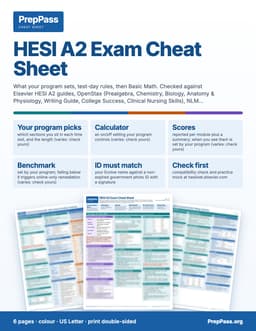
This guide is the teaching, read over weeks. If your exam is inside two weeks, the printable colour cheat sheet is the other product: the figures the exam turns on, laid out by section.
See the HESI A2 Admission Assessment cheat sheet PDF — $9.99 →
6 pages · US Letter · printable PDF · yours to keep
Questions buyers ask
- Is a study guide enough for the HESI A2 Admission Assessment exam, or do I need a course?
- A book is exam review: it does not replace any education, training or experience your licensing body requires before you may sit the exam, so check those requirements first. For the exam content itself, this 780-page guide teaches the material chapter by chapter with 120 practice questions and explanations inside, and 400 more practice questions are free on PrepPass. A prep course adds live instruction and a set schedule; whether you need one beyond any required education is your call.
- What is the cheapest way to prepare for the HESI A2 Admission Assessment exam?
- Start with what costs nothing: 400 practice questions on PrepPass, with explanations and no signup. If you want it taught in one file you keep, the full study guide is $29.99 once; the printable cheat sheet for the last days is $9.99. No subscription on any of them.
- Does the HESI A2 Admission Assessment study guide come as a PDF?
- Yes — HESI A2 Exam — Complete Study Guide (2026) downloads as PDF and EPUB, 780 pages. The download link is emailed the moment payment clears and does not expire.
- How much does the HESI A2 Admission Assessment study guide cost?
- $29.99, once. There is no subscription and no account to create; the PDF and EPUB files are yours to keep.
- Are there free HESI A2 Admission Assessment practice questions?
- Yes — 400 of them, free to use with no signup and an explanation on every one. They are separate from this study guide, which is what you are buying here. The same free, no-account system also has practice modes (adaptive, new questions, spaced review of misses, weak-topic focus, saved, my mistakes); a timed mock exam (100 questions, 120 minutes) with a score report by topic; a 10-question readiness check (about 5 minutes); 5 study chapters; a day-by-day study plan. None of it needs this study guide.
- Can I read part of the HESI A2 Admission Assessment study guide before buying?
- Yes. A full chapter is free to read on this page — not a summary of one, the chapter itself.
- What is the difference between the HESI A2 Admission Assessment study guide and the cheat sheet?
- The study guide ($29.99) teaches the material chapter by chapter and is meant to be read over weeks. The cheat sheet ($9.99, 6 pages) drops the teaching and keeps the figures: every number on the exam grouped by value so the confusable ones sit together, each reference page paired with a recall page that blanks the answers, and four routes by days left — 14, 7, 3, or tonight. They are separate purchases; neither replaces the other.
- Is this the official HESI A2 Admission Assessment study guide?
- No. This is an independent study guide and is not affiliated with or endorsed by the exam's awarding body. It is written from Elsevier / HESI A2 exam outline. Always confirm current requirements with the body that issues your licence.
Free HESI A2 Admission Assessment practice questions and study chapters →
What's included — and what isn't
Included
- Math, Reading, Vocabulary, Grammar, Biology, Chemistry and Anatomy & Physiology — the areas Elsevier's own review book covers
- Nursing math worked step by step (fractions, ratios, conversions)
- Reading, vocabulary, and grammar strategy with modeled questions
- Biology, chemistry, and anatomy science review
- 120 original practice questions with answer explanations
- PDF (print & tab it) + EPUB (phone / e-reader)
Not included
- No printed copy is shipped — this is a file you download and can print yourself
- No video course, instructor or tutoring comes with the book — the free videos on the site are separate
- Not your exam registration or the testing centre's fee, which you still pay to the official body
Read a chapter free, in full
One complete chapter, exactly as it ships in the eBook. Scroll the window to read it right here; no download, no email.
Read chapter 1 here, without leaving the page
Everyday arithmetic done by hand — fractions, decimals, percents, ratios, conversions and simple algebra, with every method shown the way you would write it on paper.
Introduction
What this section really tests
The maths on a nursing-school admission assessment is not hard mathematics. There is no trigonometry, no quadratic formula, no geometry proof. What there is instead is a long list of small, ordinary calculations — a fraction added to a fraction, a weight turned from pounds into kilograms, a percentage taken off a price, a proportion scaled up — done accurately, one after another, under time pressure.
That distinction matters because it tells you where the points are actually lost. Candidates rarely fail this section because they do not know that you need a common denominator. They fail it because they found the common denominator, converted one fraction correctly, forgot to convert the other, and produced a number that was on the answer list anyway. The exam's wrong answers are not random. They are the results of the specific slips a rushed person makes, printed out and offered back to you as plausible choices.
So the skill being tested is not really "fractions." It is arithmetic reliability — the ability to run a four-step calculation by hand and arrive at the right number on the first attempt, then prove it was right in five seconds. Everything in this chapter is organized around that.
The content areas are stable and small: whole-number arithmetic, fractions, decimals, ratios and proportions, percentages, basic algebra, and measurement conversions including the metric system, household measures and temperature. Programs commonly weight this area heavily in admission decisions, and it is the area where focused practice pays back fastest, because unlike vocabulary or anatomy, there is nothing to memorize that you do not already half-know. You are tightening a method, not learning a subject.
The two habits that protect the score
Habit one: write it down and line it up. Almost every maths error on this test is a transcription error or a place-value error, not a conceptual one. You read 0.05 and wrote 0.5. You carried the 1 into the wrong column. You copied 154 from the question and worked with 145. None of those are failures of understanding, and none of them can be prevented by understanding harder. They are prevented by writing each number on its own line, with the digits stacked in vertical columns, and by reading the question a second time before you start.
Habit two: estimate before you compute. Before you do the real arithmetic, produce a rough answer in your head from round numbers. If 154 ÷ 2.2 should be "a bit less than 154 ÷ 2, so somewhere around 70," then an answer of 7 or 700 or 33.9 is visibly wrong before you check anything else. An estimate does not tell you that your answer is right. It tells you instantly when your answer is impossible, and a misplaced decimal point is the single most common way to produce an impossible answer.
Those two habits together catch the large majority of the errors this section punishes. Everything else in this chapter is technique built on top of them.
How to use this chapter
Work every example with a pencil before you read the solution. Reading a worked example is not practice; reproducing it is. When you get an answer that differs from the book's, do not scan the solution for the line where you went wrong — redo the whole problem from the original numbers first, because in about half of those cases the error is a copying slip that you will repeat if you only look at the middle.
Work everything by hand. Do not reach for a phone. A student who can only get the answer by typing it into something is a student who cannot check it, and checking is most of what this chapter teaches. Hand methods on numbers this small are also genuinely faster once they are fluent: 25 × 48 is one second of mental work and about eight seconds of typing.
Finally, do not skip the "wrong turn" paragraphs. Each one names a specific error and, more usefully, the specific wrong number that error produces. Recognizing that number on an answer list is a second line of defense.
### Remember this | Habit | What it prevents | |---|---| | Write each number on its own line, digits in columns | Carrying errors, place-value slips | | Re-read the question before computing | Working with the wrong number entirely | | Estimate first from round numbers | Misplaced decimal points, inverted divisions | | Reverse the operation to check | Nearly everything else | Wrong answers on this test are manufactured from predictable mistakes. If your answer appears on the list, that is not proof it is right.
Arithmetic without a calculator
Estimate first, compute second
An estimate is a cheap, deliberately sloppy version of the calculation, done with numbers you can handle in your head. Round each figure to one or two significant digits, do the easy operation, and hold the result. Then do the real arithmetic and compare.
The reason this works so well is that the errors hand arithmetic actually produces are not small. A carrying mistake shifts an answer by 10 or 100, not by 0.3. A misplaced decimal point moves it by a factor of ten. An inverted division turns 70 into 0.014. Every one of those is enormous compared with the gap between your estimate and the truth, so a rough estimate separates them cleanly.
Worked example — estimating before a multiplication.
Step 1 — The problem is 312 × 19. Round both numbers: 312 is about 300, and 19 is about 20.
Step 2 — Estimate: 300 × 20 = 6,000. So the true answer should be near 6,000, and slightly under, because you rounded 312 down only a little but rounded 19 up by a whole unit.
Step 3 — Now compute exactly. 312 × 19 is easier as 312 × 20 − 312.
Step 4 — 312 × 20 = 6,240. Subtract 312: 6,240 − 312 = 5,928.
Step 5 — Check against the estimate: 5,928 is just under 6,000, exactly as predicted.
Answer: 5,928. Had you written 592.8 or 59,280, the estimate would have caught it instantly.
The wrong turn. Students skip the estimate because it feels like doing the problem twice. It is not — it is doing a two-second version of the problem. The error it catches most often is the decimal shift: computing 0.4 × 0.05 and writing 0.2. An estimate ("less than a half of a twentieth, so tiny") makes 0.2 obviously wrong, while 0.02 survives.
Place-value discipline
Every digit in a written number has a value that depends only on its column. That is the whole idea of place value, and it is why hand arithmetic works at all: you add ones to ones, tens to tens, hundredths to hundredths, and carry when a column overflows past nine.
The practical consequence is that your columns have to be genuinely vertical. If you write 4.25 + 3.7 as a ragged pair, your eye will line the 7 up under the 5 and you will add seven hundredths to five hundredths. Writing the trailing zero — 3.70 — costs nothing and removes the ambiguity completely.
| Place | Value | Example digit in 3,482.517 |
|---|---|---|
| Thousands | 1000 | 3 |
| Hundreds | 100 | 4 |
| Tens | 10 | 8 |
| Ones | 1 | 2 |
| Tenths | 1/10 = 0.1 | 5 |
| Hundredths | 1/100 = 0.01 | 1 |
| Thousandths | 1/1000 = 0.001 | 7 |
Read that number aloud as "three thousand four hundred eighty-two and five hundred seventeen thousandths." The word "and" marks the decimal point. That habit matters later, when you have to decide whether 0.125 is an eighth or a sixteenth, or whether 2500 mL is more or less than 2.5 L.
Worked example — adding decimals by alignment.
Step 1 — Add 12.4 + 7.65 + 0.083. Write them stacked with the points in one vertical line, and pad every number to three decimal places: 12.400, 7.650, 0.083.
Step 2 — Add the thousandths column: 0 + 0 + 3 = 3.
Step 3 — Add the hundredths column: 0 + 5 + 8 = 13. Write 3, carry 1 into the tenths.
Step 4 — Tenths: 4 + 6 + 0 = 10, plus the carried 1 = 11. Write 1, carry 1 into the ones.
Step 5 — Ones: 2 + 7 + 0 = 9, plus the carried 1 = 10. Write 0, carry 1 into the tens.
Step 6 — Tens: 1 + 0 + 0 = 1, plus the carried 1 = 2.
Step 7 — Assemble: 20.133.
Check by estimating: 12 + 8 + 0 = 20, and the answer is 20.133. Answer: 20.133.
The wrong turn. Adding 12.4 + 7.65 right-aligned instead of point-aligned gives 12.4 stacked as if it were 12.40 shifted — the common result is 19.89 or 8.89, both far from 20. Padding with zeros first makes the mistake impossible.
Checking by reversing the operation
Every arithmetic operation has an inverse, and the inverse is a far better check than redoing the same steps. Redoing the same steps repeats the same mistake, because you will make it in the same place for the same reason. Reversing forces a different calculation.
| You did | Check by |
|---|---|
| Addition | Subtract one addend from the sum; you should get the other |
| Subtraction | Add the answer to the number you subtracted; you should get the start |
| Multiplication | Divide the product by one factor; you should get the other |
| Division | Multiply the quotient by the divisor, add any remainder |
| Converting a unit | Convert back and see whether you land on the original |
| Reducing a fraction | Multiply the reduced fraction back up by the factor you removed |
Worked example — checking a division by multiplying back.
Step 1 — You computed 4,725 ÷ 15 and got 315. Do not re-divide.
Step 2 — Multiply back: 315 × 15. Break it as 315 × 10 + 315 × 5.
Step 3 — 315 × 10 = 3,150. 315 × 5 = 1,575.
Step 4 — 3,150 + 1,575 = 4,725.
Step 5 — That is the original dividend, so 315 is correct.
Answer: 315, confirmed.
The wrong turn. Checking by re-reading your own work is not checking. If you divided 4,725 by 15 and got 305 because you dropped a digit in the middle, reading the same page again will very often reproduce the same drop. Multiplying 305 × 15 gives 4,575, which is visibly not 4,725, and the error surfaces in one line.
The mental shortcuts worth owning
A small set of shortcuts converts awkward products into easy ones. They are worth drilling until they are automatic, because each one saves twenty seconds and removes a chance to slip.
Halve and double. Multiplication does not care how a factor is split, so you may halve one factor and double the other without changing the product. 35 × 16 is awkward; halve the 16 and double the 35 to get 70 × 8 = 560. You can repeat it: 140 × 4 = 560 as well. Every version gives the same answer because you keep multiplying by 2 and dividing by 2 at the same time.
Multiply by 25 as "a quarter of a hundred." 25 × 48 = 48 × 100 ÷ 4 = 4,800 ÷ 4 = 1,200. Similarly 50 × n is n × 100 ÷ 2, and 5 × n is n × 10 ÷ 2.
Compensate to a round number. 312 × 19 became 312 × 20 − 312. 98 × 7 becomes 100 × 7 − 2 × 7 = 700 − 14 = 686.
Multiply by powers of ten by shifting the point. × 10 moves the decimal point one place right, × 100 two places, × 1000 three. Dividing moves it the same number of places left. This single rule does most of the metric system's work later in the chapter.
Worked example — halve and double under pressure.
Step 1 — Compute 45 × 12 without writing partial products.
Step 2 — Halve the 12 and double the 45: 90 × 6.
Step 3 — 90 × 6 = 540.
Step 4 — Check by a different route: 45 × 12 = 45 × 10 + 45 × 2 = 450 + 90 = 540.
Answer: 540.
The wrong turn. Halving the wrong factor, or halving both, breaks the identity. Halving both 35 and 16 gives 17.5 × 8 = 140, which is a quarter of the true 560. The guard is to say the trade out loud: "one gets smaller, the other gets bigger."
### Key numbers | Shortcut | Form | Example | |---|---|---| | Halve and double | a × b = (a÷2) × (b×2) | 35 × 16 = 70 × 8 = 560 | | Times 25 | n × 100 ÷ 4 | 25 × 48 = 4,800 ÷ 4 = 1,200 | | Times 5 | n × 10 ÷ 2 | 5 × 86 = 860 ÷ 2 = 430 | | Times 50 | n × 100 ÷ 2 | 50 × 36 = 3,600 ÷ 2 = 1,800 | | Compensate | a × b = a × (b+1) − a | 312 × 19 = 6,240 − 312 = 5,928 | | Powers of ten | shift the decimal point | 4.7 × 1000 = 4,700 |
Before you buy
- How do I get it?
- Pay, and the download appears on this page straight away. The links are also emailed to you. No account is required.
- What if it isn't for me?
- Email us within 14 days for a full refund, no questions asked.
- Is the free practice going away?
- No. Every practice question, the timed mock and the free chapters on this site stay free. This book is the studying half, not a gate around the free half.
- Can I read it on my phone?
- Yes — the EPUB is for phones and e-readers, the PDF is for printing and tabbing. You get both.
The details
Seven subjects — Math, Reading, Vocabulary, Grammar, Biology, Chemistry, and Anatomy & Physiology — with worked examples in every one but Grammar; each nursing program sets its own cut score.
- Format: PDF + EPUB download · 780 pages
- 120 practice questions in the book, with a full answer key
- 400 free practice questions for this exam on PrepPass, included at no cost
- $29.99 one-time — no subscription
- 14-day money-back guarantee · refund policy
- Cross-referenced against: Elsevier / HESI A2 exam outline
- Last updated: September 2026
- Verified from the official source(Elsevier / HESI A2 exam outline)
- 400 free practice questions
- Instant download, yours for life
An HESI A2 prep course runs $50–$300. This book teaches the same exam — same rules, verified to current standards — for a one-time $29.99 you keep for life.
Why buy the book when the practice is free?
Our practice questions and timed mock stay free — nothing on the site moves behind this book. The $29.99 book is the studying half: the material itself, taught in order, in a file you own.
- Systematic teaching — every exam section explained chapter by chapter, start to finish, not just questions
- Print it & tab it — a paper-ready PDF you can highlight, mark up, and bring to your study table
- Study anywhere, offline — EPUB on your phone or e-reader; no wifi, no browser tabs
- Everything in one place — the chapters and the practice questions in one file
- Yours for life — one-time $29.99, instant download, no subscription
And it's risk-free: 14-day money-back guarantee — not satisfied? Email us for a full refund, no questions asked. See the refund policy.
Also free on PrepPass for HESI A2 Admission Assessment
Beside this guide, PrepPass has a free study system for the same exam. It needs no account, and buying the guide does not unlock or change it: 400 practice questions with explanations; practice modes (adaptive, new questions, spaced review of misses, weak-topic focus, saved, my mistakes); a timed mock exam (100 questions, 120 minutes) with a score report by topic; a 10-question readiness check (about 5 minutes); 5 study chapters; a day-by-day study plan.
Progress is saved in your browser; a free account keeps it across devices. The readiness gauge reflects your own practice, not a prediction of the real exam result. How the practice works
14-day money-back guarantee · full refund, no questions asked.
One-time purchase, lifetime access to the download. The eBook is the full HESI A2 Admission Assessment study guide in PDF and EPUB. Educational summary, not professional or legal advice — always confirm the current rules with the official source. Last updated: September 2026.