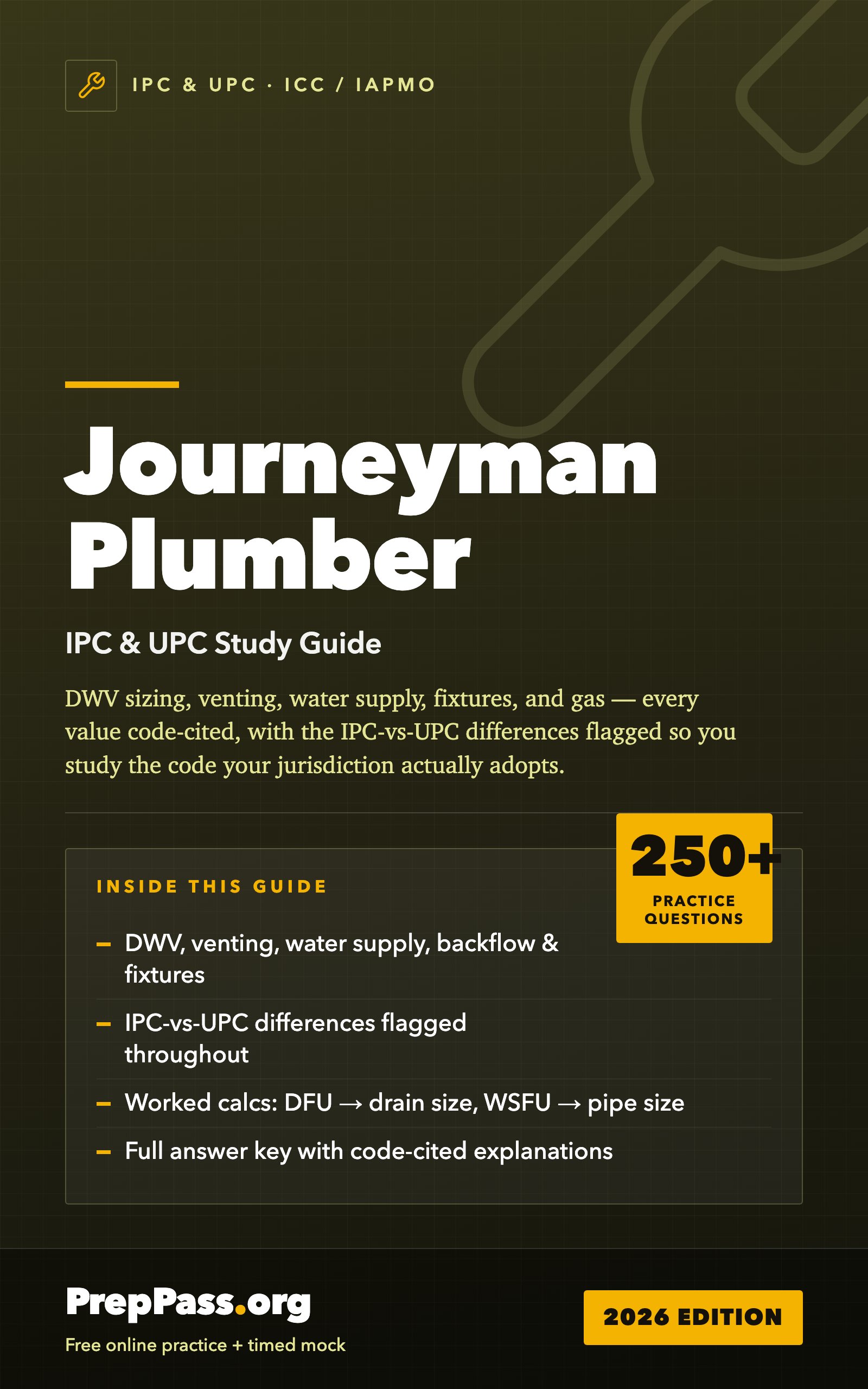
Journeyman Plumber — IPC & UPC Study Guide (2026)
DWV sizing, venting, water supply, fixtures, and gas — every value code-cited, with the IPC-vs-UPC differences flagged so you study the code your jurisdiction actually adopts.
A journeyman plumber exam prep course runs $150–$600. This book teaches the same exam — same rules, verified to current standards — for a one-time $9.99 you keep for life.
This is an independent study guide, not affiliated with or endorsed by the ICC or IAPMO. Plumbing is governed by two competing model codes — the IPC (International Plumbing Code) and the UPC (Uniform Plumbing Code) — plus state and local amendments, and some values differ between them. This guide flags those differences and gives the value common to both where possible, but always confirm every figure and section number against the exact code, edition, and amendments your jurisdiction has adopted before relying on it.
Own the complete book — PDF + EPUB
The practice questions and timed mock stay free. The book is the studying half:
- Taught chapter by chapter — every exam section explained in order, not just questions
- Print it & tab it — a paper reference you can highlight and mark up
- Works offline — PDF for print, EPUB for your phone or e-reader
- Everything in one file — chapters, cram sheets, and practice questions together
14-day money-back guarantee — not satisfied? Email us for a full refund, no questions asked. Refund policy
Chapter 1 is free to read on this page — try before you buy. One payment unlocks the complete book (PDF + EPUB, practice questions with explanations, per-chapter cram sheets).
Instant PDF + EPUB download · one-time, yours forever · no subscription · 14-day money-back guarantee · not sure yet? read a full chapter free below.
- Verified from the official source(IPC / UPC (ICC & IAPMO) — independently source-checked)
- 299 free practice questions
- Instant download, yours for life
One complete chapter, exactly as it ships in the eBook. Scroll the window to read it right here; no download, no email.
Most trades have one rulebook. Plumbing has two — and they do not always agree. Before you memorize a single dimension, slope, or fixture-unit value, you have to know which rulebook your inspector is holding, because the exact same wall can pass in one town and fail in the next. This chapter builds the mental map every journeyman needs: who writes the codes, who enforces them, how the two national model codes differ, and how to keep a study fact from becoming a field mistake.
The two model codes
A model code is a rulebook written by a standards organization. It has no legal force on its own. It becomes law only when a state, county, or city formally adopts it. Two model plumbing codes dominate the United States:
- The International Plumbing Code (IPC), published by the International Code Council (ICC). It is part of the "I-Code" family that includes the International Building Code and International Residential Code, which is why many states that adopt the IBC also adopt the IPC.
- The Uniform Plumbing Code (UPC), published by the International Association of Plumbing and Mechanical Officials (IAPMO). The UPC descends from the older Uniform Plumbing Code tradition used heavily in the western United States.
A given jurisdiction adopts one or the other as its base plumbing code — never both — and then layers on state and local amendments. As a rough pattern, many western and some southern states lean UPC while many eastern and midwestern states lean IPC, but there is no reliable shortcut: adoption is decided state by state (and sometimes city by city) and it changes with each new code cycle. The only safe move is to confirm the adopted code and edition for the exact place you are working or testing.
Why this matters for your exam. Licensing exams are written to a specific code and edition. A "correct" answer on a UPC-based exam can be the wrong answer on an IPC-based exam. When you register, the testing agency or state board tells you which code the exam is based on. Study that code first. This guide teaches the concepts common to both and, wherever the two diverge, tells you so explicitly.
Where the two codes actually differ
Most plumbing physics is identical in both codes — water still runs downhill, traps still hold a seal, vents still protect that seal. The codes agree on the big ideas. They diverge on specific numbers and allowances. The differences you are most likely to be tested on, and that this book flags chapter by chapter, include:
- Trap-arm length (the maximum distance from a trap to its vent). The UPC's maximum distances are much shorter than the IPC's at every pipe size — for a 1½-inch arm, roughly 3 ft 6 in under the UPC versus 6 ft under the IPC. (Both codes separately cap the arm's fall at one pipe diameter so the vent stays above the trap weir — that rule is common to both; it is the length that diverges.) (Chapter 4.)
- Minimum drainage slope on larger pipe. The IPC openly allows 1/8 inch per foot on 3-to-6-inch pipe; the UPC generally holds 1/4 inch per foot and reduces slope on large pipe only with approval. (Chapter 3.)
- Fixture-unit values and fixture-unit-to-flow conversions, which differ table to table between the codes. (Chapters 2 and 6.)
- Where and whether air admittance valves may replace a vent through the roof, and details of wet and combination venting. (Chapter 4.)
Whenever you see a number in this book, check the two tags next to it: which code it comes from, and whether it is common to both or diverges. Never carry one code's number into the other code's world.
Who enforces the code: the Authority Having Jurisdiction
The Authority Having Jurisdiction (AHJ) is the office that has legally adopted and now enforces the code where you work — usually a city or county building or plumbing department, acting through a plumbing inspector. The AHJ, not the code publisher and not the manufacturer, has the final say on your installation. The AHJ:
- issues the permit that must be in hand before most plumbing work begins;
- inspects the work at defined stages — commonly underground/rough-in and final;
- interprets the code where it is silent or ambiguous, and enforces any local amendments;
- can require testing and can reject non-listed materials.
When the code and a manufacturer's instructions conflict, the general rule is that the more restrictive requirement governs, and the AHJ decides — you do not get to pick the easier one because it is faster.
Permits, inspections, and tests
Plumbing is inspected because its failures are hidden and dangerous: a cross-connection can poison a water supply, a lost trap seal can vent sewer gas into a home, and a blocked relief line can turn a water heater into a projectile. The system is proven before it is covered up.
The DWV (drain-waste-vent) rough-in is typically proven with a water test or an air test:
- Water test: the system is filled with water to a head of at least 10 feet (or the entire system where the building is less than 10 feet tall) and must hold without leaking. This 10-foot head is common to both codes (IPC 312.2; UPC 712.0); confirm the hold time your adopted edition and AHJ require.
- Air test: the system is pressurized with air (commonly 5 psi, held for a set time) and must hold pressure. This alternative is in both codes (IPC 312.3; UPC 712.0); confirm the exact pressure and duration your AHJ enforces.
The water-supply system is separately pressure-tested. Always confirm the exact test pressure and duration your AHJ enforces; these are among the values that vary by code and local amendment.
Listed and labeled materials
Both codes require plumbing materials and devices to be listed and labeled — that is, evaluated by an approved third-party agency to a recognized product standard (for example, ASME for valves and fittings, ASSE for backflow devices, NSF for potable-water contact, ASTM for pipe). The label is your evidence to the inspector that the product meets the standard the code references. "The inspector approved one last year" and "the cheapest one that looked right" are not substitutes for a listing.
Key numbers & facts (Chapter 1)
| Item | Value / rule | Code & note |
|---|---|---|
| Model codes | IPC (ICC) and UPC (IAPMO) | Common framing; a jurisdiction adopts one, plus amendments |
| Legal authority | The Authority Having Jurisdiction (AHJ) | The local official enforces the adopted code |
| Permit | Required before work begins (most work) | Both codes; scope of exempt minor work varies — confirm locally |
| DWV water test | ≥ 10 ft head, or whole system if shorter | Common to both (IPC 312.2 / UPC 712.0); confirm hold time |
| DWV air test | 5 psi, held | Alternative to water test (IPC 312.3 / UPC 712.0); confirm duration |
| Materials | Must be listed and labeled to a standard | Both codes (ASME/ASSE/NSF/ASTM) |
| Conflict rule | More restrictive requirement governs; AHJ decides | General principle |
Every figure above is a general or common-to-both value. Any figure that differs by code is flagged where it appears in later chapters. Confirm the adopted code and edition before you rely on any number.
Worked example — reading the same job two ways
A plumber studying for a license pulls a detail from memory: "A 1½-inch trap arm can be up to 6 feet from its vent." On the job in a UPC jurisdiction, the inspector red-tags it: under the UPC (Table 1002.2), a 1½-inch trap arm is limited to roughly 3 feet 6 inches to its vent — far shorter than the IPC's 6 feet (Table 909.1). (Both codes also require the arm's total fall to stay within one pipe diameter so the vent stays above the trap weir, but here it is the length that fails.)
What went wrong? The plumber memorized an IPC number (where the 1½-inch limit is about 6 feet) and applied it in a UPC town. Both numbers are "right" — in their own code. The fix is not to memorize harder; it is to tag every number with its code and confirm the jurisdiction first. That single habit prevents a large share of code-based exam misses and field rejections.
Named exam traps
- Trap 1 — treating one code's number as national. If a question does not name the code, answer with the value that is common to both codes, or recognize that the answer is "it depends on the adopted code." Do not default to the IPC (or the UPC) number you happened to memorize.
- Trap 2 — confusing the publisher with the enforcer. The ICC and IAPMO write the codes; the AHJ enforces them. A question asking "who approves the work" is the AHJ, not the code council.
- Trap 3 — manufacturer instructions vs. code. When they conflict, the more restrictive rule governs and the AHJ decides — you cannot simply follow the manufacturer because it is easier.
- Trap 4 — "listed" means cheap or previously approved. Listing means third-party evaluation to a standard, nothing else.
- Trap 5 — assuming no permit for "small" work. What counts as exempt minor work is a local call; do not assume.
What's in the eBook
Why buy the book when the practice is free?
Our practice questions and timed mock stay free — nothing on the site moves behind this book. The $9.99 book is the studying half: the material itself, taught in order, in a file you own.
- Systematic teaching — every exam section explained chapter by chapter, start to finish, not just questions
- Print it & tab it — a paper-ready PDF you can highlight, mark up, and bring to your study table
- Study anywhere, offline — EPUB on your phone or e-reader; no wifi, no browser tabs
- Everything in one place — chapters, per-chapter cram sheets, and practice questions in one file
- Yours for life — one-time $9.99, instant download, no subscription
And it's risk-free: 14-day money-back guarantee — not satisfied? Email us for a full refund, no questions asked. See the refund policy.
14-day money-back guarantee · full refund, no questions asked.
One-time purchase, lifetime access to the download. The eBook is the full Journeyman Plumber study guide in PDF and EPUB. Educational summary, not professional or legal advice — always confirm the current rules with the official source. Last updated: August 2026.