NCLEX-RN Nursing Licensure · 2026 Edition
NCLEX-RN Exam — Complete Study Guide (2026)
All 8 client-needs categories, weighted like the NCSBN test plan — with the CAT scoring explained honestly (no fake pass %).
- All 7 client-needs chapters as one PDF + EPUB you keep
- 120 practice questions with a full rationale each, in the book
- Key numbers and clinical values, a worked example, named traps and a self-check in each of the 7 chapters
$19.99one-time · lifetime download · no subscription
PDF + EPUB · English · 105 pages · $19.99 one-time
This book is written in English.
Instant download after payment — no account needed, no subscription.
14-day money-back guarantee: not satisfied for any reason? Email support@preppass.org within 14 days of purchase for a full refund. It's a download, so there is nothing to ship back. Refund policy
Exam facts last checked against official sources: September 2026.
Try 10 questions first — free
Answer all 10, then see every answer explained — with the section of this guide that teaches it. About 5 minutes, no sign-up.
Start 10 free questionsLook inside the book
Three real pages, rendered straight from the PDF you download — a reference page, a teaching page, and a worked question, always in that order. Nothing here was redrawn to look better.
- Quick referenceAnswer Key & Explanations · PDF page 103
A page you can turn back to: the numbers, deadlines or terms gathered in one place.
- How it's taughtAnswer Key & Explanations · PDF page 94
An explanation page: the material taught in prose, in the order the exam tests it.
- How it's taughtAnswer Key & Explanations · PDF page 97
An explanation page: the material taught in prose, in the order the exam tests it.
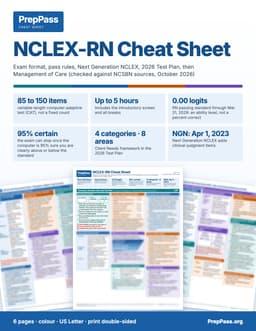
Exam inside two weeks?
This guide is the teaching, read over weeks. If your exam is inside two weeks, the printable colour cheat sheet is the other product: the figures the exam turns on, laid out by section.
See the NCLEX-RN Nursing Licensure cheat sheet PDF — $9.99 →
6 pages · US Letter · printable PDF · yours to keep
About the exam itself
| Administering body | National Council of State Boards of Nursing, Inc. (NCSBN) — exam delivered by Pearson VUE Source: NCSBN — 2026 NCLEX Examination Candidate Bulletin (PDF, April 2026) |
|---|---|
| Questions | 85–150 questions Source: NCSBN — NCLEX-RN® Test Plan, effective April 2026 (PDF) |
| Time limit | 300 minutes Source: NCSBN — 2026 NCLEX Examination Candidate Bulletin (PDF, April 2026) |
| Passing score | Pass or fail only — no fixed cut score Source: NCSBN — Passing Standard (NCLEX-RN 0.00 logits, effective through March 31, 2029) |
| Fees |
Source: NCSBN — 2026 NCLEX Examination Candidate Bulletin (PDF, April 2026) |
| Languages offered | English · French Source: NCSBN — NCLEX Frequently Asked Questions (“How is the NCLEX translated?”) |
Questions buyers ask
- Is a study guide enough for the NCLEX-RN Nursing Licensure exam, or do I need a course?
- A book is exam review: it does not replace any education, training or experience National Council of State Boards of Nursing, Inc. (NCSBN) requires before you may sit the exam, so check those requirements first. For the exam content itself, this 105-page guide teaches the material chapter by chapter with 120 practice questions and explanations inside, and 400 more practice questions are free on PrepPass. A prep course adds live instruction and a set schedule; whether you need one beyond any required education is your call.
- What is the cheapest way to prepare for the NCLEX-RN Nursing Licensure exam?
- Start with what costs nothing: 400 practice questions on PrepPass, with explanations and no signup. If you want it taught in one file you keep, the full study guide is $19.99 once; the printable cheat sheet for the last days is $9.99. No subscription on any of them.
- Who administers the NCLEX-RN® Examination?
- National Council of State Boards of Nursing, Inc. (NCSBN) — exam delivered by Pearson VUE. NCSBN develops the examination; Pearson VUE handles registration, scheduling and delivery at test centers. Results are released only by the candidate's nursing regulatory body — NCSBN and Pearson VUE will not give a candidate their result.
- How many questions are on the NCLEX-RN® Examination?
- 85–150 questions. A range, not a number: the NCLEX-RN is a variable-length computerized adaptive test. Every RN candidate must answer at least 85 items, and no candidate answers more than 150, within the same five-hour limit. The length of your exam is not a sign of passing or failing — NCSBN states a candidate may pass or fail at any length. Of a minimum-length 85-item exam, 15 items are unscored pretest items (the other 70 are 52 content-area items plus three six-item clinical judgment case studies); NCSBN does not publish the scored/unscored split for longer exams, so no fixed number of scored items is stated here.
- How long is the NCLEX-RN® Examination?
- 300 minutes. Five hours, and NCSBN is explicit that the limit does not change with the number of items administered. The five hours include the introductory screen and all breaks, which are optional: a break is offered after about two hours of testing and again after about three and a half hours, and the clock does not stop for them. Running out of time before the minimum number of items has been answered is an automatic fail.
- What is the passing score for the NCLEX-RN® Examination?
- Pass or fail only — no fixed cut score. There is no percentage and no number of correct answers that means “pass”. NCSBN publishes the NCLEX-RN passing standard as 0.00 logits on the NCLEX-RN ability scale; its Board of Directors voted in December 2022 to uphold that standard, and it is effective through March 31, 2029. The exam ends under one of three rules: the computer stops once it is 95% certain the candidate's ability is clearly above or clearly below the standard (after the minimum 85 items); at 150 items it decides on the final ability estimate alone; and if time runs out, the candidate fails unless the minimum number of items was answered, in which case the final ability estimate decides. NCSBN also states that there is no fixed percentage of candidates who pass or fail.
- How much does the NCLEX-RN® Examination cost?
- $200 — NCLEX registration fee (candidates seeking U.S. or Australian licensure) (Pearson VUE, per attempt); $150 — Additional international scheduling fee (testing outside the candidate's licensing country) (Pearson VUE, per attempt). The registration fee is charged for every registration, and NCSBN states there is no refund for any reason — a candidate who does not test within the validity of their Authorization to Test must register and pay again. The international scheduling fee is additional and non-refundable, and a value-added tax may be added where applicable. Two figures on NCSBN's fee table are not in US dollars or not universal and so are not listed above: candidates seeking Canadian licensure or registration pay CAD 360 (excluding local taxes), and separate $50 fees apply to changing your nursing regulatory body after registering, to changing exam type between RN and PN (U.S. candidates), and — for Canadian candidates only, at CAD 50 — to changing exam language between English and French. The licensure or registration fee itself is set by each nursing regulatory body, not by NCSBN.
- What languages is the NCLEX-RN® Examination offered in?
- English · French. English, and Canadian French. NCSBN states it offers the NCLEX-RN in French to meet the needs of French-speaking Canadian candidates, translating two operational item pools a year and having them reviewed by a Canadian Translation Panel of nurses proficient in both languages. The French option is Canadian: NCSBN's own fee table marks “change exam language (English/French)” as not applicable to candidates seeking U.S. or Australian licensure. The exam is not offered in paper-and-pencil or oral formats in any language.
- Does the NCLEX-RN Nursing Licensure study guide come as a PDF?
- Yes — NCLEX-RN Exam — Complete Study Guide (2026) downloads as PDF and EPUB, 105 pages. The download link is emailed the moment payment clears and does not expire.
- How much does the NCLEX-RN Nursing Licensure study guide cost?
- $19.99, once. There is no subscription and no account to create; the PDF and EPUB files are yours to keep.
- Are there free NCLEX-RN Nursing Licensure practice questions?
- Yes — 400 of them, free to use with no signup and an explanation on every one. They are separate from this study guide, which is what you are buying here. The same free, no-account system also has practice modes (adaptive, new questions, spaced review of misses, weak-topic focus, saved, my mistakes); a timed mock exam (100 questions, 120 minutes) with a score report by topic; a 10-question readiness check (about 5 minutes); 7 study chapters; a day-by-day study plan. None of it needs this study guide.
- Can I read part of the NCLEX-RN Nursing Licensure study guide before buying?
- Yes. A full chapter is free to read on this page — not a summary of one, the chapter itself.
- What is the difference between the NCLEX-RN Nursing Licensure study guide and the cheat sheet?
- The study guide ($19.99) teaches the material chapter by chapter and is meant to be read over weeks. The cheat sheet ($9.99, 6 pages) drops the teaching and keeps the figures: every number on the exam grouped by value so the confusable ones sit together, each reference page paired with a recall page that blanks the answers, and four routes by days left — 14, 7, 3, or tonight. They are separate purchases; neither replaces the other.
- Is this the official NCLEX-RN Nursing Licensure study guide?
- No. This is an independent study guide and is not affiliated with or endorsed by the exam's awarding body. It is written from NCSBN NCLEX-RN Test Plan. Always confirm current requirements with the body that issues your licence.
Free NCLEX-RN Nursing Licensure practice questions and study chapters →
What's included — and what isn't
Included
- All 7 client-needs chapters, weighted like the NCSBN test plan
- Prioritization (ABC / Maslow), delegation, and safety frameworks
- Labs, fluid & electrolytes, acid-base, and high-alert medications
- How the variable-length CAT is scored — no fake “X% to pass”
- 120 original practice questions with answer explanations
- PDF (print & tab it) + EPUB (phone / e-reader)
Not included
- No printed copy is shipped — this is a file you download and can print yourself
- No video course, instructor or tutoring comes with the book — the free videos on the site are separate
- Not your exam registration or the testing centre's fee, which you still pay to the official body
Contents
See 2 sections and the page each one starts on
- Practice Questionsp. 67
- Answer Key & Explanationsp. 93
Taken from the PDF you download, with the page each one starts on — not typed here.
Read a chapter free, in full
One complete chapter, exactly as it ships in the eBook. Scroll the window to read it right here; no download, no email.
Read chapter 6 here, without leaving the page
We didn't give you the easy intro — the free chapter opens on one of the hardest-working parts of the book, so you can judge the teaching where the exam gets difficult.
Introduction
Pharmacological and Parenteral Therapies is tied for the second-largest content area, and it tests safe medication administration end to end: applying the rights of medication administration, calculating doses accurately, monitoring the labs and vital signs specific to each drug class, recognizing adverse effects and toxicity, and handling high-alert parenteral therapies without a fatal error. It is a high-stakes category because a medication mistake reaches the client directly, which is exactly why the exam layers so many safety checks into it.
The category has a memorization core — which lab monitors which anticoagulant, which vital sign holds which cardiac drug, which electrolyte a loop diuretic depletes — but it rewards reasoning about mechanism. If you know why a loop diuretic wastes potassium, you don't have to memorize that furosemide causes hypokalemia; it follows. If you know why ACE inhibitors cause a dry cough (bradykinin accumulation), the teaching point is obvious. Throughout this chapter the numbers and rules are paired with their mechanism so the knowledge holds under pressure.
Above all, this category is about high-alert discipline. Certain drugs — insulin, heparin, IV potassium, blood products, digoxin, lithium — cause disproportionate harm when given wrong, so they carry extra rules: independent double-checks, holding parameters, dilution and slow infusion, and level monitoring for narrow-therapeutic-range drugs. The recurring correct answer is the cautious one: verify, double-check, hold and notify, and never take a shortcut with a high-alert drug.
Key concepts
| Item | Rule | Why it matters |
|---|---|---|
| Rights of administration | Right client, drug, dose, route, time, documentation | The core safety checklist |
| Documented allergy | Hold the drug and notify the prescriber | A hard contraindication |
| Dose calculation | Desired ÷ available × quantity | Prevents under/overdose |
| High-alert double-check | Second nurse verifies insulin, heparin, pediatric doses, blood | Catches lethal errors |
| Warfarin monitoring | PT / INR; reversed by vitamin K | Wrong lab = wrong drug |
| Heparin monitoring | aPTT; reversed by protamine sulfate | Distinguish from warfarin |
| Digoxin | Hold for apical pulse < 60; watch for toxicity | Further slows the heart |
| Loop diuretic (furosemide) | Causes hypokalemia — monitor potassium | Dysrhythmia risk |
| Aminoglycosides | Monitor renal function + peak/trough | Nephrotoxic/ototoxic |
| Lithium | Narrow range — vomiting, coarse tremor, confusion = toxicity | Level monitoring + hydration |
| IV potassium | Never IV push; dilute, infuse slowly via pump | Rapid push can be fatal |
| Rapid-acting insulin (lispro) | Food within ~15 minutes | Prevents hypoglycemia |
| Blood products | Infuse with normal saline only, verify with second nurse | Prevents reaction |
Safe medication administration
Every administration runs through the rights of medication administration — verify the right client, drug, dose, route, time, and documentation (many programs add right reason and right response). Client identity is confirmed with two identifiers before any drug. These checks feel routine precisely so that they catch the non-routine error — the look-alike drug name, the transposed dose, the wrong client.
Allergies are a hard stop. When the client has a documented allergy to a drug, the nurse holds the medication and notifies the prescriber to clarify or change the order — you do not give a smaller "test" dose, do not pre-medicate with an antihistamine and give it anyway, and do not give it and "monitor closely." A documented allergy is a contraindication, and overriding it risks a life-threatening reaction. This is one of the most reliable right answers in the category: allergy → hold and notify.
Documentation is immediate and truthful: record administration promptly after giving the drug, and never chart a medication before it is given. Charting ahead of administration is both a veracity violation (Chapter 1) and a setup for a real error if the dose is then missed or changed. Right checks, allergy discipline, honest and timely documentation — this is the safety spine the rest of the category hangs on.
Dosage calculation
Accurate calculation prevents both underdosing and overdosing, and the workhorse method is desired over available: divide the ordered (desired) dose by the dose on hand and multiply by the quantity the dose comes in. If 250 mg is ordered and the pharmacy supplies 125 mg tablets, then 250 ÷ 125 = 2 tablets. Set the problem up the same way every time and the arithmetic becomes routine.
Two safety habits protect the calculation. Convert units before you calculate — make sure everything is in the same units (mg to mg, not mg to g) — because a unit mismatch is how a tenfold error sneaks in. And double-check high-alert drugs: have a second nurse independently verify insulin, heparin, and pediatric doses, where a small error does large harm. Independent verification means the second nurse calculates without being told your answer.
Finally, question any dose that seems off. A calculation that requires an unusual number of tablets or vials, or a dose that seems far too high, is a signal to stop and re-verify rather than proceed. The professional instinct the exam is cultivating is that a strange-looking answer is probably a wrong answer — recheck the math and the order before the drug reaches the client.
Drug classes and monitoring
Each drug class has signature parameters, and the anticoagulants are the most tested pair. Warfarin is monitored with the PT and INR and reversed by vitamin K; heparin is monitored with the aPTT and reversed by protamine sulfate. Keep the pairs straight — using aPTT for warfarin, or giving vitamin K for a heparin overdose, are classic wrong answers. So for a client bleeding on IV heparin with a very high aPTT, the antidote is protamine sulfate, not vitamin K (that's for warfarin) and not naloxone (that's for opioids).
Cardiac drugs have holding parameters tied to vital signs. Hold digoxin for an apical heart rate below 60 beats/minute in an adult, because digoxin further slows the heart and bradycardia may signal toxicity — so an apical rate of 52 means hold and notify, while a normal blood pressure, respiratory rate, or temperature would not. Before a beta-blocker such as metoprolol, check the apical heart rate and blood pressure, since beta-blockers lower both and the dose is held for significant bradycardia or hypotension per parameters.
Two more classes round out the section. Loop diuretics such as furosemide promote potassium excretion and cause hypokalemia — monitor potassium and watch for muscle weakness and dysrhythmias (not hyperkalemia, hypernatremia, or hypercalcemia). And aminoglycoside antibiotics are nephrotoxic and ototoxic, so monitor renal function and peak-and-trough drug levels to keep the drug in its safe window. Each rule is really a mechanism: the diuretic dumps potassium, the aminoglycoside stresses the kidney, so those are what you watch.
Adverse effects and toxicity
Recognizing trouble early prevents harm, and several drugs have hallmark warnings. Opioids (such as morphine) can cause respiratory depression and sedation, so assess respiratory rate and level of sedation before and after administration, and start a bowel regimen (stool softener, fluids, fiber) to prevent the constipation opioids reliably cause — withholding fluids or fiber is the wrong direction. Lithium has a narrow therapeutic range, and vomiting, coarse tremors, and confusion signal toxicity, requiring level monitoring and adequate hydration; these are not "normal side effects to ignore."
ACE inhibitors commonly cause a persistent dry cough (from bradykinin accumulation) that clients should be taught to report, while angioedema, though rare, is an emergency. Corticosteroids taken long term must be tapered, never stopped abruptly, to prevent adrenal insufficiency — they are taken with food, and blood glucose is monitored because steroids raise it. So "stop when symptoms improve" and "take on an empty stomach" are wrong for long-term steroids.
A few other teaching points recur. Phenytoin causes gingival hyperplasia, so meticulous oral hygiene is taught; doses are never skipped, and a rash is reported because it may signal a serious reaction. The pattern across the section is that each drug carries a specific, mechanism-based warning — respiratory rate for opioids, tremor and confusion for lithium, cough for ACE inhibitors, taper for steroids, gum care for phenytoin — and the exam tests whether you can attach the right warning to the right drug.
Parenteral and high-alert therapies
Parenteral therapy is where the highest-alert rules live, and IV potassium is the headline: never give potassium by IV push. It must be diluted and infused slowly with an infusion pump, because rapid IV administration can cause fatal cardiac arrest; cardiac monitoring is maintained during the infusion. "Undiluted for faster effect" and "rapid IV push" are dangerous, always-wrong answers. This is the single most important safety rule in the chapter.
Insulin and blood products carry their own timing and verification rules. Rapid-acting insulin such as lispro begins working within about 15 minutes, so ensure the client has food available within roughly 15 minutes of the injection to prevent hypoglycemia — two hours later is far too long. Blood products are infused with normal saline only (never dextrose or another solution) and are verified by a second qualified nurse for client and product before hanging, with baseline vital signs taken first.
Finally, food-and-drug interactions get specific teaching. Clients on MAOIs must avoid tyramine-rich foods — aged cheese and cured meats — which can trigger a hypertensive crisis; fresh fruit, rice, and steamed vegetables are safe. Clients on tetracycline must separate the dose from dairy and antacids, because the calcium in them binds the drug and blocks absorption (and doses are never doubled when missed). Across parenteral and high-alert therapy, the through-line is the same as the whole category: dilute, verify, time correctly, teach the interaction, and never shortcut a high-alert drug.
Key numbers & clinical values
- Hold digoxin for an apical pulse < 60 beats/minute.
- Rapid-acting insulin (lispro) — ensure food within ~15 minutes.
- Dose calculation — desired ÷ available × quantity (e.g., 250 mg ÷ 125 mg/tab = 2 tablets).
- Warfarin → PT/INR (reverse with vitamin K); heparin → aPTT (reverse with protamine sulfate).
- Loop diuretic (furosemide) → hypokalemia (monitor potassium; normal potassium ~3.5–5.0 mEq/L, see Chapter 7).
- Aminoglycosides — monitor renal function + peak/trough.
- IV potassium — never IV push; dilute and infuse slowly via pump.
- Blood products — normal saline only, second-nurse verification.
- Lithium — narrow range; vomiting, coarse tremor, confusion = toxicity.
Worked example
Scenario. You are about to give digoxin and find an apical heart rate of 52 beats/minute. What do you do? Reasoning. Hold digoxin for an apical rate below 60 — it further slows the heart and bradycardia may signal toxicity — and notify the provider. A normal BP, respiratory rate, or temperature would not stop the dose. Hold and notify.
Scenario. A client on IV heparin has an aPTT far above range and is bleeding. Which antidote? Reasoning. Heparin is reversed by protamine sulfate. Vitamin K reverses warfarin; naloxone reverses opioids. Give protamine sulfate.
Common exam traps
- Swapping the anticoagulant labs/antidotes. Warfarin = PT/INR + vitamin K; heparin = aPTT + protamine. Don't cross them.
- Giving a drug despite a documented allergy. Always hold and notify — no test dose, no "give and monitor."
- IV push potassium. Never — dilute and infuse slowly via pump.
- Expecting hyperkalemia from a loop diuretic. Furosemide causes hypokalemia.
- Stopping long-term steroids abruptly. Taper to avoid adrenal insufficiency; take with food.
- Charting a med before giving it. Document promptly after administration, never before.
Self-check
- What is the antidote for heparin, and how is heparin monitored? (Protamine sulfate; monitored by aPTT.)
- Below what apical heart rate do you hold digoxin? (Below 60 beats per minute.)
- Order: 250 mg; supply: 125 mg tablets. How many tablets? (Two tablets — desired ÷ available.)
- Which electrolyte imbalance does furosemide cause? (Hypokalemia.)
- Can IV potassium be given by IV push? (No — never; it must be diluted and infused slowly via pump.)
Before you buy
- How do I get it?
- Pay, and the download appears on this page straight away. The links are also emailed to you. No account is required.
- What if it isn't for me?
- Email us within 14 days for a full refund, no questions asked.
- Is the free practice going away?
- No. Every practice question, the timed mock and the free chapters on this site stay free. This book is the studying half, not a gate around the free half.
- Can I read it on my phone?
- Yes — the EPUB is for phones and e-readers, the PDF is for printing and tabbing. You get both.
The details
All 8 client-needs categories, weighted like the NCSBN test plan — with the CAT scoring explained honestly (no fake pass %).
- Format: PDF + EPUB download · 105 pages
- 120 practice questions in the book, with a full answer key
- 400 free practice questions for this exam on PrepPass, included at no cost
- $19.99 one-time — no subscription
- 14-day money-back guarantee · refund policy
- Cross-referenced against: NCSBN NCLEX-RN Test Plan
- Last updated: August 2026
- Verified from the official source(NCSBN NCLEX-RN Test Plan)
- 400 free practice questions
- Instant download, yours for life
An NCLEX review course runs $200–$800. This book teaches the same exam — same rules, verified to current standards — for a one-time $19.99 you keep for life.
Why buy the book when the practice is free?
Our practice questions and timed mock stay free — nothing on the site moves behind this book. The $19.99 book is the studying half: the material itself, taught in order, in a file you own.
- Systematic teaching — every exam section explained chapter by chapter, start to finish, not just questions
- Print it & tab it — a paper-ready PDF you can highlight, mark up, and bring to your study table
- Study anywhere, offline — EPUB on your phone or e-reader; no wifi, no browser tabs
- Everything in one place — the chapters and the practice questions in one file
- Yours for life — one-time $19.99, instant download, no subscription
And it's risk-free: 14-day money-back guarantee — not satisfied? Email us for a full refund, no questions asked. See the refund policy.
Also free on PrepPass for NCLEX-RN Nursing Licensure
Beside this guide, PrepPass has a free study system for the same exam. It needs no account, and buying the guide does not unlock or change it: 400 practice questions with explanations; practice modes (adaptive, new questions, spaced review of misses, weak-topic focus, saved, my mistakes); a timed mock exam (100 questions, 120 minutes) with a score report by topic; a 10-question readiness check (about 5 minutes); 7 study chapters; a day-by-day study plan.
Progress is saved in your browser; a free account keeps it across devices. The readiness gauge reflects your own practice, not a prediction of the real exam result. How the practice works
14-day money-back guarantee · full refund, no questions asked.
One-time purchase, lifetime access to the download. The eBook is the full NCLEX-RN Nursing Licensure study guide in PDF and EPUB. Educational summary, not professional or legal advice — always confirm the current rules with the official source. Last updated: August 2026.