Study guide · 2026 Edition
RBT Practice Test Book 2026 — 3rd Edition Outline
PrepPass's independent 2026 study guide for the RBT exam is 441 pages including 444 practice questions with a full answer key, PDF + EPUB, $29.99 one-time; it is not affiliated with the exam provider. The book does not include PrepPass's separate online timed mock for this exam (85 questions, 90 minutes). The book also prints its own practice exam, which is separate.
Edition: Written to the BACB's RBT Test Content Outline (3rd ed.), which the exam uses from 2026; older books predate it.
- Length
- 441 pages
- Practice questions in the book
- 444
- PrepPass online timed mock
- 85 questions · 90 min
- Exam facts checked, file updated
- October 2026
- Delivery
- PDF + EPUB · English · instant download
What is in the RBT (Registered Behavior Technician) study guide?
Exam facts last checked October 2026 against the exam body's published sources. Inside: 424 questions in 2 full-length forms and 6 domain practice sets, with all four options explained — plus 20 worked walkthroughs of the best-answer method; an answer key and a domain scoring grid for each of the 2 forms — score yourself by domain the same day.
The real exam: Registered Behavior Technician (RBT) Certification Examination — 85 questions (75 scored, 10 unscored pretest) · 90 minutes · Passing score: Not published by BACB. RBT examination: RBT examination 75 (90 min) = 75 scored questions plus 10 unscored pretest. BACB RBT Test Content Outline (3rd ed.) (updated 09/2024; the outline the RBT examination uses beginning in 2026) gives the scored items in each section: Data Collection and Graphing 13, Behavior Assessment 8, Behavior Acquisition 19, Behavior Reduction 14, Documentation and Reporting 10, Ethics 11. The outline lists 43 tasks in six domains and prints the number of scored questions per domain; the examination also carries 10 unscored pilot questions. Last checked 2026-10-15.
Written to the BACB Test Content Outline that took effect in 2026 — the one older books were not.
Examination appointment fee (charged for every appointment, retakes included): $45 per attempt, paid to Pearson VUE. A retake pays it again. This guide: $29.99, one time.
Exam facts, who it suits and what changed
To prepare for the RBT (Registered Behavior Technician) exam, start with what the exam body publishes: RBT Test Content Outline (3rd ed.) from Behavior Analyst Certification Board (BACB) — the official list of tasks the exam tests, free (PDF). That is enough if you only need to see what the exam covers; this book is for learning it and practising it. The exam itself (Registered Behavior Technician (RBT) Certification Examination): 85 questions (75 scored, 10 unscored pretest), 90 minutes, passing score not published by BACB. Choose this book if you want full practice exams written to the current outline and scored by domain. It does not replace the training BACB requires.
About the exam itself
| Administering body | Behavior Analyst Certification Board, Inc. (BACB) — exam delivered by Pearson VUE Source: BACB — Registered Behavior Technician Handbook (PDF, updated 06/2026) |
|---|---|
| Questions | 85 questions (75 scored, 10 unscored pretest) Source: BACB — Registered Behavior Technician Handbook (PDF, updated 06/2026) |
| Time limit | 90 minutes Source: BACB — Registered Behavior Technician Handbook (PDF, updated 06/2026) |
| Passing score | Not published by BACB What we read and found nothing in: BACB — Registered Behavior Technician Handbook (PDF, updated 06/2026) |
| Fees |
Source: BACB — Registered Behavior Technician Handbook (PDF, updated 06/2026) |
| Languages offered | English Source: BACB — Registered Behavior Technician Handbook (PDF, updated 06/2026) |
Look inside the book
Three real pages, rendered straight from the PDF you download — a reference page, a teaching page, and a worked question, always in that order. Nothing here was redrawn to look better.
- Quick referencePart IV — Domain practice sets · PDF page 418
A page you can turn back to: the numbers, deadlines or terms gathered in one place.
- How it's taughtPart III — Two full-length practice forms · PDF page 279
An explanation page: the material taught in prose, in the order the exam tests it.
- A question, workedPart IV — Domain practice sets · PDF page 314
A practice question with its answer and the reasoning behind it — not just a key.
Exam inside two weeks?
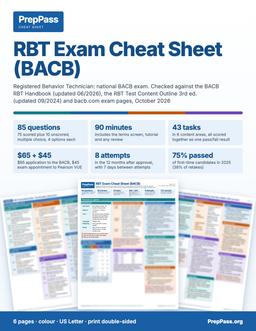
This guide is the teaching, read over weeks. If your exam is inside two weeks, the printable colour cheat sheet is the other product: the figures the exam turns on, laid out by section.
See the RBT cheat sheet PDF — $9.99 →
6 pages · US Letter · printable PDF · yours to keep
How this book compares
BACB publishes the RBT Test Content Outline (3rd ed.) for free; it applies to exams from January 1, 2026. This book gives you full practice exams written to it; Mometrix sells a study guide with practice tests.
| Resource | Price | What you get | Choose it if |
|---|---|---|---|
| This bookRBT Practice Test Book 2026 — 3rd Edition OutlinePrepPass | $29.99 | Downloadable practice-test book for the RBT exam
| Choose this book if you want full practice exams written to the current outline and scored by domain. It does not replace the training BACB requires. |
| From the exam bodyRBT Test Content Outline (3rd ed.) (opens the publisher's page in a new tab)Behavior Analyst Certification Board (BACB) | Free (PDF) | The official list of tasks the exam tests | Read it in any case: every exam question is written to one of its tasks. |
| AlternativeRBT Exam Secrets (opens the publisher's page in a new tab)Mometrix Test Preparation | $19.99 ebook; $24.99 printed book | Study guide with practice tests
| Choose Mometrix if you want a printed copy. |
This book
RBT Practice Test Book 2026 — 3rd Edition Outline
PrepPass
- Price
- $29.99
- What you get
Downloadable practice-test book for the RBT exam
- 444 practice questions, each mapped to its outline task and explained
- 441 pages, PDF + EPUB
- Choose it if
- Choose this book if you want full practice exams written to the current outline and scored by domain. It does not replace the training BACB requires.
From the exam body
RBT Test Content Outline (3rd ed.) (opens the publisher's page in a new tab)
Behavior Analyst Certification Board (BACB)
- Price
- Free (PDF)
- What you get
The official list of tasks the exam tests
- Choose it if
- Read it in any case: every exam question is written to one of its tasks.
Alternative
RBT Exam Secrets (opens the publisher's page in a new tab)
Mometrix Test Preparation
- Price
- $19.99 ebook; $24.99 printed book
- What you get
Study guide with practice tests
- Three full-length practice tests with detailed answer explanations (per the product title)
- Choose it if
- Choose Mometrix if you want a printed copy.
Other resources' prices and contents are as listed on each publisher's or seller's own page, checked September 24, 2026. Prices change; confirm on the linked page before you buy. This book's price and contents come from our own catalog.
Sources (2)
- https://www.bacb.com/test-content-outlines-for-bacb-certifications/ — read September 24, 2026
- https://www.mometrix.com/studyguides/rbt/ — read September 24, 2026
What's included — and what isn't
Included
- Written to the 2026 3rd-edition outline — including the tasks that are new in it
- Exam review for people who have finished the 40-hour training; it does not replace the training or the competency assessment, and it does not teach behavior analysis from zero
Not included
- No printed copy is shipped — this is a file you download and can print yourself
- No video course, instructor or tutoring comes with the book — the free videos on the site are separate
Everything included, and everything that isn't
Included
- Every answer mapped to its domain and task, so you can score yourself by domain the same day
- 444 questions in all: two full 85-question practice exams weighted to the six official domains, six domain practice sets and 20 worked walkthroughs of the best-answer method
- The 43-task self-audit checklist — find your weak tasks before the exam finds them
- The best-answer method: worked scenarios showing why the “almost right” option loses
- A 14-day retake study plan keyed to your own diagnostic results
- Retake rules current to the 06/2026 Handbook: 7-day wait, up to 8 attempts in 12 months
- Every question in the forms and the domain sets comes with all four options explained — why the key is best AND why each of the other three loses
- PDF (print & tab it) + EPUB (phone / e-reader)
Not included
- Not your exam registration or the testing centre's fee, which you still pay to the official body
Contents
See 12 sections and the page each one starts on
- Part I — The Study Guidep. 24
- Chapter 1 — Data Collection and Graphingp. 25
- Chapter 2 — Behavior Assessmentp. 42
- Chapter 3 — Behavior Acquisitionp. 55
- Part I — Shaping (C.10.)p. 68
- Chapter 4 — Behavior Reductionp. 77
- Chapter 5 — Documentation and Reportingp. 97
- Chapter 6 — Ethicsp. 111
- Part I — Interpersonal and professional skills (F.9.)p. 124
- Part II — The Retake Toolkitp. 134
- Part III — Two full-length practice formsp. 179
- Part IV — Domain practice setsp. 288
Taken from the PDF you download, with the page each one starts on — not typed here.
Read a chapter free, in full
One complete chapter, exactly as it ships in the eBook. Scroll the window to read it right here; no download, no email.
Read chapter 1 here, without leaving the page
The free chapter is Chapter 1, Data Collection and Graphing: it shows the level of the whole book, a compact review that defines each term and then drills the distinctions the exam turns on, written for someone who has met the terms in training.
Introduction
Data is the part of this job that cannot be faked, and it is the part of the exam that cannot be bluffed. Every other domain depends on this one: an acquisition program is only working if the data say so, a behavior plan is only justified if the data say so, and your session note is only honest if it matches what you recorded.
Domain A is 13 scored questions, the third-largest domain behind Behavior Acquisition and Behavior Reduction, and it is the domain that changed most in the 3rd edition. The old Measurement domain asked you to collect data and plot it. The new Data Collection and Graphing domain also asks you to compute summary measures (A.6.), read a graph and describe its trend (A.7.), and explain what goes wrong when data or implementation are sloppy (A.8.). Those three tasks are new. If your last attempt included graph-reading items or a "responses per hour" arithmetic item and they felt like they came from nowhere, this is why.
The good news is that Domain A is the most learnable domain on the exam. The distinctions are crisp, the arithmetic is simple, and the traps are a short, fixed list. This chapter walks through the two families of measurement (continuous and discontinuous), permanent product, observable and measurable description, the three summary calculations you will actually be asked for, how to read a line graph, and what procedural fidelity means.
Learning objectives
After working through this chapter you should be able to:
- A.1. Implement continuous measurement procedures — frequency, duration, latency, and interresponse time — and choose the right one for a described behavior.
- A.2. Implement discontinuous measurement procedures — partial interval, whole interval, and momentary time sampling — and state which over-estimates and which under-estimates occurrence.
- A.3. Implement permanent product recording procedures, and recognize when a permanent product is and is not available.
- A.4. Enter data and update graphs accurately, on the correct axes, in the correct phase.
- A.5. Describe behavior and environment in observable and measurable terms, and rewrite a subjective description into an objective one.
- A.6. Calculate and summarize data in different ways — rate, mean duration, and percentage — from raw session data.
- A.7. Identify trends in graphed data, including level, trend direction, variability, and what a phase-change line means.
- A.8. Describe the risks associated with unreliable data collection and poor procedural fidelity, and explain why both threaten the client, not just the paperwork.
Part A — Continuous measurement: counting the behavior itself (A.1.)
Continuous measurement means you record every occurrence of the behavior during the observation period. Nothing is estimated. Four procedures, and the exam expects you to pick between them from a one-sentence description.
Frequency (count). A tally of how many times the behavior occurred. Use it when the behavior has a clear beginning and end and each instance takes roughly the same amount of time. "Ravi hit the table 7 times." Frequency alone is only interpretable if the observation periods are the same length — which is exactly why rate exists (see A.6.).
Duration. How long the behavior lasts, from onset to offset. Use it when how long is the clinically important part: tantrums, on-task engagement, crying, self-stimulation. You can record total duration across a session, or duration per occurrence, from which you compute mean duration.
Latency. The time from a stimulus or instruction to the start of the behavior. Use it when the concern is how long it takes the learner to get going after a demand. "The RBT says 'put on your shoes'; 42 seconds pass before Maya reaches for a shoe." Latency starts at the antecedent event and stops when the behavior begins.
Interresponse time (IRT). The time between the end of one occurrence of a behavior and the start of the next. Use it when the concern is spacing or pacing: how long between two requests, two bites, two vocalizations. IRT and rate move in opposite directions — shorter IRTs mean a higher rate.
The discrimination that matters most: latency versus IRT. Both are time-between measures, which is why the exam loves them together. Latency is measured from something the environment did (an instruction, a cue) to the behavior starting. IRT is measured from one behavior to the next occurrence of the same behavior. If the stem mentions an instruction or an SD, and the clock starts there, it is latency. If the clock starts at the end of a response, it is IRT.
| Procedure | Clock starts | Clock stops | Answers the question |
|---|---|---|---|
| Frequency | — (tally) | — | How many times? |
| Duration | Behavior begins | Behavior ends | How long does it last? |
| Latency | Antecedent/instruction | Behavior begins | How long until it starts? |
| IRT | One response ends | Next response begins | How much time between them? |
Part B — Discontinuous measurement: sampling the behavior (A.2.)
Discontinuous measurement divides the observation into intervals and records whether the behavior occurred, rather than recording every instance. It is an estimate, chosen because it lets one person watch a behavior while also teaching. Three procedures — and the exam tests them almost entirely through what each one over- or under-estimates.
Partial-interval recording. Mark the interval if the behavior occurred at any point during it, even for one second, even once. Because a single brief occurrence scores the whole interval, partial interval over-estimates how much the behavior actually occurred. It is usually chosen for behaviors you want to decrease, since over-estimating a problem behavior is the conservative error.
Whole-interval recording. Mark the interval only if the behavior occurred for the entire interval, start to finish. A behavior that stops for two seconds in the middle does not score. Because of that, whole interval under-estimates occurrence. It is usually chosen for behaviors you want to increase, such as on-task engagement or sustained play, since under-estimating a desired behavior is the conservative error there.
Momentary time sampling (MTS). Look at the one moment the interval ends and record whether the behavior is occurring right then. What happens in between is not recorded at all. MTS may over- or under-estimate depending on the behavior; because it requires attention only at fixed moments, it is the least intrusive of the three and the most practical for a teacher or an RBT running a group.
All three are reported as a percentage of intervals — number of intervals scored divided by total intervals, times 100. This is the single most-missed detail in the domain. Interval methods never yield a count of responses. If an option says "momentary time sampling; recorded as 4 occurrences," it is wrong on the reporting even if the procedure were right.
| Procedure | You score an interval when… | Bias | Typically used for |
|---|---|---|---|
| Partial interval | Behavior occurs at any point in the interval | Over-estimates | Behaviors to decrease |
| Whole interval | Behavior occurs throughout the entire interval | Under-estimates | Behaviors to increase |
| Momentary time sampling | Behavior is occurring at the moment the interval ends | Either direction | Group settings, long observations |
A memory hook that survives exam pressure: Partial is Plus (inflates), Whole is Weak (deflates), and Momentary is a Moment (a snapshot, nothing in between).
Part C — Permanent product recording (A.3.)
Permanent product recording measures the outcome the behavior leaves behind rather than the behavior as it happens: the completed worksheet, the number of shirts folded, the beads strung, the dishes in the rack, the photograph of a made bed.
Its advantage is that you do not have to be watching. Its requirements are strict:
- There must be a durable outcome that reliably results from the behavior. "Was polite to peers" leaves no product. "Put 12 blocks in the bin" does.
- The product must be attributable to the client. If a sibling helped, or a teacher finished the last three problems, the product no longer measures the client's behavior. The exam likes this one: a stem where someone else may have contributed is testing whether you notice that permanent product has become invalid.
- It tells you nothing about how the behavior occurred. Twenty completed math problems could be twenty independent responses or twenty fully prompted ones. If the program cares about independence, prompt level, or topography, permanent product is the wrong measure.
Permanent product versus direct observation is a scope question in disguise: use permanent product when the outcome is the target, and direct observation when the process is the target.
Part D — Observable and measurable description (A.5.)
Task A.5. asks you to describe behavior and environment in observable and measurable terms. This shows up in Domain A as "which description is best written," and again in Domain E as "which session note is objective." It is the same skill in two places, and it is one of the cheapest points on the exam to secure.
A description is observable if two people watching the same event would agree it happened, and measurable if you could count it, time it, or otherwise quantify it.
| Not observable/measurable | Observable and measurable |
|---|---|
| "Jonah was aggressive." | "Jonah struck the therapist's arm with a closed fist 4 times." |
| "Amara was frustrated and shut down." | "Amara placed her head on the desk and did not respond to 3 consecutive instructions." |
| "Ben had a meltdown for a while." | "Ben screamed and dropped to the floor for 6 minutes 40 seconds." |
| "Client was uncooperative today." | "Client completed 2 of 10 presented trials." |
| "Sara enjoyed the activity." | "Sara remained at the table and manipulated the materials for 9 of 10 intervals." |
The words the exam plants to signal a bad description are internal-state and evaluative words: angry, frustrated, upset, anxious, defiant, unmotivated, refused, enjoyed, attempted, manipulative, attention-seeking. Notice that "attention-seeking" is on that list. It states a function — a conclusion drawn from data — as though it were an observation. An RBT records what happened; the analysis of why belongs to the supervising BCBA.
Also describe the environment the same way: not "the room was chaotic," but "four peers were present and the fire alarm sounded at 10:14."
Part E — Entering data and updating graphs (A.4.)
Task A.4. is the mechanical one, and it is mostly about not corrupting the record.
The conventional line graph. Behavior data are plotted on a line graph with the behavior measure on the y-axis (vertical) and time or sessions on the x-axis (horizontal). Each session is one data point. Points within the same condition are connected; points are not connected across a phase-change line.
The phase-change line is a vertical line separating conditions — baseline from intervention, or one intervention from the next — usually labeled at the top ("Baseline," "DRA + extinction"). Its purpose is to let anyone reading the graph see what changed and when. Drawing a connecting line across it visually implies continuity that did not exist, which is why the convention is to break the line.
Practical rules the exam can turn into items:
- Enter data during or immediately after the session, not from memory hours later. Delay is a data-integrity problem, not a paperwork problem.
- Record what actually happened, including a session that went badly, a session cut short, or a session where you made an implementation error. Data that flatter you are worse than no data.
- If a session did not occur, that is not a zero. A zero means the behavior was measured and did not occur. A missed session is a gap.
- If you notice a data-entry error later, correct it through the documented process and tell your supervisor — do not quietly overwrite it.
- Graph on the schedule the program specifies, so that the person making decisions is looking at current data.
Part F — Calculating and summarizing data (A.6.)
New in the 3rd edition, and arithmetic-light. Three computations cover almost everything.
Rate = count ÷ time. Rate converts a raw count into something comparable across sessions of different lengths. Always state the unit.
Worked: An RBT records 15 instances of aggression during a 90-minute session. Rate per minute = 15 ÷ 90 = 0.17 per minute. Rate per hour = 15 ÷ 1.5 hours = 10 per hour.
That example is not arbitrary — it is the shape of the BACB's own published sample question in the current Handbook. Get comfortable converting minutes to hours: 90 minutes is 1.5 hours, 30 minutes is 0.5 hours, 45 minutes is 0.75 hours. The trap is dividing by 90 and then labeling the result "per hour."
Mean duration = total duration ÷ number of occurrences. Not divided by the session length, and not divided by the number of intervals.
Worked: Three tantrums lasting 4, 7, and 4 minutes. Total duration = 15 minutes. Mean duration = 15 ÷ 3 = 5 minutes per occurrence. Total duration (15 minutes) and mean duration (5 minutes) are different summaries of the same data, and an item will offer you both.
Percentage = (part ÷ whole) × 100. The judgment is entirely in choosing the denominator.
Worked: Maya responds independently on 12 of 20 trials: 12 ÷ 20 × 100 = 60% independent responding. Worked: Stereotypy is scored in 4 of 10 intervals: 4 ÷ 10 × 100 = 40% of intervals — note the units. It is 40% of intervals, not "40% of the session" and not "4 occurrences."
Choosing the summary that fits the measure is itself testable:
| Raw data | Correct summary |
|---|---|
| Count in sessions of unequal length | Rate (per minute or per hour) |
| Several timed episodes | Total duration and/or mean duration |
| Trials with a correct/incorrect outcome | Percentage of trials |
| Interval recording sheet | Percentage of intervals |
| Time from instruction to response, several trials | Mean latency |
Questions buyers ask
How do I get it?
Pay, and the download appears on this page straight away. The links are also emailed to you. No account is required.
What if it isn't for me?
Email us within 14 days for a full refund, no questions asked.
Is the free practice going away?
No. Every practice question, the timed mock and the free chapters on this site stay free. This book is the studying half, not a gate around the free half.
More questions (17)
Can I read it on my phone?
Yes — the EPUB is for phones and e-readers, the PDF is for printing and tabbing. You get both.
What has changed on the RBT (Registered Behavior Technician) exam?
Written to the BACB's RBT Test Content Outline (3rd ed.), which the exam uses from 2026; older books predate it.
Which RBT (Registered Behavior Technician) study guide should I use?
It depends on what you already have. Behavior Analyst Certification Board (BACB): RBT Test Content Outline (3rd ed.), free (PDF) — read it in any case: every exam question is written to one of its tasks. Mometrix Test Preparation: RBT Exam Secrets, $19.99 ebook; $24.99 printed book — choose Mometrix if you want a printed copy. This PrepPass guide: 441 pages, 444 practice questions with explanations, PDF + EPUB, $29.99 one-time — choose this book if you want full practice exams written to the current outline and scored by domain. It does not replace the training BACB requires. Prices were checked on 2026-09-24; confirm them with each seller.
Is a study guide enough for the RBT (Registered Behavior Technician) exam, or do I need a course?
A book is exam review: it does not replace any education, training or experience Behavior Analyst Certification Board, Inc. (BACB) requires before you may sit the exam, so check those requirements first. For the exam content itself, this 441-page guide teaches the material chapter by chapter with 444 practice questions and explanations inside, and 403 more practice questions are free on PrepPass. A prep course adds live instruction and a set schedule; whether you need one beyond any required education is your call.
What is the cheapest way to prepare for the RBT (Registered Behavior Technician) exam?
Start with what costs nothing: RBT Test Content Outline (3rd ed.) from Behavior Analyst Certification Board (BACB) — free (PDF) and 403 practice questions on PrepPass, with explanations and no signup. If you want it taught in one file you keep, the full study guide is $29.99 once; the printable cheat sheet for the last days is $9.99. No subscription on any of them.
Who administers the Registered Behavior Technician (RBT) Certification Examination?
Behavior Analyst Certification Board, Inc. (BACB) — exam delivered by Pearson VUE. The examination is taken in person at an authorised Pearson VUE testing center.
How many questions are on the Registered Behavior Technician (RBT) Certification Examination?
85 questions (75 scored, 10 unscored pretest). The scored items are distributed across the six content areas of the RBT Test Content Outline (3rd edition). All questions are equally weighted.
How long is the Registered Behavior Technician (RBT) Certification Examination?
90 minutes. The 90 minutes is not pure question time: BACB states it includes reviewing the terms and conditions, the navigation tutorial and the load-time prompt. Breaks are taken on your own time and the clock does not stop.
What is the passing score for the Registered Behavior Technician (RBT) Certification Examination?
Not published by BACB. The RBT examination is pass/fail. BACB states that the passing point is criterion-referenced and set by a modified Angoff method, and publishes no percentage, no raw cut score and no scaled score. PrepPass states none.
How much does the Registered Behavior Technician (RBT) Certification Examination cost?
$65 — Certification application processing fee (BACB, one-time); $45 — Examination appointment fee (charged for every appointment, retakes included) (Pearson VUE, per attempt); $50 — Recertification application processing fee (BACB, every two years, from 2026-01-01). There is currently no BACB fee to submit a retake application, but a new Pearson VUE appointment fee applies to each attempt and a seven-day wait is required. Attempts are capped: the Handbook allows "a maximum of 8 total attempts within a 12-month period following your initial application approval" (checked 2026-09-23). RBT recertification moves from an annual to a two-year cycle from 2026, so an annual recertification figure is out of date.
What languages is the Registered Behavior Technician (RBT) Certification Examination offered in?
English. English only, stated affirmatively. BACB adds that check-in is conducted in English and that translators or interpreters — print, electronic or in person — are not allowed at testing centers without an approved accommodation.
Does the RBT (Registered Behavior Technician) study guide come as a PDF?
Yes — RBT Practice Test Book 2026 — 3rd Edition Outline downloads as PDF and EPUB, 441 pages. The download link is emailed the moment payment clears and does not expire.
How much does the RBT (Registered Behavior Technician) study guide cost?
$29.99, once. There is no subscription and no account to create; the PDF and EPUB files are yours to keep.
Are there free RBT (Registered Behavior Technician) practice questions?
Yes — 403 of them, free to use with no signup and an explanation on every one. They are separate from this study guide, which is what you are buying here. The same free, no-account system also has practice modes (adaptive, new questions, spaced review of misses, weak-topic focus, saved, my mistakes); a timed mock exam (85 questions, 90 minutes) with a score report by topic; a 10-question readiness check (about 5 minutes); 6 study chapters. None of it needs this study guide.
Can I read part of the RBT (Registered Behavior Technician) study guide before buying?
Yes. A full chapter is free to read on this page — not a summary of one, the chapter itself.
What is the difference between the RBT (Registered Behavior Technician) study guide and the cheat sheet?
The study guide ($29.99) teaches the material chapter by chapter and is meant to be read over weeks. The cheat sheet ($9.99, 6 pages) drops the teaching and keeps the figures: every number on the exam grouped by value so the confusable ones sit together, each reference page paired with a recall page that blanks the answers, and four routes by days left — 14, 7, 3, or tonight. They are separate purchases; neither replaces the other.
Is this the official RBT (Registered Behavior Technician) study guide?
No. This is an independent study guide and is not affiliated with or endorsed by the exam's awarding body. It is written from BACB RBT Test Content Outline (3rd ed.) · RBT Ethics Code (2.0). Always confirm current requirements with the body that issues your licence.
Why buy the book when the practice is free?
Our practice questions and timed mock stay free — nothing on the site moves behind this book. The $29.99 book is the studying half: the material itself, taught in order, in a file you own.
- Systematic teaching — every exam section explained chapter by chapter, start to finish, not just questions
- Print it & tab it — a paper-ready PDF you can highlight, mark up, and bring to your study table
- Study anywhere, offline — EPUB on your phone or e-reader; no wifi, no browser tabs
- Everything in one place — the chapters and the practice questions in one file
- Yours for life — one-time $29.99, instant download, no subscription
The details
- Verified from the official source(BACB RBT Test Content Outline (3rd ed.) · RBT Ethics Code (2.0))
- 403 free practice questions
Also free on PrepPass for RBT (Registered Behavior Technician)
Beside this guide, PrepPass has a free study system for the same exam. It needs no account, and buying the guide does not unlock or change it: 403 practice questions with explanations; practice modes (adaptive, new questions, spaced review of misses, weak-topic focus, saved, my mistakes); a timed mock exam (85 questions, 90 minutes) with a score report by topic; a 10-question readiness check (about 5 minutes); 6 study chapters.
Progress is saved in your browser; a free account keeps it across devices. The readiness gauge reflects your own practice, not a prediction of the real exam result. How the practice works
One-time purchase, lifetime access to the download. The eBook is the full RBT (Registered Behavior Technician) study guide in PDF and EPUB. Educational summary, not professional or legal advice — always confirm the current rules with the official source. Last updated: October 2026.