RBT (Registered Behavior Technician)
- 403 free practice questions, every one explained · no signup required
- Full-length timed mock exam (85 questions, 90 minutes) — free
- Study guide: free to read online · PDF + EPUB download $19.99 one-time
- Written from: Behavior Analyst Certification Board (BACB)
- Languages: English
- Last updated: August 2026
Start here — your free study path
Everything you need to pass the RBT (Registered Behavior Technician), in the order to use it — check, read, then drill.
- 1Try 10 questions (5 min)10 free RBT (Registered Behavior Technician) questions, every answer explained. No sign-up.
- 2Read the study guide — free onlineEvery RBT (Registered Behavior Technician) content area, written to the official outline — free to read online.
- 3Drill practice questions + a timed mock403 free questions with answer explanations, then a full timed mock exam.
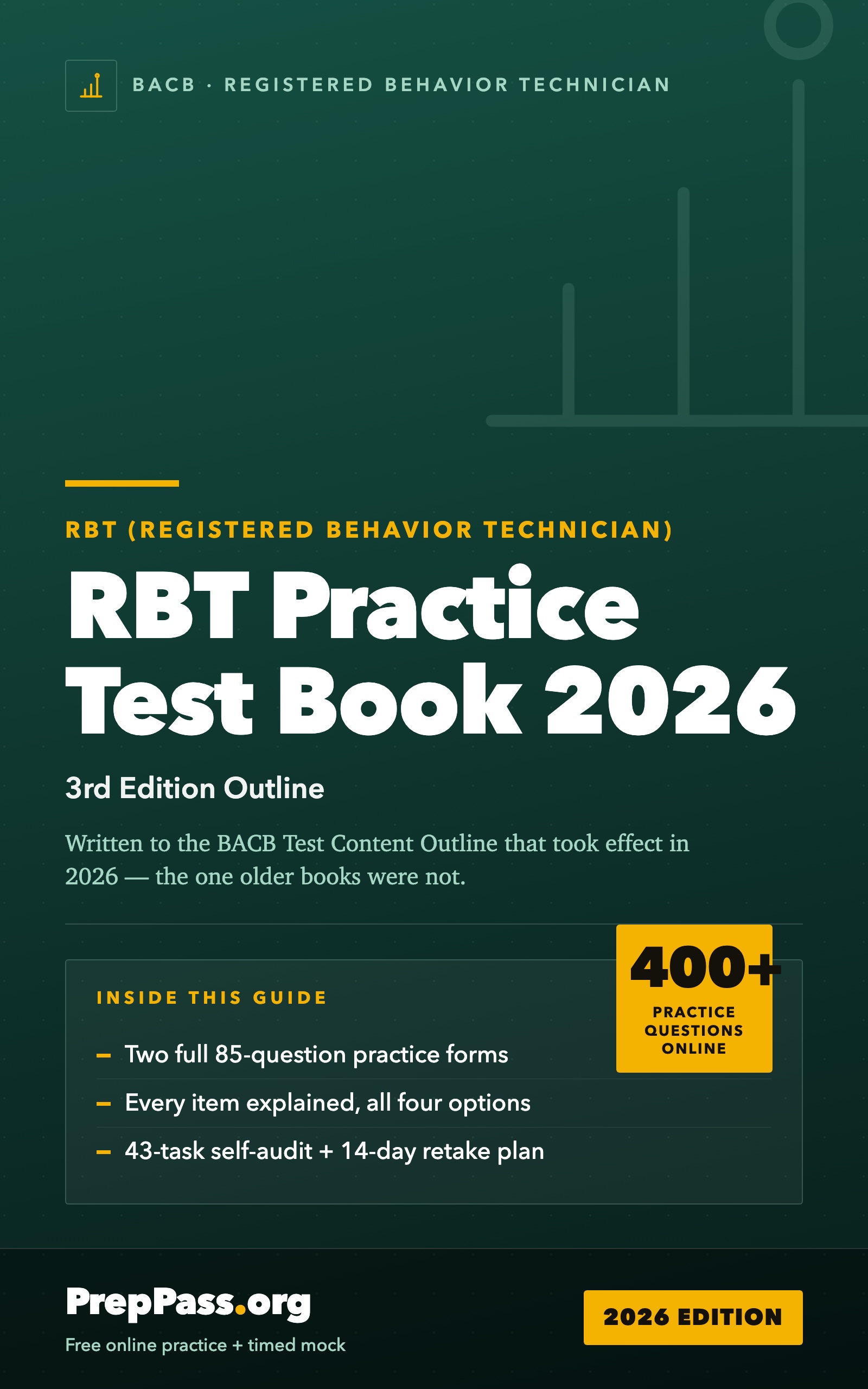
Practice stays free. The full RBT (Registered Behavior Technician) study guide is the material itself, taught start to finish — a downloadable PDF + EPUB you keep.
Free practice for the BACB Registered Behavior Technician exam, written to the 3rd-edition Test Content Outline that took effect in 2026. Scenario questions across all six domains, with an explanation for every option — not just the right one.
Thousands of people teach themselves here — free RBT (Registered Behavior Technician) practice, honest answers, and a full mock. No expensive course. Your turn.
Updated for 2026 · 403 practice questions with answers & explanations
| Administering body | Behavior Analyst Certification Board, Inc. (BACB) — exam delivered by Pearson VUE Source: BACB — Registered Behavior Technician Handbook (PDF, updated 06/2026) |
|---|---|
| Questions | 85 questions (75 scored, 10 unscored pretest) Source: BACB — Registered Behavior Technician Handbook (PDF, updated 06/2026) |
| Time limit | 90 minutes Source: BACB — Registered Behavior Technician Handbook (PDF, updated 06/2026) |
| Passing score | Not published by BACB What we read and found nothing in: BACB — Registered Behavior Technician Handbook (PDF, updated 06/2026) |
| Fees |
Source: BACB — Registered Behavior Technician Handbook (PDF, updated 06/2026) |
| Languages offered | English Source: BACB — Registered Behavior Technician Handbook (PDF, updated 06/2026) |
Sample practice questions
A few real questions from this free bank, with full explanations. Use the practice tool above for the whole set.
- 1. Data Collection and Graphing
Maya's program says to record how long it takes her to start brushing her teeth after the instruction 'Time to brush' is delivered. The RBT starts a stopwatch as the instruction ends and stops it the instant Maya picks up the toothbrush. Which measurement procedure is the RBT using?
- a.Latency recording, timing from the instruction to the start of the response
- b.Duration recording, timing from the start of the response to its end
- c.Interresponse time, timing from one response to the next response
- d.Frequency recording, counting each toothbrushing response in the session
Answer: a
Explanation: (a) is correct: latency is the elapsed time between the onset of a stimulus — here the instruction — and the beginning of the response, which is exactly what the stopwatch captures. (b) is plausible because duration is also a timed measure, but duration would begin when Maya starts brushing and end when she stops; the RBT stops the watch at the moment brushing begins, so no duration is recorded. (c) is plausible because interresponse time is timed too, but IRT runs from the end of one response to the start of the next, and only one response is involved here. (d) is wrong because frequency produces a count, not a time value; it would tell the team how often Maya brushed, not how long she took to begin.
- 2. Behavior Assessment
An RBT finishes a paired-stimulus assessment in which each of five items appeared in eight trials. The BCBA asks how the results should be summarized. What should the RBT report?
- a.The percentage of trials in which each item was selected when presented
- b.The total time the learner spent engaging with each item today
- c.The order in which each item was removed from the array during trials
- d.The number of prompts needed before the learner selected any one item
Answer: a
Explanation: (a) is correct: in a paired-stimulus assessment each item appears a fixed number of times, so dividing selections by presentations gives a percentage that ranks the items fairly. (b) describes how a free-operant assessment is scored, which was not the format used. (c) describes how an array assessment without replacement is scored; no array was presented here. (d) is plausible because prompt counts appear on many data sheets, but prompting has no place in a preference assessment, where the learner's unprompted choice is the measure.
- 3. Behavior Acquisition
Nadia correctly touches the "spoon" card on nearly every trial. The RBT notices that the spoon card has been placed on the left side of the table for every trial this month. Nadia's plan calls for randomized placement. How should the RBT proceed?
- a.Present the spoon card alone for several trials to confirm that Nadia can identify it correctly.
- b.Continue with the current placement but add a third distractor card to increase the difficulty.
- c.Randomize the position of the cards each trial as the plan states, so position cannot control responding.
- d.Continue with the current placement, since Nadia's accuracy shows the discrimination is mastered.
Answer: c
Explanation: (c) is correct: if the target is always in the same spot, position rather than the picture may be controlling responding, and randomizing placement — which the plan already requires — is what tests whether Nadia is discriminating the card itself. (a) removes the discrimination entirely; with one card on the table there is nothing to discriminate and any reach appears correct. (b) makes the array harder while leaving the confound in place, so the results remain uninterpretable. (d) treats accuracy as proof of discrimination when a position bias produces exactly the same accuracy.
- 4. Behavior Reduction
Aiden's plan directs the RBT to reinforce every instance of his 'help me' sign and to withhold reinforcement for whining. During a session Aiden signs 'help me' while the RBT is still setting out materials for the next task. What should the RBT do?
- a.Finish setting out the materials, then respond so the routine is not disrupted.
- b.Prompt Aiden to wait quietly and reinforce the sign after ten seconds pass.
- c.Ask the supervising BCBA whether every single sign must really be reinforced.
- d.Stop setting up and respond to the sign immediately, as the plan specifies.
Answer: d
Explanation: (d) is correct: during the teaching phase the plan calls for reinforcing every occurrence, and immediacy is what builds the new response strongly enough to compete with whining. (a) delays reinforcement, which weakens the sign and makes whining more likely to reappear when the sign does not work quickly. (b) adds a waiting requirement the plan does not contain; thinning the schedule is a clinical decision, not an in-session adjustment. (c) is unnecessary escalation over a procedure the plan states explicitly — the question of when to thin reinforcement can be raised with the BCBA outside the session.
- 5. Documentation and Reporting
An RBT is writing a brief report of a variable that could affect client progress. Which entry best meets the requirement to report such a variable objectively?
- a.The client has been struggling since the family's schedule became so chaotic this month.
- b.The caregiver reported that the client's school day now ends ninety minutes later.
- c.The client's new school schedule is clearly making the afternoon programs impossible.
- d.The client seems much more tired lately, most likely because of the later school day.
Answer: b
Explanation: (b) is correct: it names the source, states a specific and verifiable fact, and adds no inference about its effect. (a) uses the evaluative words struggling and chaotic, neither of which is observable. (c) draws a conclusion about program viability that only the supervisor can reach. (d) attributes tiredness to a cause and hedges it with most likely, which is speculation inside a clinical record.
Free video lessons
Subscribe on YouTube →RBT Practice Test 2026 — 20 Questions Where "Ask Your BCBA" Is the WRONG Answer
RBT Practice Test 2026 — When All 4 Answers Look Right (20 Scenario Questions)
RBT Practice Test 2026 — Behavior Reduction (20 Questions, 3rd Edition)
RBT Practice Test 2026 — Ethics & Professional Conduct (20 Questions, 3rd Ed)
RBT Practice Test 2026 — Measurement & Data Collection (20 Questions, 3rd Edition)
Exam content
What the RBT (Registered Behavior Technician) exam covers
Free practice
Sample RBT (Registered Behavior Technician) questions
A few real questions from the bank, each with the correct answer and a written explanation. Every question is free — no signup to start.
- Data Collection and Graphing
1. Maya's program says to record how long it takes her to start brushing her teeth after the instruction 'Time to brush' is delivered. The RBT starts a stopwatch as the instruction ends and stops it the instant Maya picks up the toothbrush. Which measurement procedure is the RBT using?
- a.Latency recording, timing from the instruction to the start of the responseCorrect
- b.Duration recording, timing from the start of the response to its end
- c.Interresponse time, timing from one response to the next response
- d.Frequency recording, counting each toothbrushing response in the session
Why: (a) is correct: latency is the elapsed time between the onset of a stimulus — here the instruction — and the beginning of the response, which is exactly what the stopwatch captures. (b) is plausible because duration is also a timed measure, but duration would begin when Maya starts brushing and end when she stops; the RBT stops the watch at the moment brushing begins, so no duration is recorded. (c) is plausible because interresponse time is timed too, but IRT runs from the end of one response to the start of the next, and only one response is involved here. (d) is wrong because frequency produces a count, not a time value; it would tell the team how often Maya brushed, not how long she took to begin.
- Data Collection and Graphing
2. Devon's plan asks the RBT to record how much time passes between one hand-raise and the next during a 20-minute lesson. The RBT starts timing when Devon lowers his hand and stops when he raises it again, repeating this for every pair of raises. Which measure is being recorded?
- a.Latency, the time from the teacher's question to Devon's hand-raise
- b.Duration, the total time Devon's hand stays in the air each time
- c.Interresponse time, the time between the end of one raise and the nextCorrect
- d.Rate, the number of hand-raises divided by the total minutes of the lesson
Why: (c) is correct: interresponse time is the interval between the end of one response and the beginning of the next, which is precisely what the RBT times. (a) is plausible because latency is also measured in seconds, but latency is anchored to a stimulus such as the teacher's question, and no stimulus is being timed from here. (b) is plausible because duration is timed as well, but duration would run from the moment the hand goes up to the moment it comes down — the RBT is timing the gap between raises instead. (d) is wrong because rate is a count divided by time and would yield hand-raises per minute, not the spacing between individual responses.
- Data Collection and Graphing
3. Nora's crying episodes vary from a few seconds to nearly ten minutes, and the team wants to know whether the episodes are getting shorter over time. What should the RBT record?
- a.Frequency, by counting each crying episode that occurs in the session
- b.Duration, by timing each crying episode from its onset to its endCorrect
- c.Latency, by timing from the demand to the start of each crying episode
- d.Rate, by dividing the number of crying episodes by the session length
Why: (b) is correct: the team's question is about how long episodes last, and duration recording times each episode from onset to offset, so a shrinking duration answers it directly. (a) is plausible because counting is the most common measure, but a count would stay the same whether an episode lasted five seconds or five minutes. (c) is plausible because latency is a timed measure, but it captures how quickly crying begins after a demand, not how long it continues. (d) is wrong for the same reason as (a): rate standardizes a count for session length but still says nothing about episode length.
- Data Collection and Graphing
4. An RBT counts Ellis's blurt-outs in a 30-minute session on Monday and in a 50-minute session on Tuesday. The BCBA wants the two days compared fairly on a single graph. Which summary should the RBT plot?
- a.Total count of blurt-outs, because the raw number is what was observed
- b.Duration of blurt-outs, because it controls for how long each one lasts
- c.Percentage of intervals with blurt-outs, because percentages compare well
- d.Rate of blurt-outs per minute, because it controls for session lengthCorrect
Why: (d) is correct: when observation periods differ in length, a raw count is not comparable, and dividing the count by the minutes observed produces a rate that puts both days on the same footing. (a) is plausible because the counts are what the RBT actually collected, but a larger count in a longer session may reflect more time, not more behavior. (b) is plausible because duration also controls for something, but it measures how long each blurt-out lasts, which is not what was counted here. (c) is plausible because percentages are comparable across sessions, but interval data were never collected; the RBT cannot report a percentage of intervals from a simple tally.
- Data Collection and Graphing
5. Which description defines interresponse time?
- a.The time from a stimulus to the beginning of the first response
- b.The time from the beginning of a response to the end of that response
- c.The time from the end of one response to the beginning of the next oneCorrect
- d.The number of responses divided by the time the behavior was observed
Why: (c) is correct: interresponse time measures the gap between consecutive responses — from the end of one to the onset of the next — and is used when the team cares about how closely responses are spaced. (a) defines latency, which is anchored to a stimulus rather than to a preceding response. (b) defines duration, which measures the length of a single response rather than the space between two. (d) defines rate, which is a count standardized by observation time; it can be high while individual interresponse times still vary widely.
- Data Collection and Graphing
6. Kai claps once, briefly, several times an hour, and each clap has a clear beginning and end. Sessions are always exactly 60 minutes. The BCBA wants the simplest count-based measure of how much clapping occurs. What should the RBT record?
- a.Frequency, tallying each clap as it occurs throughout the sessionCorrect
- b.Duration, timing how long each individual clap lasts in seconds
- c.Latency, timing how long after arrival the first clap occurs
- d.Partial interval, marking each interval in which a clap occurs
Why: (a) is correct: clapping is a discrete response with a clear onset and offset that occurs at a manageable rate, so a simple tally captures it accurately, and because sessions are always 60 minutes the counts are already comparable. (b) is plausible because duration is a continuous measure, but a clap lasts a fraction of a second, so timing it adds nothing the count does not already say. (c) is plausible because latency is easy to collect, but it describes only the first clap of the session. (d) is plausible because interval recording is common, but it is an estimate and it would lose the exact count that this behavior easily supports.
These practice questions are AI-assisted study material, written from the official content outline — for practice only, not official exam questions. Always confirm current exam details with BACB — RBT certification (official).
Frequently asked questions
Is PrepPass's RBT (Registered Behavior Technician) practice free?
Yes — every RBT (Registered Behavior Technician) practice question, study guide, and lesson on PrepPass is free. A full timed mock exam is also included at no cost.
How many RBT (Registered Behavior Technician) practice questions does PrepPass have?
PrepPass currently has 403 original RBT (Registered Behavior Technician) practice questions across 6 topic areas, and every question comes with a written answer explanation.
What languages is PrepPass's RBT (Registered Behavior Technician) prep available in?
English, 中文 (Chinese), Español (Spanish), and Tiếng Việt (Vietnamese).
How are PrepPass's RBT (Registered Behavior Technician) questions written?
They are original questions written by PrepPass from public-domain statutes and official exam blueprints — never copied from the real exam. Read our question methodology →
Is PrepPass affiliated with the licensing board or exam provider?
No. PrepPass is an independent study resource and is not affiliated with, endorsed by, or connected to any licensing board or official exam provider.
Can I practice RBT (Registered Behavior Technician) on my phone?
Yes — PrepPass runs in any mobile or desktop web browser, with no app to download.
Related exams
Other license and certification exams people prep for alongside this one.
- NCLEX-PN Nursing
- NCLEX-RN Nursing
- NREMT EMT
- ABO Optician
- Certified Medication Aide (CMA)
- NHA Patient Care Technician (CPCT)