ASVAB · 2026 Edition
ASVAB — Complete Study Guide (2026)
The PrepPass ASVAB study guide book (2026 edition) is an independent guide: 328 pages of teaching plus 120 practice questions with a full answer key, PDF + EPUB, $19.99 one-time. Exam facts last checked September 2026 against the exam body's published sources. Inside: the 9 test chapters, each with a key-facts box, worked examples, named traps and a self-check; a full practice exam at the back, with the reasoning behind every answer.
- The 9 test chapters, each with a key-facts box, worked examples, named traps and a self-check
- A full practice exam at the back, with the reasoning behind every answer
- 8 reference appendices — master formula sheet, composite formulas, word parts, vocabulary, study plans, exam-day strategy, recruiter questions, glossary
$19.99one-time · lifetime download · no subscription
PDF + EPUB · English · 328 pages · $19.99 one-time
This book is written in English.
Instant download after payment — no account needed, no subscription.
14-day money-back guarantee: not satisfied for any reason? Email support@preppass.org within 14 days of purchase for a full refund. It's a download, so there is nothing to ship back. Refund policy
Exam facts last checked against official sources: September 2026.
To prepare for the ASVAB exam, cover every topic on the exam body's current content outline and practise with timed questions. The exam itself (Armed Services Vocational Aptitude Battery (ASVAB)): 135 questions, 197 minutes.
Try 10 questions first — free
Answer all 10, then see every answer explained — with the section of this guide that teaches it. About 5 minutes, no sign-up.
You do not need the book to practise: 800 practice questions for this exam are free on PrepPass.
Start 10 free questionsLook inside the book
Three real pages, rendered straight from the PDF you download — a reference page, a teaching page, and a worked question, always in that order. Nothing here was redrawn to look better.
- Quick referenceChapter 3 — Word Knowledge (WK) · PDF page 71
A page you can turn back to: the numbers, deadlines or terms gathered in one place.
- How it's taughtChapter 1 — Scores, Line Scores, and the Job You Actually Want · PDF page 26
An explanation page: the material taught in prose, in the order the exam tests it.
- A question, workedChapter 1 — Scores, Line Scores, and the Job You Actually Want · PDF page 21
A practice question with its answer and the reasoning behind it — not just a key.
Studying for both? There's a pair price
- ASVAB — Complete Study Guide (2026)$19.99
- ASVAB — Cheat Sheet (2026)$9.99
Buy both: $22.99 — save $6.99 vs buying separately
Separately $29.98 · 23% off · One checkout, both items.
Already bought ASVAB? Don't buy the bundle — it includes that book and you'd pay for it twice. Get ASVAB on its own for $19.99. ASVAB · What's in the bundle →
Exam inside two weeks?
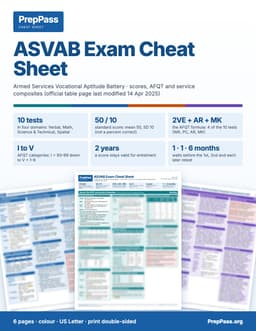
This guide is the teaching, read over weeks. If your exam is inside two weeks, the printable colour cheat sheet is the other product: the figures the exam turns on, laid out by section.
See the ASVAB cheat sheet PDF — $9.99 →
6 pages · US Letter · printable PDF · yours to keep
About the exam itself
| Administering body | U.S. Department of Defense Source: Official ASVAB — What to Expect When You Take the ASVAB |
|---|---|
| Questions | 135 questions Source: Official ASVAB — ASVAB Fact Sheet, Enlistment Testing Program (PDF, revised April 2025) |
| Time limit | 197 minutes Source: Official ASVAB — ASVAB Fact Sheet, Enlistment Testing Program (PDF, revised April 2025) |
| Passing score | There is no pass mark. Enlistment eligibility turns on the AFQT score, which is computed from four of the tests (Arithmetic Reasoning, Mathematics Knowledge, Paragraph Comprehension, Word Knowledge) and reported as a percentile between 1-99 — a rank against a 1997 national sample of 18 to 23 year olds, not a percentage of questions answered correctly. DoD's ASVAB pages do not state a minimum AFQT for enlistment. What we read and found nothing in: Official ASVAB — Understanding ASVAB Scores |
| Fees | Not published by U.S. Department of Defense What we read and found nothing in: Official ASVAB — What to Expect When You Take the ASVAB |
| Languages offered | English Source: Official ASVAB — Frequently Asked Questions (applicants) |
Questions buyers ask
- Is a study guide enough for the ASVAB exam, or do I need a course?
- A book is exam review: it does not replace any education, training or experience U.S. Department of Defense requires before you may sit the exam, so check those requirements first. For the exam content itself, this 328-page guide teaches the material chapter by chapter with 120 practice questions and explanations inside, and 800 more practice questions are free on PrepPass. A prep course adds live instruction and a set schedule; whether you need one beyond any required education is your call.
- What is the cheapest way to prepare for the ASVAB exam?
- Start with what costs nothing: 800 practice questions on PrepPass, with explanations and no signup. If you want it taught in one file you keep, the full study guide is $19.99 once; the printable cheat sheet for the last days is $9.99. No subscription on any of them.
- Who administers the Armed Services Vocational Aptitude Battery (ASVAB)?
- U.S. Department of Defense. Applicants are tested at Military Entrance Processing Stations (MEPS) — which DoD describes as a Department of Defense joint-service organization, with 65 across the U.S. and Puerto Rico — or at satellite Military Entrance Test (MET) sites, after a recruiter schedules the test. The same test is also given in high schools through the ASVAB Career Exploration Program, where the Assembling Objects test is not included. Retakes: wait one calendar month after the first test, another month before a second retest, then six months before each later one; scores can be used for enlistment for up to two years.
- How many questions are on the Armed Services Vocational Aptitude Battery (ASVAB)?
- 135 questions. The computer version, CAT-ASVAB, which DoD says is used at all MEPS: 135 scored questions across 10 tests (10 or 15 per test). On top of those, each examinee also gets unscored “tryout” questions in 2 to 4 of the tests, so the number of questions you actually see is higher and varies. The paper version, P&P-ASVAB, has 225 questions. CAT-ASVAB is adaptive — each question is chosen from your answers so far — so two people do not see the same questions.
- How long is the Armed Services Vocational Aptitude Battery (ASVAB)?
- 197 minutes. The sum of the CAT-ASVAB's 10 separate test time limits as DoD prints it, without tryout questions. Each test is timed on its own; when tryout questions are added to a test, that test gets extra time (Arithmetic Reasoning goes from 55 to 113 minutes, for example). Most people finish well inside the limits, but DoD's own pages disagree on the typical length — its Fact Sheet says about 1 1/2 hours on average, its What to Expect page about 2 hours. The paper version's time limits total 149 minutes. The unproctored PiCAT has no time limits on its tests.
- What is the passing score for the Armed Services Vocational Aptitude Battery (ASVAB)?
- There is no pass mark. Enlistment eligibility turns on the AFQT score, which is computed from four of the tests (Arithmetic Reasoning, Mathematics Knowledge, Paragraph Comprehension, Word Knowledge) and reported as a percentile between 1-99 — a rank against a 1997 national sample of 18 to 23 year olds, not a percentage of questions answered correctly. DoD's ASVAB pages do not state a minimum AFQT for enlistment.
- How much does the Armed Services Vocational Aptitude Battery (ASVAB) cost?
- Not published by U.S. Department of Defense. None of DoD's ASVAB pages states a fee — or states that there is none — for enlistment testing at a MEPS or MET site; the test is arranged through a recruiter. For the school version, DoD states that the ASVAB Career Exploration Program “is free of charge to participating schools”.
- What languages is the Armed Services Vocational Aptitude Battery (ASVAB) offered in?
- English. English only. DoD answers “Why is there no Spanish version of the ASVAB?” directly: the ASVAB is given only in English, because all military members need to be able to speak English and a translated test would not measure the same thing.
- Does the ASVAB study guide come as a PDF?
- Yes — ASVAB — Complete Study Guide (2026) downloads as PDF and EPUB, 328 pages. The download link is emailed the moment payment clears and does not expire.
- How much does the ASVAB study guide cost?
- $19.99, once. There is no subscription and no account to create; the PDF and EPUB files are yours to keep.
- Are there free ASVAB practice questions?
- Yes — 800 of them, free to use with no signup and an explanation on every one. They are separate from this study guide, which is what you are buying here. The same free, no-account system also has practice modes (adaptive, new questions, spaced review of misses, weak-topic focus, saved, my mistakes); a timed mock exam (100 questions, 120 minutes) with a score report by topic; a 10-question readiness check (about 5 minutes); 8 study chapters; a day-by-day study plan. None of it needs this study guide.
- Can I read part of the ASVAB study guide before buying?
- Yes. A full chapter is free to read on this page — not a summary of one, the chapter itself.
- What is the difference between the ASVAB study guide and the cheat sheet?
- The study guide ($19.99) teaches the material chapter by chapter and is meant to be read over weeks. The cheat sheet ($9.99, 6 pages) drops the teaching and keeps the figures: every number on the exam grouped by value so the confusable ones sit together, each reference page paired with a recall page that blanks the answers, and four routes by days left — 14, 7, 3, or tonight. They are separate purchases; neither replaces the other.
- Is there a cheaper way to buy the ASVAB study guide with anything else?
- Yes. ASVAB + Cheat Sheet is $22.99 for 2 files in one checkout — 23% less than the $29.98 those items cost bought separately today. It adds ASVAB — Cheat Sheet (2026). The saving is measured against the items' real current prices; there is no struck-through "original" price on this site.
- Is this the official ASVAB study guide?
- No. This is an independent study guide and is not affiliated with or endorsed by the exam's awarding body. It is written from ASVAB subtest outline / officialasvab.com. Always confirm current requirements with the body that issues your licence.
What's included — and what isn't
Included
- Key numbers & facts boxed in every test chapter, plus a self-check to close it
- Worked examples with the arithmetic shown, and the common traps named — not just the answer
- All 10 tests in 9 chapters, with the AFQT four (AR, WK, PC, MK) taught first — Assembling Objects included
- Math and algebra/geometry worked step by step with checked arithmetic
- General science, electronics, mechanical, and auto & shop review
- Word Knowledge roots and Paragraph Comprehension strategy
- 120 original practice questions with answer explanations
- PDF (print & tab it) + EPUB (phone / e-reader)
Not included
- No printed copy is shipped — this is a file you download and can print yourself
- No video course, instructor or tutoring comes with the book — the free videos on the site are separate
- Not your exam registration or the testing centre's fee, which you still pay to the official body
Contents
See 26 sections and the page each one starts on
- Part I — What the ASVAB actually decidesp. 6
- Chapter 1 — Scores, Line Scores, and the Job You Actually Wantp. 6
- Part II — The nine tests, taughtp. 6
- Answer Key with Explanations.p. 8
- Chapter 2 — Arithmetic Reasoning (AR)p. 41
- Chapter 3 — Word Knowledge (WK)p. 70
- Chapter 4 — Paragraph Comprehension (PC)p. 102
- Chapter 5 — Mathematics Knowledge (MK)p. 122
- Part I — The coordinate plane Quantity Formulap. 145
- Chapter 6 — General Science (GS)p. 150
- Part I — Astronomyp. 168
- Chapter 7 — Electronics Information (EI)p. 174
- Part I — Magnetism and machinesp. 191
- Chapter 8 — Mechanical Comprehension (MC)p. 196
- Chapter 9 — Auto & Shop Information (AS)p. 220
- Part I — Shop: cutting, striking, driving, grippingp. 236
- Chapter 10 — Assembling Objects (AO)p. 246
- Answer Key with Explanationsp. 283
- Appendix A — Master formula & fact sheetp. 295
- Appendix B — The composite formulas, on one pagep. 306
- Appendix C — Word parts for Word Knowledgep. 309
- Appendix D — High-frequency vocabularyp. 315
- Appendix E — Study plansp. 320
- Appendix F — Exam-day strategyp. 322
- Appendix G — What to ask your recruiterp. 324
- Appendix H — Glossary of key termsp. 326
Taken from the PDF you download, with the page each one starts on — not typed here.
Read a chapter free, in full
One complete chapter, exactly as it ships in the eBook. Scroll the window to read it right here; no download, no email.
Read chapter 5 here, without leaving the page
We didn't give you the easy intro — the free chapter opens on one of the hardest-working parts of the book, so you can judge the teaching where the exam gets difficult.
AFQT test. Appears in 11 of the 19 published service composites — and is doubled in the Navy's Basic Electricity and Electronics composite.
Introduction
Arithmetic Reasoning hides the math inside a story. Mathematics Knowledge hands it to you directly: solve this equation, simplify this expression, find this area, evaluate this exponent. There is no translation step, which means there is nowhere to hide either. You either know the rule or you do not.
That makes MK the most memorizable of the four AFQT tests, and therefore the fastest one to improve. Every formula this test uses fits on one sheet of paper — Appendix A of this book is that sheet. A candidate with three weeks and a weak MK score is in a far better position than a candidate with three weeks and a weak WK score, because a formula can be learned on Tuesday and used on Wednesday.
MK also does double duty. The same algebra that MK tests directly is the algebra you need for Ohm's law in Chapter 7 and for mechanical advantage in Chapter 8. Learning to rearrange a formula here pays off in two more chapters.
This chapter works thirty-three examples across every topic the test uses. Work them with a pencil.
Learning objectives
After working this chapter you should be able to:
- Apply the order of operations correctly, including to nested and signed expressions.
- Use the laws of exponents and simplify square roots.
- Identify factors, multiples, primes, the greatest common factor and the least common multiple.
- Add, subtract, multiply and divide fractions, including mixed numbers.
- Combine like terms, distribute, multiply two binomials, and factor simple quadratics.
- Solve one-step, two-step and variables-on-both-sides linear equations, and check by substitution.
- Rearrange a formula to isolate any variable in it.
- Solve linear inequalities, including the sign flip.
- Solve a system of two linear equations by substitution or elimination.
- Apply the angle rules for lines, triangles and parallel lines cut by a transversal.
- Use the Pythagorean theorem and recognise the common triples and special right triangles.
- Compute perimeter, area, circumference, volume and surface area for the standard figures.
- Find slope, midpoint and distance on the coordinate plane.
Key formulas & facts
| Topic | Formula / rule |
|---|---|
| Order of operations | Parentheses → Exponents → Multiply/Divide (left to right) → Add/Subtract (left to right) |
| Exponent: product | aᵐ × aⁿ = aᵐ⁺ⁿ |
| Exponent: quotient | aᵐ ÷ aⁿ = aᵐ⁻ⁿ |
| Exponent: power of a power | (aᵐ)ⁿ = aᵐⁿ |
| Exponent: zero | a⁰ = 1 (for a ≠ 0) |
| Exponent: negative | a⁻ⁿ = 1 ÷ aⁿ |
| Square root | √a × √b = √(ab); √144 = 12 |
| Signed numbers | Subtracting a negative adds; a negative times a negative is positive |
| Distribution | a(b + c) = ab + ac |
| FOIL | (a + b)(c + d) = ac + ad + bc + bd |
| Difference of squares | a² − b² = (a + b)(a − b) |
| Perfect square | (a + b)² = a² + 2ab + b² |
| Solving equations | Do the same inverse operation to both sides |
| Inequalities | Multiplying or dividing by a negative reverses the inequality sign |
| Straight angle | 180 degrees; a full turn is 360 degrees |
| Complementary / supplementary | Sum to 90 / sum to 180 degrees |
| Triangle angle sum | 180 degrees |
| Pythagorean theorem | a² + b² = c², c the hypotenuse |
| Common triples | 3-4-5, 5-12-13, 8-15-17, and any multiple |
| 45-45-90 triangle | legs x, x; hypotenuse x√2 |
| 30-60-90 triangle | short leg x, long leg x√3, hypotenuse 2x |
| Area of a triangle | ½ × base × height |
| Rectangle | area = lw; perimeter = 2l + 2w |
| Parallelogram / trapezoid | bh / ½(b₁ + b₂)h |
| Circle | circumference = 2πr = πd; area = πr² (π ≈ 3.14) |
| Rectangular solid | volume = lwh; surface area = 2(lw + lh + wh) |
| Cube | volume = s³; surface area = 6s² |
| Cylinder | volume = πr²h |
| Slope | (y₂ − y₁) ÷ (x₂ − x₁) |
| Midpoint | ((x₁ + x₂)/2 , (y₁ + y₂)/2) |
| Distance | √((x₂ − x₁)² + (y₂ − y₁)²) |
Part A — Number properties and operations
Order of operations
Evaluate in this order, and never out of it:
- Parentheses (and anything inside a radical or above/below a fraction bar, which act as invisible parentheses)
- Exponents
- Multiplication and division, left to right — they have equal priority
- Addition and subtraction, left to right — equal priority
The two places people go wrong are both about "equal priority." Multiplication does not outrank division, and addition does not outrank subtraction. When operations of equal priority sit side by side, work left to right.
Worked example 1 — order of operations, written out
Evaluate 4² + 3³.
Exponents first. 4² = 4 × 4 = 16. 3³ = 3 × 3 × 3 = 27. Then add. 16 + 27 = 43. The trap. Adding first: 4 + 3 = 7, then something with the exponents. Exponents outrank addition, always.
Worked example 2 — equal priority, left to right
Evaluate 24 ÷ 6 × 2.
Division and multiplication have equal priority, so work left to right. 24 ÷ 6 = 4. Then 4 × 2 = 8. The trap. Doing the multiplication first because "multiplication comes before division in the mnemonic": 6 × 2 = 12, then 24 ÷ 12 = 2. That gives 2, which is wrong, and 2 will be among the choices. The rule to fix in your mind. The mnemonic lists multiplication and division together on one line, and addition and subtraction together on another. Within a line, left to right.
Worked example 3 — nested parentheses and a negative
Evaluate 3 × (8 − (5 − 9)) ÷ 2.
Innermost parentheses first. 5 − 9 = −4. Next parentheses. 8 − (−4). Subtracting a negative adds: 8 + 4 = 12. Now left to right through the multiplication and division. 3 × 12 = 36. Then 36 ÷ 2 = 18. The two traps in one problem. Doing 8 − 5 first (ignoring the inner parentheses) and mishandling the double negative. Write each stage on its own line; that is what stops both.
Exponents
An exponent counts repeated multiplication: 3³ = 3 × 3 × 3 = 27. The laws you need:
- Same base, multiplying — add the exponents. 2³ × 2⁴ = 2⁷ = 128.
- Same base, dividing — subtract the exponents. 5⁶ ÷ 5² = 5⁴ = 625.
- A power raised to a power — multiply the exponents. (3²)³ = 3⁶ = 729.
- Anything to the zero power is 1 (except zero itself). 7⁰ = 1.
- A negative exponent means the reciprocal. 2⁻³ = 1 ÷ 2³ = 1/8.
Worked example 4 — the exponent laws, applied
Simplify (2³ × 2²) ÷ 2⁴.
Numerator — same base, multiplying, so add exponents. 2³ × 2² = 2⁵. Now divide — same base, so subtract exponents. 2⁵ ÷ 2⁴ = 2¹ = 2. Check the long way. 8 × 4 = 32; 32 ÷ 16 = 2. ✓ The trap. Multiplying the exponents in the numerator: 3 × 2 = 6, giving 2⁶ ÷ 2⁴ = 4. Exponents multiply only when a power is raised to a power, not when two powers are multiplied.
Square roots
The square root of a number is the value that, multiplied by itself, gives it: √144 = 12 because 12 × 12 = 144.
Memorize the perfect squares to 15 — they appear constantly, in geometry as well as here:
| n | 1 | 2 | 3 | 4 | 5 | 6 | 7 | 8 | 9 | 10 | 11 | 12 | 13 | 14 | 15 |
|---|---|---|---|---|---|---|---|---|---|---|---|---|---|---|---|
| n² | 1 | 4 | 9 | 16 | 25 | 36 | 49 | 64 | 81 | 100 | 121 | 144 | 169 | 196 | 225 |
Simplifying a root: pull out the largest perfect-square factor. √50 = √(25 × 2) = √25 × √2 = 5√2.
Worked example 5 — simplifying a radical
Simplify √72.
Find the largest perfect square that divides 72. The perfect squares are 4, 9, 16, 25, 36… and 36 divides 72. 72 = 36 × 2. √72 = √36 × √2 = 6√2. Check it numerically. 6 × 1.414 ≈ 8.49, and 8.49² ≈ 72.1. ✓ A slower but safe route if you do not spot 36: 72 = 4 × 18, so √72 = 2√18; then 18 = 9 × 2, so 2√18 = 2 × 3√2 = 6√2. Same answer. Pulling out squares in stages always works.
Factors, multiples, primes
- A factor divides a number evenly. The factors of 12 are 1, 2, 3, 4, 6, 12.
- A multiple is that number times a whole number. The multiples of 12 are 12, 24, 36, 48…
- A prime has exactly two factors, 1 and itself: 2, 3, 5, 7, 11, 13, 17, 19, 23, 29. Two is the only even prime, and 1 is not prime.
- The greatest common factor (GCF) is the largest number dividing both.
- The least common multiple (LCM) is the smallest number both divide into.
Worked example 6 — GCF and LCM
Find the GCF and the LCM of 12 and 18.
Prime-factorize both. 12 = 2 × 2 × 3 = 2² × 3 18 = 2 × 3 × 3 = 2 × 3² GCF — take the lowest power of each shared prime. Shared primes are 2 and 3. Lowest power of 2 is 2¹; lowest power of 3 is 3¹. GCF = 2 × 3 = 6. LCM — take the highest power of every prime that appears. Highest power of 2 is 2²; of 3 is 3². LCM = 4 × 9 = 36. Check both. 6 divides 12 and 18. ✓ 36 is divisible by 12 (three times) and by 18 (twice). ✓ A useful cross-check. GCF × LCM = the product of the two numbers: 6 × 36 = 216, and 12 × 18 = 216. ✓ That identity holds for any pair and is a free way to catch an error.
Signed numbers
Three rules cover almost everything:
- Subtracting a negative is adding. 5 − (−3) = 5 + 3 = 8.
- A negative times a negative is positive; a negative times a positive is negative.
- A negative raised to an even power is positive; to an odd power, negative. (−2)² = 4, but (−2)³ = −8.
And one notational trap: −2² and (−2)² are different. Without parentheses, the exponent attaches to the 2 alone and the minus sign is applied afterwards: −2² = −(2²) = −4. With parentheses, the whole −2 is squared: (−2)² = +4.
Part B — Fractions
The four operations
- Multiply: multiply straight across, then reduce. (2/3) × (3/4) = 6/12 = 1/2.
- Divide: invert the second fraction and multiply. (2/3) ÷ (3/4) = (2/3) × (4/3) = 8/9.
- Add or subtract: get a common denominator first, then combine the numerators only.
- Mixed numbers: convert to improper fractions before doing anything else.
Worked example 7 — adding fractions with unlike denominators
Compute 3/4 + 5/6.
Find the LCM of the denominators. 4 = 2², 6 = 2 × 3, so the LCM is 2² × 3 = 12. Convert both. 3/4 = 9/12 (multiply top and bottom by 3). 5/6 = 10/12 (multiply top and bottom by 2). Add the numerators only. 9/12 + 10/12 = 19/12. Convert to a mixed number. 19 ÷ 12 = 1 remainder 7, so 1 7/12. The trap, named. Adding denominators: 3/4 + 5/6 = 8/10. This is the most common fraction error there is. Denominators tell you what size the pieces are; you do not add the sizes, you make them the same and then add how many you have.
Worked example 8 — dividing mixed numbers
Compute 2½ ÷ 1¼.
Convert to improper fractions first. 2½ = (2 × 2 + 1)/2 = 5/2. 1¼ = (1 × 4 + 1)/4 = 5/4. Divide by inverting the second and multiplying. (5/2) ÷ (5/4) = (5/2) × (4/5). Cancel before multiplying — it keeps the numbers small. The 5s cancel; 4 ÷ 2 = 2. Result: 2. Check. 1¼ × 2 = 2½. ✓ The trap. Trying to divide the whole parts and the fractions separately. Convert to improper fractions and the problem becomes mechanical.
Worked example 9 — comparing fractions without decimals
Which is larger, 5/8 or 7/11?
Cross-multiply, comparing the products in the right positions. 5 × 11 = 55 (this belongs to 5/8) 7 × 8 = 56 (this belongs to 7/11) 56 > 55, so 7/11 is larger. Check with decimals. 5/8 = 0.625; 7/11 = 0.636… ✓ Why cross-multiplication works. You are multiplying both fractions by the same positive quantity (8 × 11), which cannot change which is bigger. It is faster than long division and it does not round.
Before you buy
- How do I get it?
- Pay, and the download appears on this page straight away. The links are also emailed to you. No account is required.
- What if it isn't for me?
- Email us within 14 days for a full refund, no questions asked.
- Is the free practice going away?
- No. Every practice question, the timed mock and the free chapters on this site stay free. This book is the studying half, not a gate around the free half.
- Can I read it on my phone?
- Yes — the EPUB is for phones and e-readers, the PDF is for printing and tabbing. You get both.
The details
All ten ASVAB tests in nine chapters — the four AFQT tests that decide enlistment eligibility taught first, and Assembling Objects included.
- Format: PDF + EPUB download · 328 pages
- 120 practice questions in the book, with a full answer key
- 800 free practice questions for this exam on PrepPass, included at no cost
- $19.99 one-time — no subscription
- 14-day money-back guarantee · refund policy
- Cross-referenced against: ASVAB subtest outline / officialasvab.com
- Last updated: September 2026
- Verified from the official source(ASVAB subtest outline / officialasvab.com)
- 800 free practice questions
- Instant download, yours for life
An ASVAB prep course runs $88–$118. This book teaches the same exam — same rules, verified to current standards — for a one-time $19.99 you keep for life.
Why buy the book when the practice is free?
Our practice questions and timed mock stay free — nothing on the site moves behind this book. The $19.99 book is the studying half: the material itself, taught in order, in a file you own.
- Systematic teaching — every exam section explained chapter by chapter, start to finish, not just questions
- Print it & tab it — a paper-ready PDF you can highlight, mark up, and bring to your study table
- Study anywhere, offline — EPUB on your phone or e-reader; no wifi, no browser tabs
- Everything in one place — the chapters and the practice questions in one file
- Yours for life — one-time $19.99, instant download, no subscription
And it's risk-free: 14-day money-back guarantee — not satisfied? Email us for a full refund, no questions asked. See the refund policy.
Also free on PrepPass for ASVAB
Beside this guide, PrepPass has a free study system for the same exam. It needs no account, and buying the guide does not unlock or change it: 800 practice questions with explanations; practice modes (adaptive, new questions, spaced review of misses, weak-topic focus, saved, my mistakes); a timed mock exam (100 questions, 120 minutes) with a score report by topic; a 10-question readiness check (about 5 minutes); 8 study chapters; a day-by-day study plan.
Progress is saved in your browser; a free account keeps it across devices. The readiness gauge reflects your own practice, not a prediction of the real exam result. How the practice works
14-day money-back guarantee · full refund, no questions asked.
One-time purchase, lifetime access to the download. The eBook is the full ASVAB study guide in PDF and EPUB. Educational summary, not professional or legal advice — always confirm the current rules with the official source. Last updated: September 2026.