Study guide · 2026 Edition
ITIL 4 Foundation — Complete Study Guide (2026)
PrepPass's independent 2026 study guide for the ITIL 4 Foundation exam is 259 pages including 430 practice questions with a full answer key, PDF + EPUB, $14.99 one-time; it is not affiliated with the exam provider.
Edition: Covers ITIL 4 Foundation. PeopleCert has released ITIL Version 5 and plans to sunset ITIL 4 modules on 31 December 2027.
- Length
- 259 pages
- Practice questions in the book
- 430
- Exam facts last checked
- September 2026
- File last updated
- October 2026
- Delivery
- PDF + EPUB · English · instant download
What is in the ITIL 4 Foundation study guide?
Exam facts last checked September 2026 against the exam body's published sources. Inside: a short-answer check-yourself set with a worked key closing each of the 6 chapters; 8 key-exam-points boxes, and a named-traps list in each of the 6 chapters.
The real exam: ITIL 4 Foundation — 40 questions · 60 minutes · Passing score: 65%.
The whole ITIL 4 Foundation syllabus, made simple — service management concepts, the four dimensions, the seven guiding principles, the Service Value System, the service value chain, and the practices — with the exact definitions the exam tests.
Exam facts, who it suits and what changed
To prepare for the ITIL 4 Foundation exam, start with what the exam body publishes: ITIL 4 Foundation exam bundle from PeopleCert — exam voucher with the official study material, US$690.00 including VAT. The exam itself (ITIL 4 Foundation): 40 questions, 60 minutes, passing score 65%. Choose this book if you are sitting ITIL 4 Foundation and want the definitions, principles and practices explained in plain language before you buy an exam voucher.
About the exam itself
| Administering body | PeopleCert Source: PeopleCert — ITIL FAQ ("When will ITIL 4 modules be sunsetted?") |
|---|---|
| Questions | 40 questions Source: PeopleCert — ITIL 4 Foundation (certification page: Exam, Available languages, Purchase options) |
| Time limit | 60 minutes Source: PeopleCert — ITIL 4 Foundation (certification page: Exam, Available languages, Purchase options) |
| Passing score | 65% Source: PeopleCert — ITIL 4 Foundation (certification page: Exam, Available languages, Purchase options) |
| Fees |
Source: PeopleCert — ITIL 4 Foundation (certification page: Exam, Available languages, Purchase options) |
| Languages offered | English · Chinese · Dutch · French · German · Hungarian · Italian · Japanese · Polish · Portuguese (Brazil) · Spanish · Thai Source: PeopleCert — ITIL 4 Foundation (certification page: Exam, Available languages, Purchase options) |
Look inside the book
Three real pages, rendered straight from the PDF you download — a reference page, a teaching page, and a worked question, always in that order. Nothing here was redrawn to look better.
- Quick referenceExam-day question tactics · PDF page 80
A page you can turn back to: the numbers, deadlines or terms gathered in one place.
- How it's taughtAppendix — Question Bank 399 practice questions with answers and explanations · PDF page 229
An explanation page: the material taught in prose, in the order the exam tests it.
- A question, workedChapter 6 — The ITIL Practices · PDF page 69
A practice question with its answer and the reasoning behind it — not just a key.
Exam inside two weeks?
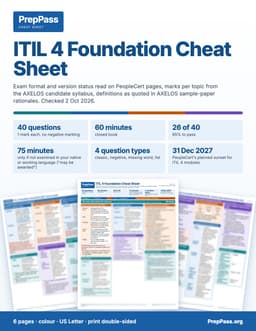
This guide is the teaching, read over weeks. If your exam is inside two weeks, the printable colour cheat sheet is the other product: the figures the exam turns on, laid out by section.
See the ITIL 4 Foundation cheat sheet PDF — $9.99 →
6 pages · US Letter · printable PDF · yours to keep
How this book compares
PeopleCert sells the ITIL 4 Foundation exam as a bundle with its official eBook, and now also offers ITIL Foundation (Version 5). This book is a separate study guide for ITIL 4 Foundation, to read before or alongside PeopleCert's material.
| Resource | Price | What you get | Choose it if |
|---|---|---|---|
| This bookITIL 4 Foundation — Complete Study Guide (2026)PrepPass | $14.99 | Independent downloadable study guide for ITIL 4 Foundation
| Choose this book if you are sitting ITIL 4 Foundation and want the definitions, principles and practices explained in plain language before you buy an exam voucher. |
| From the exam bodyITIL 4 Foundation exam bundle (opens the publisher's page in a new tab)PeopleCert | US$690.00 including VAT | Exam voucher with the official study material
| Choose the bundle if you are ready to book the exam and want the official eBook with it. |
| From the exam bodyITIL Foundation (Version 5) exam bundle (opens the publisher's page in a new tab)PeopleCert | US$690.00 including VAT | The newer ITIL Foundation exam, sold the same way
| Choose this instead if you will sit ITIL Foundation (Version 5); this book covers ITIL 4. |
This book
ITIL 4 Foundation — Complete Study Guide (2026)
PrepPass
- Price
- $14.99
- What you get
Independent downloadable study guide for ITIL 4 Foundation
- 259 pages, PDF + EPUB
- Choose it if
- Choose this book if you are sitting ITIL 4 Foundation and want the definitions, principles and practices explained in plain language before you buy an exam voucher.
From the exam body
ITIL 4 Foundation exam bundle (opens the publisher's page in a new tab)
PeopleCert
- Price
- US$690.00 including VAT
- What you get
Exam voucher with the official study material
- Official eBook, exam voucher and Learning Resource Kit
- Choose it if
- Choose the bundle if you are ready to book the exam and want the official eBook with it.
From the exam body
ITIL Foundation (Version 5) exam bundle (opens the publisher's page in a new tab)
PeopleCert
- Price
- US$690.00 including VAT
- What you get
The newer ITIL Foundation exam, sold the same way
- Official eBook, exam voucher and Learning Resource Kit
- Choose it if
- Choose this instead if you will sit ITIL Foundation (Version 5); this book covers ITIL 4.
Other resources' prices and contents are as listed on each publisher's or seller's own page, checked September 24, 2026. Prices change; confirm on the linked page before you buy. This book's price and contents come from our own catalog.
Sources (2)
What's included — and what isn't
Included
- All 6 areas: concepts, 4 dimensions, 7 principles, SVS, value chain, practices
- The exact ITIL 4 definitions the exam tests (utility/warranty, outcomes, etc.)
Not included
- No printed copy is shipped — this is a file you download and can print yourself
- No video course, instructor or tutoring comes with the book — the free videos on the site are separate
Everything included, and everything that isn't
Included
- The 7 guiding principles with concrete 'how to apply' examples
- The most-tested practices (incident, problem, change enablement, service desk)
- A short-answer self-check with worked answers closing every chapter
- A question bank of 399 practice questions, grouped by topic, with answers and explanations
- A definitions quick-reference + glossary — PDF + EPUB
Not included
- Not your exam registration or the testing centre's fee, which you still pay to the official body
Contents
See 8 sections and the page each one starts on
- Chapter 1 — Service Management Conceptsp. 10
- Chapter 2 — The Four Dimensions of Service Managementp. 23
- Chapter 3 — The Seven Guiding Principlesp. 31
- Chapter 4 — The Service Value System and Continual Improvementp. 39
- Chapter 5 — The Service Value Chainp. 47
- Chapter 6 — The ITIL Practicesp. 54
- Exam-day question tacticsp. 78
- Appendix — Question Bank 399 practice questions with answers and explanationsp. 81
Taken from the PDF you download, with the page each one starts on — not typed here.
Read a chapter free, in full
One complete chapter, exactly as it ships in the eBook. Scroll the window to read it right here; no download, no email.
Read chapter 2 here, without leaving the page
We didn't give you the easy intro — the free chapter opens on one of the hardest-working parts of the book, so you can judge the teaching where the exam gets difficult.
Having learned the vocabulary, we zoom out to the first big structural idea in ITIL 4: the four dimensions. These are four perspectives that must all be considered for any service or for service management as a whole, so that the result is holistic and effective. The exam tests two things: naming all four correctly, and placing a described concern into the right dimension. It also tests the PESTLE external factors that surround all four.
The concept: why four dimensions exist
ITIL 4 argues that if you optimize a service from only one angle — say, you buy brilliant technology but ignore the people who have to run it, or you write perfect processes but pick unreliable suppliers — the service will fail. To create value effectively and efficiently, an organization must give balanced focus to four dimensions. Neglecting any one of them leads to services that are degraded, undelivered, or fail to meet expectations. The four dimensions apply to everything in the Service Value System, not just to a single service.
The four dimensions are:
- Organizations and people
- Information and technology
- Partners and suppliers
- Value streams and processes
A common memory aid is that these expand and modernize the old "people, process, products/technology, partners" idea into four balanced, equally weighted lenses. Learn them in this order and learn the exact names — the exam plants wrong sets (like "strategy, design, transition, operation," which are ITIL v3 lifecycle stages, not dimensions; or "plan, do, check, act," which is a cycle).
Dimension 1: Organizations and people
This dimension covers the human side: the organization's structure, its roles and responsibilities, its systems of authority and communication, its culture, and — critically — whether it has people with the right skills, competencies, and understanding. It's about how people are organized and led, and whether the culture supports the organization's objectives.
Concerns that belong here: organizational structure, staffing and skills, roles and responsibilities, leadership and management style, organizational culture, and communication. If a question mentions a team's culture, skills, training, roles, or how people are organized and managed, it is pointing at organizations and people.
Example: a service desk that keeps failing not because of bad tools but because agents were never trained and no one owns escalation — that is an organizations and people shortfall.
Dimension 2: Information and technology
This dimension covers the information the service uses and the technology that supports it. For the management of services it includes the workflow-management, knowledge, and communication systems the organization runs on. For the service itself it includes the applications, databases, and infrastructure that make the service work — plus the information the service creates, manages, and uses.
Key considerations here include the information required to deliver the service and how it is exchanged, plus factors that shape technology choices — how well a technology fits the organization's architecture, regulatory or security requirements, and emerging technologies. Questions that mention data, information, applications, databases, infrastructure, or the suitability/security of technology point to information and technology.
Example: choosing whether to adopt a new AI-based monitoring tool, and worrying about whether it complies with data-protection rules — an information and technology consideration.
Dimension 3: Partners and suppliers
This dimension covers an organization's relationships with other organizations that are involved in the design, development, deployment, delivery, support, or continual improvement of services. It includes contracts, agreements, and the way responsibilities are shared between the organization and its partners and suppliers.
ITIL 4 notes a spectrum of relationship types, from loose supplier relationships (formal, transactional, contract-based) to close partnership relationships (shared goals, shared risk, deep collaboration). A key idea is the service integration and management approach an organization uses to coordinate multiple suppliers. Factors influencing an organization's supplier strategy include its culture, resource scarcity, cost concerns, subject-matter expertise, external constraints, and demand patterns. Anything about contracts, vendors, outsourcing, third parties, or how work is shared with other organizations belongs here.
Example: deciding whether to build a data center in-house or use a cloud provider, and how tightly to integrate with that provider — a partners and suppliers decision.
Dimension 4: Value streams and processes
This dimension covers how the various parts of the organization work in an integrated, coordinated way to enable value creation through products and services. It has two elements:
- A value stream is a series of steps an organization undertakes to create and deliver products and services to consumers. It is the end-to-end flow of activities that turns demand into value.
- A process is a set of interrelated or interacting activities that transform inputs into outputs. A process takes defined inputs and turns them into defined outputs; it defines the sequence of actions and their dependencies.
This dimension asks: what activities does the organization perform, in what sequence, and how does work flow to create value? It is about workflow, the sequence of steps, and how activities are coordinated. Questions mentioning the steps to deliver something, the flow of work, or how activities are organized into a repeatable sequence point to value streams and processes.
Example: mapping every step from "customer requests a new laptop" to "laptop delivered and working," so bottlenecks can be found and removed — a value streams and processes exercise.
Key terms — the four dimensions - Organizations and people: structure, roles, culture, skills, staffing, communication — the human side. - Information and technology: the information and knowledge, plus the technologies (applications, databases, infrastructure) a service needs. - Partners and suppliers: relationships with other organizations involved in the service — contracts, vendors, integration. - Value streams and processes: how work flows and is coordinated to create value; a value stream is the end-to-end series of steps, a process transforms inputs into outputs.
The concept: the four dimensions must be balanced
The exam's single biggest four-dimensions point is that all four must be considered together, and kept in balance. Failing to address any one dimension — brilliant tech but untrained people, great people but weak suppliers — undermines the whole service. The four dimensions apply to the entire Service Value System and to every service and product, not to a specific lifecycle stage. If an option suggests you can safely focus on just one dimension, it is wrong.
The concept: PESTLE — the external factors
The four dimensions do not float in a vacuum. They are constantly shaped by external factors the organization cannot control but must respond to. ITIL 4 groups these using the PESTLE model (sometimes written PESTEL). Each letter is a category of external influence:
- P — Political factors (government policy, political stability, trade policy)
- E — Economic factors (economic growth, interest rates, inflation, exchange rates)
- S — Social factors (demographics, culture, social trends, customer attitudes)
- T — Technological factors (new technologies, automation, the pace of tech change)
- L — Legal factors (laws, regulations, licensing, employment and data-protection law)
- E — Environmental factors (climate, sustainability, environmental regulation)
The point of PESTLE is that these six categories of external constraint act on all four dimensions simultaneously and continuously. A new data-protection law (Legal) affects your information and technology; an economic downturn (Economic) affects your supplier strategy; a demographic shift (Social) affects your people and your services. An organization must scan these factors and adapt. On the exam, if you see the acronym PESTLE, know that it lists the external factors that affect the four dimensions, and be ready to slot an example (a new regulation, an interest-rate change) into the right letter.
Key term — PESTLE - PESTLE (or PESTEL): the external factors that affect the four dimensions and the organization — Political, Economic, Social, Technological, Legal, Environmental. The organization cannot control them but must respond to them.
Putting Chapter 2 together — a worked scenario
"MediTrust runs an online patient-records service. It is rolling out a new AI diagnosis-assistant feature. The project team frets about four things: the clinicians lack training on the new tool and no one owns the after-hours support rota; the tool must comply with a strict new health-data-privacy law and integrate with the existing records database; the AI is built by an outside vendor whose contract must be renegotiated; and the end-to-end flow from 'clinician requests an AI assessment' to 'result delivered' needs mapping to remove delays."
Sort each concern into its dimension:
- Clinicians lacking training + no one owning the support rota → organizations and people (skills, roles, staffing, culture).
- Compliance with the new privacy law + integration with the records database → information and technology (the information the service uses and the technology's fitness and security). Note the privacy law itself is also a PESTLE "Legal" external factor pressing on this dimension.
- The outside vendor and the contract renegotiation → partners and suppliers.
- Mapping the end-to-end request-to-result flow to remove delays → value streams and processes.
All four dimensions are in play at once, and the external Legal factor shapes them. If MediTrust nailed the technology but skipped clinician training, the service would still fail — which is exactly why ITIL insists all four be balanced. Being able to sort a paragraph like this is the whole Chapter 2 skill.
Common traps
- Naming the wrong "four." The four dimensions are organizations and people; information and technology; partners and suppliers; value streams and processes. They are not "strategy, design, transition, operation" (those are ITIL v3 lifecycle stages), not "people, process, products, partners" (an older phrasing), and not "plan, do, check, act" (a cycle).
- Putting culture or skills under the wrong dimension. Culture, skills, roles, and staffing are organizations and people, even though people obviously use technology.
- Confusing "value streams and processes" with the service value chain. The value chain (Chapter 5) is a specific model with six activities inside the SVS; "value streams and processes" is one of the four dimensions, a general lens. Related, but not the same thing.
- Thinking one dimension can be skipped. All four must be considered and balanced for every service. Neglect of any one degrades value.
- Missing that PESTLE factors are external and uncontrollable. They affect the four dimensions from outside; the organization responds to them but cannot dictate them.
- Mixing up a value stream and a process. A value stream is the end-to-end series of steps to create and deliver products/services; a process transforms inputs into outputs. A process is a building block; a value stream is the whole route.
Check yourself
- Name all four dimensions of service management, in ITIL 4's exact terms.
- A company worries that its staff lack the skills to run a new platform and that no one owns the on-call rota. Which dimension is this?
- A firm must comply with a newly passed privacy regulation. Which PESTLE category is that, and does it affect only one dimension?
- True or false: "value streams and processes" is another name for the service value chain.
- Which dimension covers contracts with cloud vendors and how tightly the organization integrates with them?
Answers: 1. Organizations and people; information and technology; partners and suppliers; value streams and processes. 2. Organizations and people (skills, roles, staffing). 3. Legal (the "L" in PESTLE); it is an external factor that can affect all four dimensions, not just one. 4. False — "value streams and processes" is one of the four dimensions; the service value chain is a distinct model inside the SVS. 5. Partners and suppliers.
Questions buyers ask
How do I get it?
Pay, and the download appears on this page straight away. The links are also emailed to you. No account is required.
What if it isn't for me?
Email us within 14 days for a full refund, no questions asked.
Is the free practice going away?
No. Every practice question, the timed mock and the free chapters on this site stay free. This book is the studying half, not a gate around the free half.
More questions (17)
Can I read it on my phone?
Yes — the EPUB is for phones and e-readers, the PDF is for printing and tabbing. You get both.
What has changed on the ITIL 4 Foundation exam?
Covers ITIL 4 Foundation. PeopleCert has released ITIL Version 5 and plans to sunset ITIL 4 modules on 31 December 2027.
Which ITIL 4 Foundation study guide should I use?
It depends on what you already have. PeopleCert: ITIL 4 Foundation exam bundle, US$690.00 including VAT — choose the bundle if you are ready to book the exam and want the official eBook with it. This PrepPass guide: 259 pages, 430 practice questions with explanations, PDF + EPUB, $14.99 one-time — choose this book if you are sitting ITIL 4 Foundation and want the definitions, principles and practices explained in plain language before you buy an exam voucher. Prices were checked on 2026-09-24; confirm them with each seller.
Is a study guide enough for the ITIL 4 Foundation exam, or do I need a course?
A book is exam review: it does not replace any education, training or experience PeopleCert requires before you may sit the exam, so check those requirements first. For the exam content itself, this 259-page guide teaches the material chapter by chapter with 430 practice questions and explanations inside, 399 of them in a question bank grouped by topic. A prep course adds live instruction and a set schedule; whether you need one beyond any required education is your call.
What is the cheapest way to prepare for the ITIL 4 Foundation exam?
Start with what costs nothing: 399 practice questions on PrepPass, with explanations and no signup. If you want it taught in one file you keep, the full study guide is $14.99 once; the printable cheat sheet for the last days is $9.99. No subscription on any of them.
Who administers the ITIL 4 Foundation?
PeopleCert. PeopleCert owns ITIL and runs the exam. It has released ITIL (Version 5), and its ITIL FAQ says the current plan is to sunset all ITIL 4 modules on 31 December 2027, with voucher validity dates still to be announced. ITIL 4 Foundation holders do not need to retake Foundation to progress to Version 5 modules.
How many questions are on the ITIL 4 Foundation?
40 questions. Multiple choice, closed book.
How long is the ITIL 4 Foundation?
60 minutes
What is the passing score for the ITIL 4 Foundation?
65%. PeopleCert states the cut as "Minimum required score to pass: 65%" and publishes no raw-score equivalent.
How much does the ITIL 4 Foundation cost?
$690 — Exam bundle — exam voucher, official eBook and Learning Resource Kit (price shown to a US visitor, incl. VAT) (PeopleCert, one-time). PeopleCert's page sells the exam only in bundles; the other two bundles (with eLearning) were US$1,029 and US$1,338, and only the most expensive includes a free retake. Prices are set by region.
What languages is the ITIL 4 Foundation offered in?
English · Chinese · Dutch · French · German · Hungarian · Italian · Japanese · Polish · Portuguese (Brazil) · Spanish · Thai
Does the ITIL 4 Foundation study guide come as a PDF?
Yes — ITIL 4 Foundation — Complete Study Guide (2026) downloads as PDF and EPUB, 259 pages. The download link is emailed the moment payment clears and does not expire.
How much does the ITIL 4 Foundation study guide cost?
$14.99, once. There is no subscription and no account to create; the PDF and EPUB files are yours to keep.
Are there free ITIL 4 Foundation practice questions?
Yes — 399 of them, free to use with no signup and an explanation on every one. This study guide has 430 practice questions with answers and explanations. The same free, no-account system also has practice modes (adaptive, new questions, spaced review of misses, weak-topic focus, saved, my mistakes); a timed mock exam (50 questions, 60 minutes) with a score report by topic; a 10-question readiness check (about 5 minutes); 6 study chapters. None of it needs this study guide.
Can I read part of the ITIL 4 Foundation study guide before buying?
Yes. A full chapter is free to read on this page — not a summary of one, the chapter itself.
What is the difference between the ITIL 4 Foundation study guide and the cheat sheet?
The study guide ($14.99) teaches the material chapter by chapter and is meant to be read over weeks. The cheat sheet ($9.99, 6 pages) drops the teaching and keeps the figures: every number on the exam grouped by value so the confusable ones sit together, each reference page paired with a recall page that blanks the answers, and four routes by days left — 14, 7, 3, or tonight. They are separate purchases; neither replaces the other.
Is this the official ITIL 4 Foundation study guide?
No. This is an independent study guide and is not affiliated with or endorsed by the exam's awarding body. It is written from the public ITIL 4 Foundation syllabus. Always confirm current requirements with the body that issues your licence.
Why buy the book when the practice is free?
Our practice questions and timed mock stay free — nothing on the site moves behind this book. The $14.99 book is the studying half: the material itself, taught in order, in a file you own.
- Systematic teaching — every exam section explained chapter by chapter, start to finish, not just questions
- Print it & tab it — a paper-ready PDF you can highlight, mark up, and bring to your study table
- Study anywhere, offline — EPUB on your phone or e-reader; no wifi, no browser tabs
- Everything in one place — the chapters and the practice questions in one file
- Yours for life — one-time $14.99, instant download, no subscription
The details
- Verified from the official source(the public ITIL 4 Foundation syllabus)
- 399 free practice questions
An accredited ITIL 4 training course runs $500–$1,500. This book teaches the same exam — same rules, verified to current standards — for a one-time $14.99 you keep for life.
Also free on PrepPass for ITIL 4 Foundation
Beside this guide, PrepPass has a free study system for the same exam. It needs no account, and buying the guide does not unlock or change it: 399 practice questions with explanations; practice modes (adaptive, new questions, spaced review of misses, weak-topic focus, saved, my mistakes); a timed mock exam (50 questions, 60 minutes) with a score report by topic; a 10-question readiness check (about 5 minutes); 6 study chapters.
Progress is saved in your browser; a free account keeps it across devices. The readiness gauge reflects your own practice, not a prediction of the real exam result. How the practice works
One-time purchase, lifetime access to the download. The eBook is the full ITIL 4 Foundation study guide in PDF and EPUB. Educational summary, not professional or legal advice — always confirm the current rules with the official source. Last updated: October 2026.