Study guide · 2026 Edition
Texas Master Electrician Exam — Open-Book Study Guide (2026 NEC)
PrepPass's independent 2026 study guide for the Texas Master Electrician exam is 271 pages including 409 practice questions with a full answer key, PDF + EPUB, $14.99 one-time; it is not affiliated with the exam provider. The book does not include PrepPass's separate online timed mock for this exam (108 questions, 320 minutes).
Edition: Written to the 2026 NEC and PSI's bulletin updated 9/15/2026: two open-book portions, 70% on each.
- Length
- 271 pages
- Practice questions in the book
- 409
- PrepPass online timed mock
- 108 questions · 320 min
- Exam facts checked, file updated
- November 2026
- Delivery
- PDF + EPUB · English · instant download
Please read before you buy: An independent study guide, not affiliated with or endorsed by the National Fire Protection Association (NFPA), the Texas Department of Licensing and Regulation (TDLR) or PSI.
Read the rest of this notice
It cites NEC section and table numbers so you can find each rule in your own Code book; it does not reproduce Code text or tables and does not replace the Code book. Every practice question is original, not a real or recalled exam item. NEC, NFPA 70 and National Electrical Code are registered trademarks of the NFPA.
What is in the Texas Master Electrician (TDLR / PSI, 2026 NEC) study guide?
The real exam: Texas Master Electrician Examination (TDLR) — 108 questions (100 scored, 8 unscored pretest) · 320 minutes · Passing score: 70%. Texas Master Electrician Examination: NEC Knowledge portion 70 (150 min) + Calculations portion 30 (170 min) = 100 scored questions plus 8 unscored pretest (Calculations portion is about 30% of the scored questions). PSI content outline, Texas Department of Licensing and Regulation Electricians Candidate Information Bulletin (2026 NEC, effective September 1, 2026) sets the scored items for each section. PSI prints scored-item counts per content area for each portion, not percentages, and each portion is passed separately. Last checked 2026-11-14.
For the TDLR Master Electrician exam PSI gives in two open-book portions: how to set up your own 2026 NEC, where to open it for each kind of question, the calculation steps in order, and two full timed practice portions.
Examination fee, both portions: $78 per attempt, paid to PSI. A retake pays it again. This guide: $14.99, one time.
Exam facts, who it suits and what changed
About the exam itself
| Administering body | Texas Department of Licensing and Regulation (TDLR) — exam delivered by PSI |
|---|---|
| Questions | 108 questions (100 scored, 8 unscored pretest) |
| Time limit | 320 minutes |
| Passing score | 70% |
| Fees |
|
| Languages offered | English · Spanish |
Look inside the book
Three real pages, rendered straight from the PDF you download — a reference page, a teaching page, and a worked question, always in that order. Nothing here was redrawn to look better.
- How it's taughtPart 4. Find-it drills · PDF page 146
An explanation page: the material taught in prose, in the order the exam tests it.
- How it's taughtPart 5. Two full practice portions · PDF page 185
An explanation page: the material taught in prose, in the order the exam tests it.
- A question, workedChapter 2. Services, Service Equipment and Separately Derived Systems · PDF page 67
A practice question with its answer and the reasoning behind it — not just a key.
Exam inside two weeks?
This guide is the teaching, read over weeks. If your exam is inside two weeks, the printable cheat sheet is the other product: every figure pooled by value, a recall side to write it from memory, and a route for 14 days, 7, 3, or tonight.
See the Texas Master Electrician (TDLR / PSI, 2026 NEC) cheat sheet PDF — $9.99 →
47 pages · US Letter · printable PDF · yours to keep
What's included — and what isn't
Included
- PSI's published content outline on one page: the scored items per content area for both portions (bulletin updated September 15, 2026)
- A 20-question diagnostic, two questions from each of PSI's ten content areas, to tell you which areas to study first
Not included
- No printed copy is shipped — this is a file you download and can print yourself
- No video course, instructor or tutoring comes with the book — the free videos on the site are separate
Everything included, and everything that isn't
Included
- Setting up your own 2026 NEC: the tabs and markings PSI allows, what moved in the 2026 edition, and a clock plan for each portion
- A finder table for each of the ten content areas: from the kind of question to the section or table to open
- Ten chapters in PSI's content areas, each ending with a short check, 40 questions in all
- 26 timed find-it drills, each answered with the section to open first
- Two full practice portions sized to PSI's scored items: 70 NEC Knowledge questions in 150 minutes and 30 Calculations questions in 170 minutes, every answer explained
- A question-bank appendix: 223 more questions in PSI's ten content areas, with answers and explanations, for 409 practice questions in the book
- Formula pages, a seven-day final plan and an A to Z index from key word to Code section
- Reads alongside your own 2026 NEC: section and table numbers with explanations in our own words, no Code text
- PDF (print it) + EPUB (phone / e-reader)
Not included
- Not your exam registration or the testing centre's fee, which you still pay to the official body
Contents
See 14 sections and the page each one starts on
- Part 1. Your Code book is the toolp. 14
- Part 2. Finder: from the question to the pagep. 31
- Part 3. The ten content areasp. 60
- Chapter 1. Definitions, Theory and Plansp. 60
- Chapter 2. Services, Service Equipment and Separately Derived Systemsp. 67
- Chapter 4. Branch-Circuit Design: Ampacity, Terminations and Protectionp. 83
- Chapter 5. Wiring Methods and Materialsp. 91
- Chapter 6. Electrical Equipment and Devicesp. 98
- Chapter 7. Motors, Compressors and Generators: Designing the Complete Circuitp. 106
- Chapter 8. Control Devices and Disconnectingp. 114
- Chapter 9. Special Occupancies, Equipment and Conditionsp. 122
- Chapter 10. Renewable Energy Technologies: Photovoltaics and EV Chargersp. 131
- Part 4. Find-it drillsp. 140
- Part 5. Two full practice portionsp. 150
Taken from the PDF you download, with the page each one starts on — not typed here.
Read a chapter free, in full
One complete chapter, exactly as it ships in the eBook. Scroll the window to read it right here; no download, no email.
Read chapter 1 here, without leaving the page
The free part is Part 1: the Code book PSI lets into the room, how to mark it up before exam day, what moved in the 2026 edition, working the clock and the formula pages.
The exam is open book. The Code book answers every Code question on the exam, but only if you reach the right page in time. This part is about that: a book that is legal to bring, marked so your eye lands on the right line, and a way of working the clock.
1.1 A book PSI will let into the room
PSI's bulletin (updated September 15, 2026) sets these rules for the Code book you bring:
| Allowed | Not allowed |
|---|---|
| Any soft-bound edition of the NEC (questions follow the 2026 edition) | Loose-leaf, spiral-bound or ring-bound copies |
| Highlighting, underlining and notes made before the exam session | Writing, highlighting, underlining or marking the book during the session |
| Permanent index tabs made or supplied by the NEC book's publisher | Homemade, DIY or other non-NEC tabs |
| A non-programmable, silent, battery calculator with no alphabet keyboard and no paper tape | Any added paper: loose, taped, stapled or stuck in |
| The NEC Handbook |
PSI provides an electronic notepad. A candidate who arrives with a book that breaks these rules is offered three choices: test without the book, remove the non-compliant tabs, or forfeit the fee and test another day.
Two practical points follow. First, do all of your marking at home; the pen and highlighter stay outside. Second, check your tabs: if they did not come from the Code book's publisher, take them off before exam day.
1.2 Mark it up before exam day
Highlighting and notes are allowed as long as they are in the book before the session starts. Use that. A marked book turns a search into a glance.
A workable system:
- One colour for numbers you will be asked for (a distance, a percentage, an ampere rating). Highlight the number and the two or three words that say what it applies to.
- A second colour for the words that flip an answer: "not less than", "not more than", "continuous", "dwelling", "other than".
- Mark exceptions as exceptions. PSI says not to use an exception unless the question tells you to. Bracket each one in the margin so you do not read it as the main rule under time pressure.
- Write the next stop in the margin. Where a calculation sends you from one section to a table, write the table number beside the section. Chapter by chapter, this book gives you those chains.
- Write on the table pages which column to use. For ampacity questions the terminal temperature rating picks the column; note that beside the table heading.
Tabs
PSI's bulletin allows permanent index tabs manufactured or provided by the publisher of your Code book, and bars homemade, DIY and non-NEC tabs. A set from any other maker is not on the allowed list: do not put it on. A candidate who arrives with such tabs has to remove them, test without the book, or forfeit the fee and come back another day.
Putting a tab set on well takes about an hour:
- Check every tab against the 2026 contents first. A set printed for an earlier edition carries article numbers that have moved (see section 1.3).
- Start at the back of the book and work forward, so the tabs already placed never hide the page you are looking for.
- Put each tab on the right-hand page where its article or table begins, and step the tabs down the edge in rows so that no tab covers another.
- Press each tab down firmly. The bulletin's word for the tabs it allows is permanent, and it bars any added paper, loose or attached.
- If you have more tabs than patience, place these first: Article 100, Article 110, Article 120, Article 215, Article 230, Article 240, Article 250, Article 310, Article 430, Article 450, Article 500, Article 501, Article 690, Article 700. They are the articles this book sends you to most often.
Tabs get you to the article. Your highlighting gets you to the line. You need both.
The list below is where to start. These are the 40 places in the 2026 Code that this book's chapters and practice bank point to most often. That is a measure of this book, taken from its own pages; it does not predict what PSI will ask.
| Open to | What to mark there |
|---|---|
| Article 100 | Demand factor |
| §110.14 | Lowest rating governs; 100 amperes or less; Over 100 amperes |
| §110.16 | Arc-flash label and marking |
| §110.26 | Width; Headroom; Entrance at each end for large equipment; Personnel doors |
| Table 110.26(A)(1) | Depth |
| §120.41 | Dwelling general lighting |
| Table 120.45 | Lighting demand factors |
| Table 120.47 | Receptacle demand |
| §120.53 | Fastened-in-place appliances |
| Table 120.54 | Dryer demand |
| Table 120.55 | Range demand and its notes |
| Table 120.56 | Commercial kitchen equipment |
| §120.61 | Neutral reduction; Range neutral; Neutral above 200 amperes |
| §120.82 | Optional dwelling general loads; Optional heating and cooling |
| §215.4 | Conductor ampacity; Minimum grounded conductor |
| §230.42 | Continuous load test; After-correction test |
| §230.95 | GFPE setting and delay; GFPE testing |
| §240.4 | Next standard size; Small conductors |
| §240.21 | 10-foot tap; 25-foot tap; Transformer tap secondary; 10-ft secondary conductors |
| §250.28 | Main bonding jumper; Green bonding screw |
| §250.30 | Supply-side bonding jumper; Derived system GEC; Common GEC |
| Table 250.66 | GEC table |
| §250.66 | Rod, pipe or plate cap; Concrete-encased cap |
| Table 250.122 | Equipment grounding conductor |
| §310.15 | Rooftop adder; Correction and adjustment together; Nonlinear neutral |
| §430.22 | Single motor; Dc motor on a rectifier; Wye-start, delta-run |
| §430.24 | Motor feeder conductors |
| §430.32 | Separate overload; Integral protector |
| Table 430.52(C)(1) | Table percentages |
| §430.62 | Motor feeder protection |
| §430.109 | Manual motor controller; Small stationary motors; Very large motors |
| §430.110 | Single motor; Combination load; Small motor locked-rotor current |
| Table 450.5(B) | 125 percent limit |
| §500.5 | Ammonia room; Metal dust |
| §500.6 | Gas groups by safe gap |
| §501.15 | Seal at enclosures; Boundary seal |
| §690.8 | 125 percent method; Engineered method floor; Common-return conductor; Strings on one device |
| §690.9 | Device rating; Protection at one end; Device access |
| §690.12 | Voltage after shutdown; Multiple systems; Label lettering |
| §700.12 | Restoration time; Battery performance |
1.3 What moved in the 2026 edition
If you trained on an earlier edition, or your notes and tabs came from one, these are the moves to know before you mark your book. Each was confirmed on the 2026 page.
| If your old notes say | In the 2026 Code look in |
|---|---|
| Article 220, load calculations | Article 120 |
| Table 300.5, burial cover | Table 300.7(A) |
| 215.2, feeder conductor rating and size | 215.4 |
| 215.3, feeder overcurrent protection | 215.5 |
| "In Sight From" in Article 100 | 110.29 |
| 450.3 and its tables, transformer overcurrent protection | 450.5 and Tables 450.5(A) and 450.5(B) |
The load-calculation move is the big one: every section you knew as 220.xx is now in Article 120, and a 2023 tab set will send you to the wrong place.
1.4 Working the clock
The Knowledge portion gives you 75 items in 150 minutes, about 2.0 minutes each. The Calculations portion gives you 33 items in 170 minutes, about 5.2 minutes each. One question shows at a time, the minutes remaining show at the top of the screen, and PSI's bulletin says you can go back to any question and change your answer while time remains.
That makes a two-pass method possible:
- First pass: answer what you can find quickly. Read the question, pick out the key word, go to the article, answer. If you have not found the rule in about the average time per item, enter your best choice, note the question number on the electronic notepad and move on.
- Second pass: return to your noted questions with the time you saved. A long search on one item now costs you nothing else.
- Last five minutes: make sure nothing is blank.
Three reading habits prevent most wrong answers:
- Find the condition before the number. "Continuous", "dwelling unit", "75 degree C terminals", "aluminum", "more than three current-carrying conductors": each of these changes the table, the column or the multiplier.
- Main rule unless told otherwise. No exceptions and no optional calculation method unless the question names one.
- Copper unless told otherwise.
And one for the calculation portion: write every step on the notepad in the order the chapter gives it. A skipped step can still produce a number that matches an option, so a match is not proof that it is right.
1.5 Formula pages
The only reference PSI's bulletin lists for the exam room is your Code book, and it bars any added paper. Notes written in the book before the session are allowed, so the formulas you want at hand can be written on the pages where you will use them, at home, ahead of time.
Circuit formulas (not in the Code; know them cold)
| To find | Formula |
|---|---|
| Voltage, current, resistance | E = I x R; I = E / R; R = E / I |
| Power, single-phase or dc | P = E x I; P = I x I x R; P = (E x E) / R |
| Power, three-phase | P = 1.732 x E x I x power factor |
| Current from volt-amperes, single-phase | I = VA / E |
| Current from volt-amperes, three-phase | I = VA / (1.732 x E) |
| Horsepower to watts | 1 hp = 746 W |
| Efficiency | output / input |
| Percent voltage drop | (volts dropped / circuit voltage) x 100 |
Voltage drop and fault current
| To find | Formula | Open to |
|---|---|---|
| Voltage drop, single-phase | VD = (2 x K x I x L) / circular mils. L is the one-way length in feet; this book's worked examples use K = 12.9 for copper | Chapter 9, Table 8 for the circular-mil area |
| Voltage drop, three-phase | VD = (1.732 x K x I x L) / circular mils | Chapter 9, Table 8 |
| Smallest conductor for a voltage-drop limit | circular mils = (2 x K x I x L) / volts allowed, then the first size in the table with at least that area | Chapter 9, Table 8 |
| Transformer full-load current | VA / E single-phase; VA / (1.732 x E) three-phase | |
| Available fault current at transformer terminals (estimate) | full-load current / impedance as a decimal (2% is 0.02) |
Code calculations: the rule, in our words, and where to read it
Each row is a reminder of a rule this book teaches. Read the Code text at the place named before you rely on it, and write the next stop in the margin there.
Load calculations
| Step or rule | What to do | Open to |
|---|---|---|
| Dwelling general lighting | Calculated at 2 VA per sq ft before demand factors. | §120.41 |
| Show windows | 200 VA per linear foot. | §120.46(A) |
| Small-appliance and laundry circuits | Each is included at 1,500 VA. | §120.52 |
| Fastened-in-place appliances | Four or more on the same dwelling feeder may be taken at 75 percent. | §120.53 |
| Dryer load | Nameplate rating or 5,000 VA, whichever is larger. | §120.54 |
| Neutral reduction | Two 70 percent reductions are permitted: the range, wall-oven, cooking-unit and dryer portion under (B)(1), and the part of the unbalanced load above 200 amperes under (B)(2). | §120.61(B) |
| Neutral above 200 amperes | The portion over 200 amperes may be taken at 70 percent. | §120.61(B)(2) |
| Range neutral | The neutral load for household ranges may be taken at 70 percent of the range demand. | §120.61(B)(1) |
| Optional dwelling method | First 8 kVA of general load at 100 percent and the remainder at 40 percent. | §120.82(B) |
| Central space heating | Central systems: heat pump compressor at 100 percent plus 65 percent of the supplemental electric heating; 65 percent also for fewer than four separately controlled units. | §120.82(C) |
| Multifamily optional method | Limited to buildings with three or more dwelling units that meet the stated conditions. | §120.84 |
Continuous loads: branch circuits, feeders, services
| Step or rule | What to do | Open to |
|---|---|---|
| Voltage-drop guidance | 3 percent for the branch circuit and 5 percent overall are recommendations only. | §210.19 Informational Note |
| Continuous load | Device rating is at least the noncontinuous load plus 125 percent of the continuous load. | §210.20(A) |
| Conductor ampacity | At least 125 percent of the continuous load plus the noncontinuous load. | §215.4(A)(1) |
| Minimum grounded conductor | Not smaller than the equipment grounding conductor required for the feeder. | §215.4(B) |
| Device rating | At least 125 percent of the continuous load plus the noncontinuous load, rounded up to a standard size. | §215.5 |
| Continuous load test | Ampacity of at least the noncontinuous load plus 125 percent of the continuous load. | §230.42(A)(1) |
| After-correction test | Ampacity remaining after adjustment and correction must be at least the maximum load served. | §230.42(A)(2) |
Ampacity, adjustment and correction
| Step or rule | What to do | Open to |
|---|---|---|
| Terminations over 100 amperes | Higher-rated conductors are used at their 75 degrees C ampacity unless the equipment is listed and identified otherwise. | §110.14(C)(1) |
| Lowest rating governs | Ampacity at a termination is based on the lowest temperature rating of any connected termination, conductor or device. | §110.14(C) |
| 100 amperes or less | Use the 60 degree C ampacity unless the equipment is listed and identified for higher. | §110.14(C)(1)(a) |
| Over 100 amperes | Use the 75 degree C ampacity unless the equipment is listed and identified for higher. | §110.14(C)(1)(b) |
| Torque | Terminations with a marked torque are tightened to that value by an approved means. | §110.14(D) |
| Ambient correction | Multiply the table ampacity by the factor for the ambient range, such as 0.82 for 46 to 50 degrees C on a 90 degree C conductor. | Table 310.15(B)(1)(1) |
| Conductor-count adjustment | 80 percent for 4 to 6, 70 percent for 7 to 9, 50 percent for 10 to 20 current-carrying conductors. | Table 310.15(C)(1) |
| Both factors together | Where both conditions exist, apply both factors to the insulation-column ampacity. | §310.15 |
| Nonlinear neutral | The neutral of a 4-wire wye circuit with mostly nonlinear load counts as current-carrying. | §310.15(E) |
| Rooftop adder | A sunlit raceway less than 3/4 inch above a roof takes 33°C added to the outdoor temperature before correction. | §310.15(B)(2) |
Grounding and bonding sizes
| Step or rule | What to do | Open to |
|---|---|---|
| GEC table | Sized by the ungrounded service conductors, for example 2/0 copper for over 600 through 1,100 kcmil. | Table 250.66 |
| Rod, pipe or plate cap | The conductor to these electrodes alone need not exceed 6 AWG copper. | §250.66(A) |
| Concrete-encased cap | The conductor to this electrode alone need not exceed 4 AWG copper. | §250.66(B) |
| Equipment grounding conductor | Size from the rating of the feeder overcurrent device. | Table 250.122 |
Box fill and raceway fill
| Step or rule | What to do | Open to |
|---|---|---|
| Volume allowances | Each conductor is counted at the cubic-inch allowance for its own size. | Table 314.16(B)(4) |
| Internal clamps | Internal cable clamps add one allowance based on the largest conductor in the box. | §314.16(B)(2) |
| Nipple fill | A nipple 24 inches or shorter between enclosures may be filled to 60 percent of its total area. | Chapter 9, Notes to Tables, Note 4 |
| Rounding | For same-size conductors, the count goes up to the next whole number only at a decimal of 0.8 or larger. | Chapter 9, Notes to Tables, Note 7 |
| Fill limit | More than two conductors may occupy no more than 40 percent of the raceway area. | Chapter 9, Table 1 |
| Mixed sizes | Add the individual conductor areas, grounding conductor included, and compare the sum with the raceway's 40 percent area. | Chapter 9, Table 4 |
Motors and air-conditioning equipment
| Step or rule | What to do | Open to |
|---|---|---|
| General motors | Table full-load current sizes the conductors and short-circuit protection, and nameplate current sizes separate overloads. | §430.6(A)(1) |
| Torque motors | The nameplate locked-rotor current is the rated current for sizing branch-circuit conductors. | §430.6(B) |
| Single motor | Branch-circuit conductors carry at least 125 percent of the table full-load current. | §430.22 |
| Dc motor on a rectifier | Conductors from a single-phase full-wave rectifier are sized at 150 percent, and half-wave at 190 percent. | §430.22(A) |
| Wye-start, delta-run | Conductors between the controller and the motor are sized at 72 percent of full-load current. | §430.22(C) |
| Duty-cycle service | Intermittent duty with a 15-minute rated motor uses 85 percent of nameplate current. | Table 430.22(E) |
| Largest motor | Taken at 125 percent, so 25 percent of its full-load current is added. | §430.24 |
| Separate overload | 125 percent of nameplate with a 1.15 service factor or a 40 degree C rise marking, 115 percent for all other motors. | §430.32(A)(1) |
| Integral protector | 170, 156 or 140 percent of table full-load current depending on the size of that current. | §430.32(A)(2) |
| Overload units | A three-phase ac motor needs three overload units, one in each phase. | Table 430.37 |
| Table percentages | Squirrel-cage motors: 175 percent dual-element fuse, 250 percent inverse-time breaker, 300 percent non-time-delay fuse. | Table 430.52(C)(1) |
| Starting ceiling | When the table value will not start the motor, an inverse-time breaker may be raised to no more than 400 percent of full-load current of 100 A or less, or 300 percent above 100 A; the ceiling is not rounded up. | §430.52(C)(1) |
| Motor feeder protection | Not more than the largest motor branch device plus the other full-load currents; choose the standard size at or below that sum. | §430.62(A) |
| Three-phase table values | At 460 volts the table lists 34 A for 25 hp and 65 A for 50 hp. | Table 430.250 |
| Compressor protection | The device starts at 175 percent of rated-load current, and rounding up depends on an exception. | §440.22(A) |
| Single compressor conductors | At least 125 percent of the rated-load current or the branch-circuit selection current, whichever is greater. | §440.32 |
Transformers
| Step or rule | What to do | Open to |
|---|---|---|
| 125 percent limit | At 9 amperes or more, primary-only protection and the secondary device of a both-sides scheme are each limited to 125 percent of that side's current. | Table 450.5(B) |
Photovoltaic circuits
| Step or rule | What to do | Open to |
|---|---|---|
| 125 percent method | Maximum current is the sum of parallel module short-circuit currents times 125 percent. | §690.8(A)(1)(a)(1) |
| Engineered method floor | A stamped engineered calculation may not be less than 70 percent of the 125 percent method value. | §690.8(A)(1)(a)(3) |
| Common-return conductor | Ampacity is at least the sum of the overcurrent device ratings of the circuits sharing it. | §690.8(C) |
| Strings on one device | Each string conductor carries the device rating plus the maximum currents of the other strings. | §690.8(D) |
Questions buyers ask
How do I get it?
Pay, and the download appears on this page straight away. The links are also emailed to you. No account is required.
What if it isn't for me?
Email us within 14 days for a full refund, no questions asked.
Is the free practice going away?
No. Every practice question, the timed mock and the free chapters on this site stay free. This book is the studying half, not a gate around the free half.
More questions (18)
Can I read it on my phone?
Yes — the EPUB is for phones and e-readers, the PDF is for printing and tabbing. You get both.
What has changed on the Texas Master Electrician (TDLR / PSI, 2026 NEC) exam?
Written to the 2026 NEC and PSI's bulletin updated 9/15/2026: two open-book portions, 70% on each. PSI content outline in the Texas electricians candidate bulletin updated September 15, 2026 (in force from September 1, 2026): From September 1, 2026 the examinations are referenced to the 2026 National Electrical Code.
Is a study guide enough for the Texas Master Electrician (TDLR / PSI, 2026 NEC) exam, or do I need a course?
Check eligibility first — per Texas Department of Licensing and Regulation (TDLR): TDLR must approve your eligibility first; you then receive scheduling instructions from PSI and may test as many times as needed within your eligibility period. A book does not replace those requirements. For the exam content itself, this 271-page guide teaches the material chapter by chapter with 409 practice questions and explanations inside. A prep course adds live instruction and a set schedule; whether you need one beyond any required education is your call.
What is the cheapest way to prepare for the Texas Master Electrician (TDLR / PSI, 2026 NEC) exam?
Start with what costs nothing: 409 practice questions on PrepPass, with explanations and no signup. If you want it taught in one file you keep, the full study guide is $14.99 once; the printable cheat sheet for the last days is $9.99. No subscription on any of them.
What happens if I fail the Texas Master Electrician (TDLR / PSI, 2026 NEC) exam?
You can retake it under Texas Department of Licensing and Regulation (TDLR)'s rule: both portions must be passed with 70% each. If you fail one portion or both, the retake fee is $78. Confirm the current policy with Texas Department of Licensing and Regulation (TDLR) before you book.
Who administers the Texas Master Electrician Examination (TDLR)?
Texas Department of Licensing and Regulation (TDLR) — exam delivered by PSI. TDLR approves eligibility and PSI delivers the exam. Since September 1, 2026 both portions are referenced to the 2026 National Electrical Code and are open book: a soft-bound NEC may be highlighted, underlined and carry notes made before the exam, and the NEC Handbook is not allowed.
How many questions are on the Texas Master Electrician Examination (TDLR)?
108 questions (100 scored, 8 unscored pretest). NEC Knowledge portion: 75 items, 5 of them non-scored. Calculations portion: 33 items, 3 of them non-scored.
How long is the Texas Master Electrician Examination (TDLR)?
320 minutes. 150 minutes for the NEC Knowledge portion and 170 for the Calculations portion. Time left over in the first portion does not carry into the second.
What is the passing score for the Texas Master Electrician Examination (TDLR)?
70%. 70% correct on each portion; both portions must be passed.
How much does the Texas Master Electrician Examination (TDLR) cost?
$78 — Examination fee, both portions (PSI, per attempt). The retake fee is also $78, whether one portion or both were failed.
What languages is the Texas Master Electrician Examination (TDLR) offered in?
English · Spanish. English and Spanish at no extra cost; another language can be requested from PSI as a paid translation.
Does the Texas Master Electrician (TDLR / PSI, 2026 NEC) study guide come as a PDF?
Yes — Texas Master Electrician Exam — Open-Book Study Guide (2026 NEC) downloads as PDF and EPUB, 271 pages. The download link is emailed the moment payment clears and does not expire.
How much does the Texas Master Electrician (TDLR / PSI, 2026 NEC) study guide cost?
$14.99, once. There is no subscription and no account to create; the PDF and EPUB files are yours to keep.
Are there free Texas Master Electrician (TDLR / PSI, 2026 NEC) practice questions?
Yes — 409 of them, free to use with no signup and an explanation on every one. This study guide has 409 practice questions with answers and explanations. The same free, no-account system also has practice modes (adaptive, new questions, spaced review of misses, weak-topic focus, saved, my mistakes); a timed mock exam (108 questions, 320 minutes) with a score report by topic; a 10-question readiness check (about 5 minutes); 10 study chapters. None of it needs this study guide.
Can I read part of the Texas Master Electrician (TDLR / PSI, 2026 NEC) study guide before buying?
Yes. A full chapter is free to read on this page — not a summary of one, the chapter itself.
What is the difference between the Texas Master Electrician (TDLR / PSI, 2026 NEC) study guide and the cheat sheet?
The study guide ($14.99) teaches the material chapter by chapter and is meant to be read over weeks. The cheat sheet ($9.99, 47 pages) drops the teaching and keeps the figures: every number on the exam grouped by value so the confusable ones sit together, each reference page paired with a recall page that blanks the answers, and four routes by days left — 14, 7, 3, or tonight. They are separate purchases; neither replaces the other.
Is there a cheaper way to buy the Texas Master Electrician (TDLR / PSI, 2026 NEC) study guide with anything else?
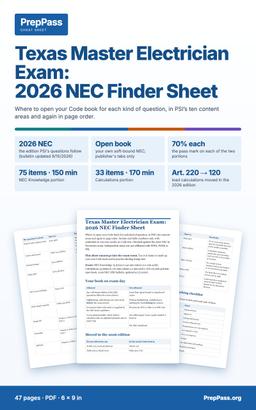
Yes. Texas Master Electrician + 2026 NEC Finder Sheet is $17.99 for 2 files in one checkout — 27% less than the $24.98 those items cost bought separately today. It adds Texas Master Electrician — 2026 NEC Finder Sheet (2026). The saving is measured against the items' real current prices; there is no struck-through "original" price on this site.
Is this the official Texas Master Electrician (TDLR / PSI, 2026 NEC) study guide?
No. This is an independent study guide and is not affiliated with or endorsed by the exam's awarding body. It is written from the 2026 NEC (NFPA 70), checked section by section in November 2026, and PSI's Texas Department of Licensing and Regulation Electricians Candidate Information Bulletin (updated September 15, 2026). Always confirm current requirements with the body that issues your licence.
Why buy the book when the practice is free?
Our practice questions and timed mock stay free — nothing on the site moves behind this book. The $14.99 book is the studying half: the material itself, taught in order, in a file you own.
- Systematic teaching — every exam section explained chapter by chapter, start to finish, not just questions
- Print it & tab it — a paper-ready PDF you can highlight, mark up, and bring to your study table
- Study anywhere, offline — EPUB on your phone or e-reader; no wifi, no browser tabs
- Everything in one place — the chapters and the practice questions in one file
- Yours for life — one-time $14.99, instant download, no subscription
The details
- Verified from the official source(the 2026 NEC (NFPA 70), checked section by section in November 2026, and PSI's Texas Department of Licensing and Regulation Electricians Candidate Information Bulletin (updated September 15, 2026))
- 409 free practice questions
Also free on PrepPass for Texas Master Electrician (TDLR / PSI, 2026 NEC)
Beside this guide, PrepPass has a free study system for the same exam. It needs no account, and buying the guide does not unlock or change it: 409 practice questions with explanations; practice modes (adaptive, new questions, spaced review of misses, weak-topic focus, saved, my mistakes); a timed mock exam (108 questions, 320 minutes) with a score report by topic; a 10-question readiness check (about 5 minutes); 10 study chapters.
Progress is saved in your browser; a free account keeps it across devices. The readiness gauge reflects your own practice, not a prediction of the real exam result. How the practice works
One-time purchase, lifetime access to the download. The eBook is the full Texas Master Electrician (TDLR / PSI, 2026 NEC) study guide in PDF and EPUB. Educational summary, not professional or legal advice — always confirm the current rules with the official source. Last updated: November 2026.